Underfloor insulation costs a landlord from about £500 to £1,500 for a suspended timber floor insulated from below, to £4,000 to £6,000 for a solid concrete floor, with the Energy Saving Trust's national average for a suspended floor at around £4,700 once lifting and relaying boards is included. The spread is real, so the useful question is which of those numbers applies to your property.
That depends on whether the floor is suspended timber or solid, whether an installer can get underneath it, and whether you are refurbishing anyway. This guide covers each route with sourced 2026 figures, the SAP points to expect, the robotic spray-foam option and its mortgage questions, grant routes, and where the floor belongs in your upgrade order.
How much does underfloor insulation cost in 2026?
Suspended floor figures for a typical terrace come from EPCGuide's own cost guide and the Energy Saving Trust; solid floor figures come from GOV.UK and trade sources.
| Route | Typical installed cost | SAP gain | Disruption | Best for |
|---|---|---|---|---|
| Suspended timber, insulated from below (crawl space or cellar) | £500 to £1,500 | 2 to 5 points | Low, one to two days | Victorian and Edwardian terraces with a void you can get into |
| Suspended timber, boards lifted and relaid | £1,500 to £4,700 | 2 to 5 points | High, floor coverings up, room out of use | Properties with no access from below |
| Robotic spray foam under a suspended floor | £3,000 to £4,500 (2 to 3 bed terrace) | 2 to 5 points | Low, one to two days, tenant can stay | Occupied rentals with no crawl space |
| Solid floor, rigid board overlay | £1,000 to £3,000 overlay, £4,000 to £6,000 standalone | 3 to 10 points | High, raises floor level, doors and skirtings refitted | Refurbishments where floor finishes are coming up anyway |
| Solid floor, full dig-out and re-pour | £8,000 upwards | 3 to 10 points | Very high | Only during a full ground-floor rebuild |
Sources for the ranges: Energy Saving Trust floor insulation guidance (typical suspended install around £4,700, updated August 2025), Which? for the Q-Bot robotic price, and GOV.UK's MEES landlord guidance, whose sample EPC recommendations table lists solid floor insulation at £4,000 to £6,000.
The most important number on that table is the first one. If an installer can crawl under a suspended timber floor, insulating it is a sub-£1,500 job with a low-single-digit point gain. Every other row costs two to eight times more for the same points.
Why do quotes range from £500 to £4,700 for the same job?
Because "floor insulation" describes four different jobs.
Materials are cheap. Glass mineral wool rolls run at £4 to £5 per m2, rigid PIR board at £7 to £20 per m2, and spray-applied foam at £35 to £70 per m2, according to MyJobQuote's 2026 price data. On a terrace ground floor the insulation itself is a few hundred pounds at most.
Labour and access are what you pay for. MyJobQuote puts installer labour at £150 to £200 per day. A job done from a cellar takes a day or two. A job that needs every floorboard lifted, insulated and relaid, plus carpet or laminate refitted, can take a week and triples the bill. The Energy Saving Trust's £4,700 average is dragged upward by exactly those jobs.
Hidden repairs. Lifted boards reveal rotten joists and missing airbricks. Budget a 10 to 20 percent contingency.
DIY changes the maths. The Energy Saving Trust says it "may be possible (and more affordable)" to insulate a typical suspended timber floor yourself, provided ventilation and moisture control are right. DIY work does not qualify for grant funding, so photograph every stage for the assessor.
Suspended timber floor or solid floor: which do you have?
Suspended timber. Common in homes built between the 1850s and the 1950s, so the default in Victorian and Edwardian terraces and most 1930s semis. The tell is airbricks (small vented bricks) in the outside walls below floor level. Lift a corner of carpet and you will see floorboards on joists over a void. Never block the airbricks: the void is ventilated on purpose to stop the joists rotting.
Solid concrete. The norm from the 1950s onwards. A property built from the early 2000s is likely to already have insulation in the slab. Older concrete floors were poured uninsulated.
Stone, tile or limecrete. Older cottages and some pre-1850 terraces. Specialist territory, and often heritage exemption territory too.
Insulating a suspended timber floor
Insulation goes between the joists, beneath the boards. From below, installers fit mineral wool held up with netting or cut rigid boards to fit snugly. From above, the boards come up and the same materials go in. The critical detail is airflow: the void must stay ventilated, and a vapour-permeable membrane is often used so moisture can escape.
Insulating a solid floor
Rigid foam boards are laid on top of the existing slab and covered with chipboard or a new floor finish. That raises the floor by 70mm or more, so door bottoms get trimmed, skirting boards move and sockets are often repositioned. It is a refurbishment job.
How many EPC points does underfloor insulation add?
Floor insulation on a suspended timber floor typically adds 2 to 5 SAP points. That range is consistent across EPCGuide's cost-to-improve guide, the E-to-C guide and the modelling behind our cost calculator. ECO4 whole-house assessments occasionally model up to 8 points where the floor was fully uninsulated and the rest of the fabric is already good.
First, floor insulation almost never moves a property a full band on its own. Band D runs from 55 to 68 and band C starts at 69. A property at 66 or 67 can tip over with the floor alone; a property at 58 cannot. Check your score before you spend.
Second, the assessor has to be able to record it. Floor insulation is invisible once fitted, and RdSAP assumes an uninsulated floor unless there is evidence. The Energy Saving Trust's advice is to keep the paid invoice and take photographs during installation "if you need to provide evidence for a new Energy Performance Certificate". Without that paperwork you paid for warmth and got no points. RdSAP 10 asks assessors for more evidence on several measures, so this matters more than it used to.
Is robotic spray foam under the floor a good idea for a rental?
Robotic underfloor insulation, best known through Q-Bot, sends a small robot into the void through a lifted board and sprays closed-cell foam onto the underside of the floorboards. Which? reports a price of £3,000 to £4,500 for a typical 2 to 3 bedroom terrace. Q-Bot's own site says most installations complete in one to two days with the tenant in place, and that installations are eligible for a 25-year insurance-backed guarantee on its higher survey tier. Those are the vendor's claims; the appeal for an occupied property with no crawl space is obvious.
The caveat is mortgages. The House of Commons Library briefing on spray foam and mortgages (published 5 January 2026) records that in November 2024 a quarter of the UK's biggest mortgage providers, and every equity release lender surveyed, would not lend against homes with spray foam insulation in the roof. RICS says the presence of spray foam may affect a surveyor's valuation. The Property Care Association and HomeOwners Alliance told government in May 2025 that 35 percent of properties they inspected had one or more defects from spray foam.
Every one of those findings concerns roofs, where foam hides the timber a surveyor needs to inspect and can trap condensation against rafters. Foam under a floor is a different application, and the same briefing records government's position that spray foam installed to the relevant standards should not prevent a mortgage. We could not find a published lender policy specific to underfloor foam, so the risk is unquantified. Before booking it on a mortgaged buy-to-let:
- Ask your lender in writing whether closed-cell underfloor foam affects their lending criteria, and keep the answer.
- Insist on the product's BBA (British Board of Agrement) certificate and the installer's written Declaration of Conformity, the paperwork RICS says to keep for a future sale or remortgage.
- Check the void for damp and rot before the foam goes in.
Where a crawl space exists, mineral wool between the joists earns the same SAP points with no lender conversation.
Does underfloor insulation count toward the MEES cost cap?
Yes. Under the Energy Efficiency (Private Rented Property) (England and Wales) Regulations 2015, the standard in force today is band E, and a landlord is only required to spend up to £3,500 including VAT on improvements before registering a high-cost exemption. GOV.UK's guidance for that cap uses floor insulation as its own worked example: its sample recommendations table lists solid floor insulation at £4,000 to £6,000, a single measure that on its own exceeds the cap.
Suspended floor insulation from below sits comfortably inside the cap, which is one reason it is worth doing early if you are below band E. Solid floor insulation almost never makes sense as a compliance spend under the current rules.
Under the proposal in the government's 21 January 2026 consultation response, the standard would rise to band C from 1 October 2030 with a proposed cost cap of £10,000, and qualifying spend from 1 October 2025 would count toward that higher cap. That remains a proposal: government has to take powers through an Act and lay a statutory instrument first. If it does become law, a floor insulation invoice dated after 1 October 2025 would count toward the proposed cap, so keep it either way. Our guide to the proposed £10,000 cap covers how the counting would work.
Can a landlord get a grant for underfloor insulation?
Two routes exist, and neither is a landlord-only scheme.
ECO4 funds underfloor insulation as part of a whole-house package, but eligibility is gated on the tenant receiving a qualifying means-tested benefit, and the property must be EPC D to G. It closes on 31 December 2026 and installers are booking months ahead. Where it applies, the floor is funded in full. See our ECO4 landlord guide.
Warm Homes: Local Grant runs through participating councils for lower-income households and can include floor insulation, usually with a landlord contribution. Availability is postcode-dependent.
Run the property through the grant checker before you pay full price. Whatever route you use, the work must be done by a TrustMark-registered installer working to PAS 2030; DIY floor insulation is never grant-fundable. Under the rules in force, grant funding does not use up your £3,500 cap, and if it covers the full cost the cap does not apply. Under the proposed £10,000 cap, Boiler Upgrade Scheme money would not count, but other third-party funding such as ECO4 or a local grant could.
Do you need building regulations approval for floor insulation?
Sometimes. Under Approved Document L in England, and the equivalent in Wales, renovating more than 25 percent of a solid or suspended floor that involves replacing the screed or the timber deck must bring the floor up to current standards. Where the full standard is not technically feasible, the floor must be upgraded to the best level achievable within a simple payback of 15 years.
Adding mineral wool between existing joists from below does not replace the deck and does not trigger that rule. A solid floor overlay or a full re-floor does. The target U-value for a floor in England and Wales is 0.25 W/m2K or lower, which the Energy Saving Trust says typically means at least 70mm of rigid foam board or around 150mm of mineral wool. Ask the installer whether a competent person scheme lets them self-certify.
Where does floor insulation sit in the EPC priority order?
Fourth or fifth. The ordering in our ranked guide to the cheapest EPC improvements is by cost per SAP point, and on that measure a suspended floor insulated from below lands around £250 to £300 per point: far behind a cylinder jacket, LED lighting, a loft top-up and cavity fill, but well ahead of double glazing and a heat pump bought without a grant. Lift the boards, or insulate a solid floor as a standalone job, and the cost per point climbs past double glazing.
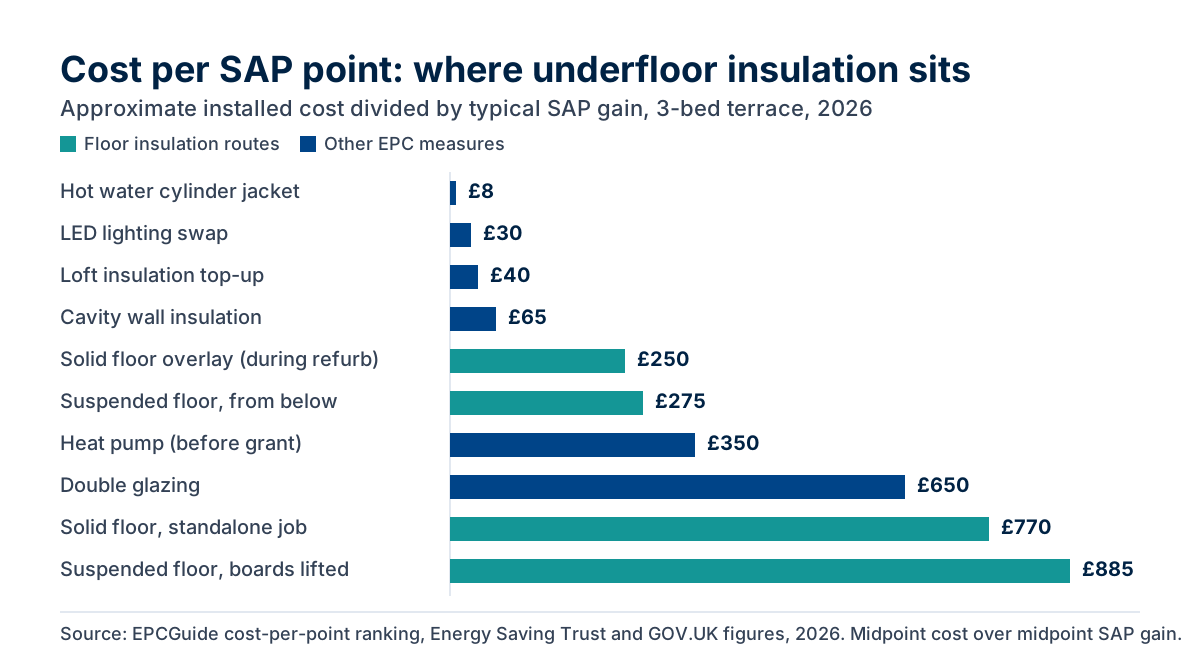 Suspended floor insulation done from below costs roughly £250 to £300 per SAP point. Lifted-board and standalone solid floor jobs cost more per point than double glazing.
The sequence that protects your budget:
- Cheap wins first. Cylinder jacket, LEDs, draught-proofing. Under £100, any time.
- Loft, then cavity. The two cheapest points on the certificate.
- Floor, if suspended and accessible. Book it alongside the loft if one installer does both.
- Reassess. A fresh EPC after the fabric work often shows you are already at C.
- Only then the expensive measures: glazing, solid wall insulation, a heat pump.
A solid floor overlay only makes the list when the floor finishes are coming up anyway. If you are refurbishing between tenancies, that is the moment: the marginal cost of the boards is £1,000 to £3,000 against a job you were doing regardless.
Run the combination through the EPC predictor before you commit; it estimates the score you would land on.
Frequently Asked Questions
How much does underfloor insulation cost for a typical terrace? For a suspended timber floor with access from below, £500 to £1,500 installed. If the floorboards have to be lifted, budget £1,500 to £4,700, the upper figure being the Energy Saving Trust's national average. Robotic spray foam under the floor is £3,000 to £4,500 for a 2 to 3 bedroom terrace.
How much does solid floor insulation cost? GOV.UK's MEES guidance lists solid floor insulation at £4,000 to £6,000 as a standalone job. If you are already refurbishing and the floor finishes are up, the overlay itself is £1,000 to £3,000. A full dig-out and re-pour starts at around £8,000.
How many EPC points does floor insulation add? Typically 2 to 5 SAP points for a suspended timber floor, occasionally up to 8 in an ECO4 whole-house package. It rarely moves a property a full band on its own. Keep the invoice and photographs, because an assessor cannot credit insulation they cannot evidence.
Is underfloor insulation worth it for a landlord? Yes where the floor is suspended timber and reachable from below, because the job costs under £1,500 and returns 2 to 5 points. It is poor value as a standalone solid floor job under the current £3,500 cost cap. Bills fall by around £70 a year for an average house according to the Energy Saving Trust, a saving the tenant sees.
Does spray foam underfloor insulation affect a mortgage? The documented lender problems concern spray foam in roofs, where a quarter of major lenders declined to lend in a 2024 BBC survey. No lender has published a floor-specific policy that we could find, so the risk is unquantified. Ask your buy-to-let lender in writing before booking, and keep the BBA certificate and installer's conformity paperwork.
Can I get a grant for floor insulation on a rental property? ECO4 funds it in full where the tenant receives a qualifying benefit and the property is EPC D to G, until 31 December 2026. Warm Homes: Local Grant may cover it through participating councils, usually with a landlord contribution. Check the grant checker for your postcode; DIY work never qualifies.
Do I need building regulations approval to insulate a floor? Not for adding insulation between existing joists from below. Renovating more than 25 percent of a floor where the screed or timber deck is replaced must meet Approved Document L standards, with a target U-value of 0.25 W/m2K in England and Wales.
Does floor insulation count toward the MEES cost cap? Yes, your own spend counts toward the £3,500 cap in force today, and grant funding does not. Under the proposed 2030 rules, qualifying spend from 1 October 2025 would count toward a proposed £10,000 cap, so keep the invoice whether or not that proposal becomes law.