Purpose-Built Flat EPC Upgrade Guide
Work around leasehold restrictions and find practical EPC improvements for your flat
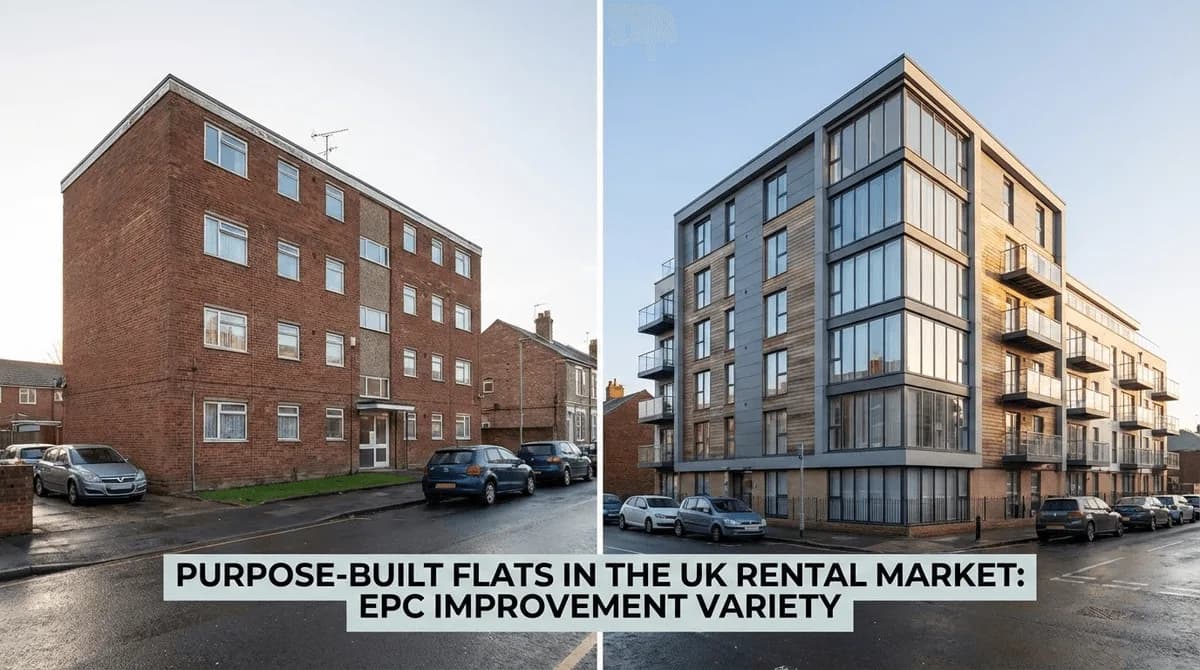
Purpose-built flats, designed and constructed specifically as apartments rather than converted from houses, represent a significant portion of the UK rental market. From 1930s mansion blocks to 1960s council-built towers and modern new-builds, these properties share common characteristics that affect their EPC improvement options.
The good news for flat landlords is that purpose-built flats typically start with better EPC ratings than houses. Shared walls with neighbouring flats reduce heat loss, and many blocks already have some level of insulation. However, leasehold restrictions can complicate improvements, and you may need consent from the freeholder or management company before making changes.
Property Characteristics
Purpose-built flats vary enormously in their construction depending on when they were built. However, they share some common characteristics that distinguish them from houses and converted flats.
Construction Types
- -1930s-50s: Brick mansion blocks with solid or cavity walls
- -1960s-70s: Concrete system-built blocks
- -1980s-90s: Brick with cavity wall insulation
- -2000s+: Modern insulated construction
Ownership Structure
- -Usually leasehold ownership
- -Freeholder owns building structure and common parts
- -Management company maintains shared areas
- -Lease terms restrict alterations
Why Flats Often Score Better Than Houses
Shared Walls
Walls shared with neighbouring flats have minimal heat loss. A mid-floor flat may only have one or two external walls.
Smaller Volume
Less space to heat means lower energy requirements and better EPC scores relative to floor area.
No Loft Heat Loss
Flats below the top floor have no roof heat loss, one of the biggest energy drains in houses.
Communal Heating
Some blocks have efficient communal heating systems that score well on EPC assessments.
Common EPC Challenges
While flats often start with better EPC ratings, they present unique challenges for improvement due to the leasehold structure and shared building elements:
1. Leasehold Restrictions
Your lease likely requires written consent from the freeholder before making alterations. This includes replacing windows, changing heating systems, and any work that affects the structure. The consent process can take time and may involve fees.
2. Cannot Modify External Walls
External walls are typically part of the building structure owned by the freeholder. You cannot add external wall insulation to your flat alone, and internal wall insulation may not be practical in smaller flats. Any wall improvements usually need to be done at block level.
3. Communal Heating Systems
If your block has communal heating, you may have no control over the boiler efficiency or heat source. Some older communal systems are inefficient and drag down EPC ratings, but upgrading requires agreement from all leaseholders and the freeholder.
4. Window Replacement Restrictions
Even if your lease allows window replacement, the freeholder may require specific window designs to maintain building appearance. Some blocks have adopted uniform replacement programmes, while others restrict individual changes entirely.
5. Top and Ground Floor Disadvantages
Top-floor flats lose heat through the roof (especially if poorly insulated), while ground-floor flats lose heat through the floor. These flats typically score 5-10 points lower than mid-floor flats in the same block.
Leasehold Considerations
The leasehold nature of most flats adds complexity to EPC improvements. Before planning any work, you need to understand what your lease allows and what consents are required. For a full guide to the leasehold-specific EPC challenges, including the third-party consent exemption and how to engage your freeholder, see our EPC for leasehold flats guide.
Getting Consent for Works
Typical Consent Requirements by Improvement Type
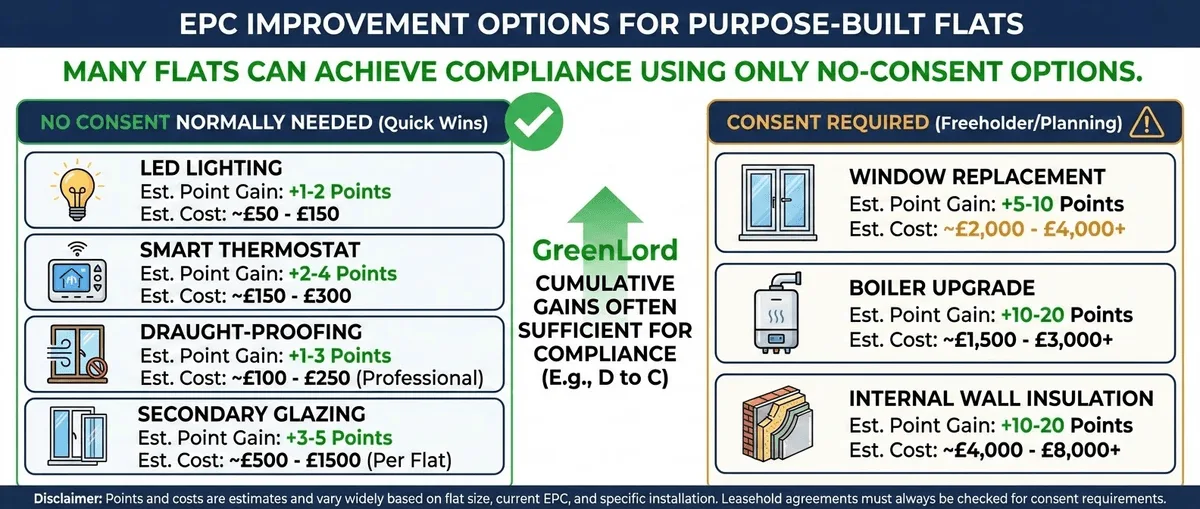
Usually No Consent Needed
LED lighting, draught-proofing, smart thermostat (if no structural changes), secondary glazing, radiator reflectors
Consent Usually Required
Window replacement, boiler replacement, electric heating upgrade, any work affecting walls or floors
Block-Level Approval Needed
External wall insulation, communal heating upgrades, roof insulation (top floor), renewable energy installations
Third-Party Consent Exemption
To Claim This Exemption, You Must:
- 1.Request consent in writing from the relevant party
- 2.Have the request refused or ignored for 30+ days
- 3.Register the exemption with evidence of the refusal
- 4.Re-apply after 5 years if consent is still withheld
Evidence Required:
- Copy of your consent request letter/email
- Proof of delivery (recorded delivery receipt or email read receipt)
- Copy of refusal letter (if received)
- Evidence that 30 days have passed without response (if no reply)
Recommended Upgrades
Given the constraints of leasehold ownership, focus on improvements that you can make within your flat without external changes. Here are the recommended upgrades in priority order:
Not every flat starts in the same place. If yours sits at E rather than D, usually because of old storage heaters and single glazing, follow the costed route from an E up to a C instead, which sets out which measures to stack and in what order.
Purpose-Built Flat Upgrade Costs and EPC Impact
| Improvement | Low Estimate | High Estimate |
|---|---|---|
| LED Lighting ThroughoutNo consent needed. 1-2 EPC points. | £100 | £200 |
| Smart Heating ControlsSmart thermostat + TRVs. 2-4 EPC points. | £200 | £400 |
| Draught ProofingWindows and doors. 1-3 EPC points. | £150 | £300 |
| Secondary GlazingIf cannot replace windows. 2-4 EPC points. | £1,000 | £2,500 |
| Electric Heating UpgradeReplace storage heaters with efficient units. 3-6 EPC points. | £1,500 | £3,000 |
| Hot Water Cylinder InsulationIf flat has its own cylinder. 1-2 EPC points. | £50 | £150 |
| Estimated Total | £3,000 | £6,550 |
Many flats may already be at or near EPC C. Check your current rating before planning improvements.
Cost Estimates
Purpose-built flats typically require the lowest investment to reach EPC C, often because they already start close to the target or need only minor improvements.
Already at C or Above
£0
Many flats, especially mid-floor in newer blocks, already meet the requirement. Check your EPC before assuming work is needed.
Starting at D (low-mid)
£1,000 - £3,000
Quick wins like smart controls, LED lighting, and secondary glazing may be sufficient to reach C.
Starting at Low D/E
£3,000 - £5,000
May need heating upgrade or window improvements. Consent exemption may apply if changes are blocked.
Heating Options
Heating is often the key variable in flat EPC ratings. The type of heating system can make a significant difference to your score.
Heating System EPC Impact in Flats
| Feature | Gas Combi Boiler | Modern Electric RadiatorsRecommended | Storage Heaters (old) | Communal (efficient) |
|---|---|---|---|---|
| EPC Impact | Good (if efficient) | Good | Poor | Very Good |
| Installation Cost | 2,500 - 4,000 | 1,500 - 3,000 | N/A | N/A |
| Running Cost | Low | Medium-High | High | Low-Medium |
| Consent Usually Needed | ||||
| Widely Suitable for Flats |
Electric heating is common in flats but can have higher running costs. Modern high-efficiency electric radiators score better on EPC than old storage heaters.
Glazing Options
If your flat has single glazing or poor double glazing, window improvements can make a significant difference. However, replacing external windows usually requires freeholder consent and may need to match a specified design.
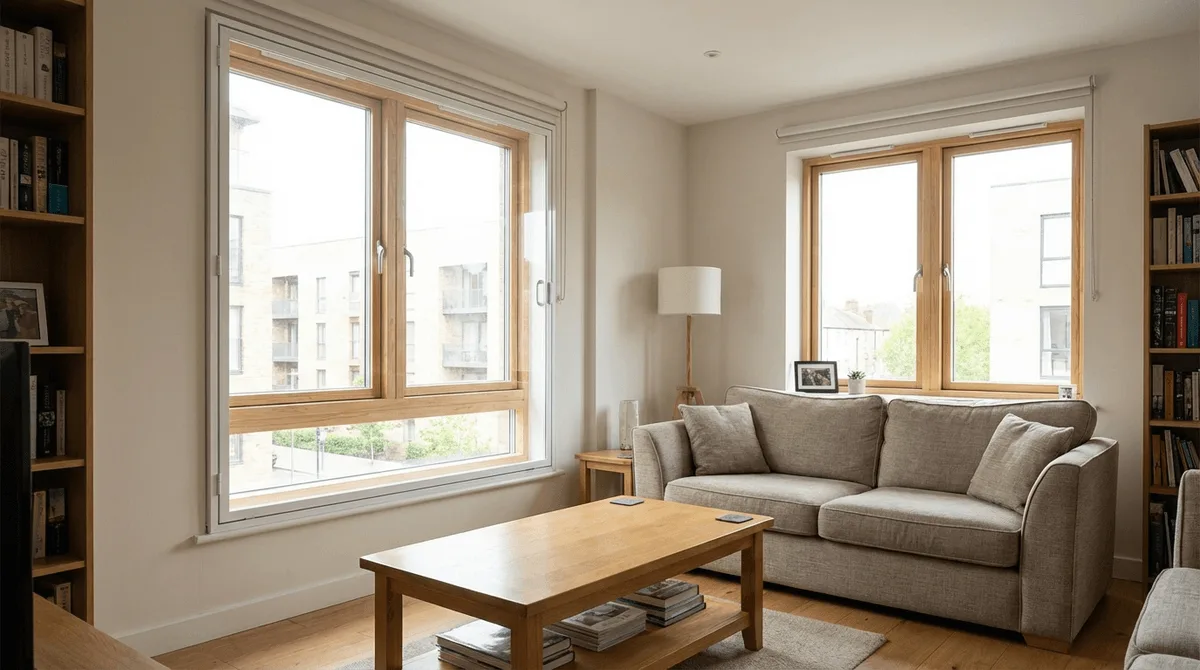
Secondary Glazing
An additional layer of glazing fitted to the inside of existing windows. Usually does not require consent as it does not affect the external appearance.
- No consent usually needed
- Reversible installation
- Good for listed or conservation buildings
- -Lower performance than replacement
Cost: £1,000 - £2,500
Window Replacement
Full replacement with modern double or triple glazing. Provides the best performance but requires freeholder consent.
- Best thermal performance
- Highest EPC point gain
- !Requires freeholder consent
- !May need to match specified design
Cost: £3,000 - £6,000
Example Upgrade Pathway
Here is a realistic example of how a 2-bedroom purpose-built flat might improve from EPC D to C:
Case Study: 2-Bed Flat, 1970s Block, Manchester
Starting
D62 points
Target
C69 points
Note: This flat reached C with simple, low-cost improvements that did not require freeholder consent. No window or heating replacement was needed.
Communal Improvements
Some of the most effective improvements for flats can only be done at block level. If you are a member of a residents association or have influence with the freeholder, consider advocating for communal improvements.
Block-Level Opportunities
- External wall insulation for the whole block
- Roof insulation improvement (benefits top-floor flats)
- Communal heating system upgrade
- Coordinated window replacement programme
- Solar panels on flat roof areas
How to Advocate for Block Improvements
- Join or form a residents association
- Present the business case to the freeholder
- Explore grant funding (ECO4, Social Housing Decarbonisation Fund)
- Get quotes for block-level work (economies of scale)
- Highlight 2030 compliance deadline to freeholder
Next Steps
1. Check Your Current EPC
Many flats already meet the C rating. Find your existing EPC to confirm whether any work is actually needed.
Find your EPC on GOV.UK2. Review Your Lease
Check what alterations require consent and understand the consent process before planning any improvements.
LEASE - free leasehold advice3. Calculate Your Costs
Use our calculator to get a personalised estimate based on your flat details and current EPC rating.
Use the Cost Calculator4. Contact Your Freeholder
If improvements are needed, start the consent process early. Allow 4-8 weeks for approval.
Contact details on your service charge statement