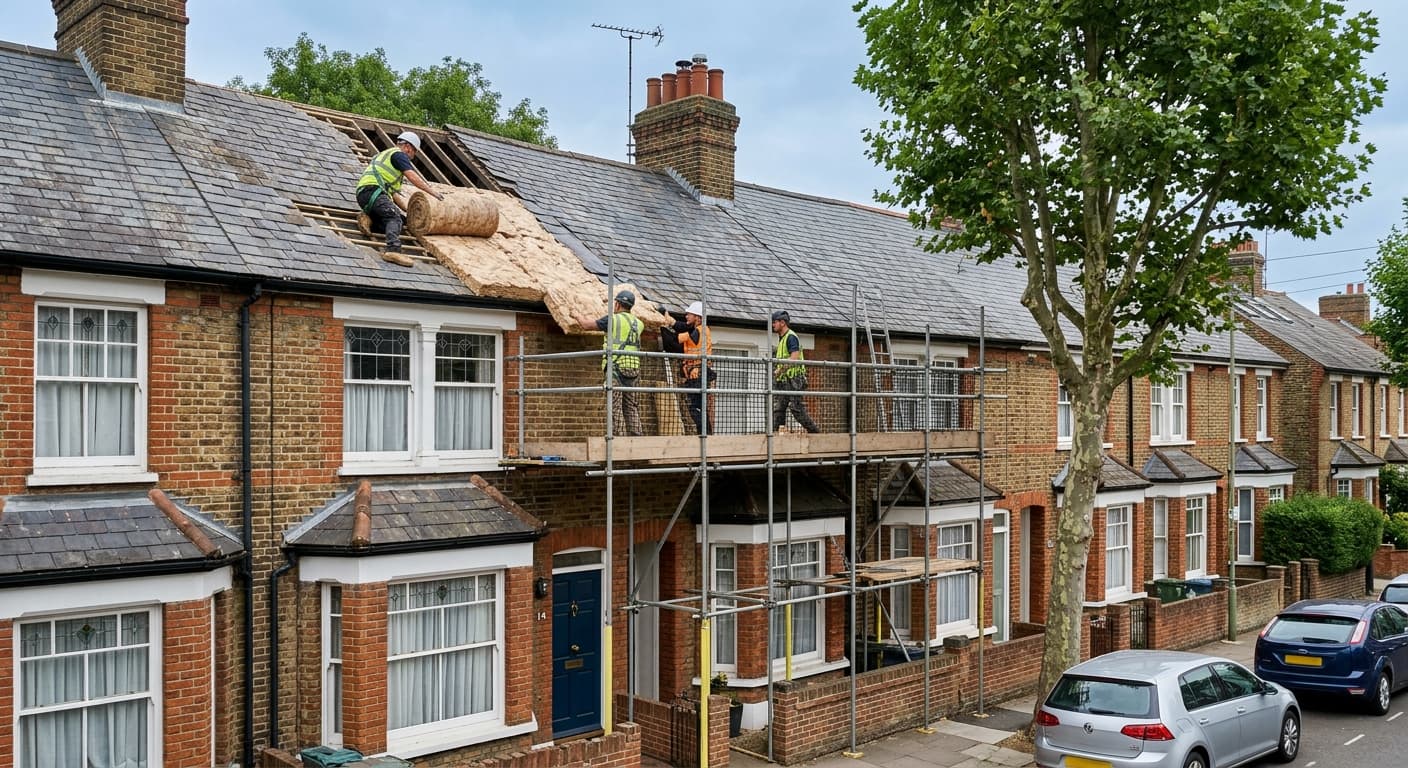
A band E property is legally lettable today. Under the current Minimum Energy Efficiency Standards (MEES) regulations, band E is the floor: you can rent it without penalty. But a band E property sits roughly 20 to 40 SAP points below band C, a gap that typically requires several upgrades, not one. If the proposed October 2030 deadline becomes law, E-band landlords have less runway than many realise.
This guide covers the most effective improvements for E-band properties, what each costs, how to layer ECO4 funding before it closes in December 2026, and what happens if the property genuinely cannot reach C.
What Does Band E Mean in SAP Points?
SAP (Standard Assessment Procedure) scores map to EPC bands: band E covers scores of 39 to 54. Band D is 55 to 68. Band C is 69 to 80. To move from the bottom of band E to the lower edge of band C, a property needs to gain roughly 15 to 30 SAP points. From the bottom of E (score 39), the gap is up to 30 points, roughly twice the improvement needed by a D-band landlord.
EPCGuide's analysis of 29.2 million EPC certificates shows 55.4% of UK certificates are below band C. Many of those are E-band properties that have not yet addressed insulation or heating. A D-to-C upgrade typically needs one or two measures. An E-to-C journey usually needs three or four, and the sequencing matters.
What Are Your Legal Obligations at Band E Right Now?
Band E is the current minimum under the MEES Regulations 2015 (SI 2015/962). Regulation 22 prohibits letting below E. Regulation 24 caps required landlord spending at £3,500 inclusive of VAT. Regulation 40 sets the maximum civil penalty at £5,000 total per property.
If your property holds a valid band E certificate, you are compliant. The current law does not require you to reach band D or C.
What is proposed, but not yet law, is a band C standard from 1 October 2030. That proposal comes from the January 2026 government response to the consultation on improving private rented sector energy performance. No Act or statutory instrument has been laid before Parliament. The 2030 standard, a proposed £10,000 cost cap, and a proposed £30,000 penalty are not yet enforceable. See GOV.UK's MEES landlord guidance (last updated 5 May 2026) for the current rules. For a full breakdown of the 2030 timeline, see our 2030 EPC C deadline guide.
Which Improvements Move a Band E Property to C?
Most E-band properties share one of three profiles: an older property with solid walls, a cavity-wall property with unfilled cavities and an uninsulated loft, or a flat with electric storage heating. The improvements that gain the most SAP points depend on which profile applies.
| Improvement | Typical SAP gain | Typical cost | Notes |
|---|---|---|---|
| Loft insulation (0mm to 270mm) | 5 to 12 points | £300 to £600 | Highest return for the cost if loft is accessible and uninsulated |
| Cavity wall insulation | 5 to 10 points | £500 to £1,500 | Only where unfilled cavities exist |
| Modern condensing boiler (replacing pre-2005) | 5 to 15 points | £2,000 to £4,000 | Largest single gain for gas-heated properties |
| Heating controls (TRVs and programmer) | 1 to 5 points | £200 to £500 | Often required alongside boiler upgrade to unlock full SAP credit |
| Double glazing (replacing single glazing) | 2 to 5 points | £3,000 to £8,000 | Lower point-per-pound return than insulation |
| Floor insulation (suspended timber) | 1 to 4 points | £500 to £1,000 | Often overlooked; best combined with loft |
| Solid wall insulation (external or internal) | 5 to 15 points | £8,000 to £20,000 | Required route for pre-1919 solid brick properties |
| Air source heat pump (replacing oil or LPG) | 10 to 25 points | £7,000 to £15,000 before grant | High gain; Boiler Upgrade Scheme grant of £7,500 applies |
| Solar PV (3kWp) | 6 to 12 points | £5,000 to £8,000 | More effective when combined with other improvements |
SAP point ranges are approximate, drawn from BRE's Standard Assessment Procedure documentation. Actual gain depends on property floor area, construction type, and current energy sources. The only way to confirm the exact gain from each measure is to ask your EPC assessor to run the modelled improvement report attached to your current certificate.
For most cavity-wall, gas-heated E-band properties, loft insulation, cavity wall fill, and a modern condensing boiler will typically deliver 15 to 30 points combined, enough to cross into band C without any single high-cost intervention. For a full breakdown of improvement costs by measure, see our EPC upgrade cost guide.
Use ECO4 Before December 2026
ECO4 (Energy Company Obligation, Phase 4) is the most valuable funding route for E-band landlords, and it closes on 31 December 2026. ECO4 covers insulation and heating measures worth up to £14,000 per property, but eligibility is gated on the tenant, not the landlord. Your tenant must receive a qualifying benefit such as Universal Credit, Pension Credit, Housing Benefit, or Income Support. Properties must hold EPC D, E, F or G to qualify.
If your tenant is eligible, ECO4 can cover loft insulation, cavity wall insulation, and in some cases a new boiler or heat pump, at no cost to you. The landlord's role is to provide written consent and coordinate access.
The Boiler Upgrade Scheme (BUS) is separate and does not require tenant eligibility. It provides a £7,500 voucher toward an air source heat pump, ground source heat pump, or biomass boiler. Landlords are eligible; it is not means-tested.
For an oil-heated E-band property, replacing the boiler with an air source heat pump funded via BUS can shift the rating into mid-band C or above in a single step.
If your tenant qualifies for ECO4, the sequencing that maximises value is: apply for ECO4 to fund insulation first, then use BUS for the heating upgrade if needed. Both can apply to the same property but must be applied for separately. ECO4 installers are booking 4 to 6 months ahead; the December 2026 cutoff is hard. See our ECO4 grants guide for landlords for the full eligibility list and how to apply.
Want the exact route from your band E property to C, including which measures apply and what they cost for your specific property? Get your costed EPC C Action Plan (£29), in your inbox within the hour and refined by a real person over the next 48 hours. Start your Action Plan
The Home Energy Model: Why C Today May Not Mean C in 2029
The proposed 2030 standard would use a new scoring methodology: the Home Energy Model (HEM), also called SAP 11. It introduces a dual metric covering fabric performance and a heating/smart energy score, and it is due to replace the current SAP 10.2 methodology for new EPC certificates from October 2029.
A property that scores at the lower end of band C under current methodology could fall to band D under HEM, particularly if it relies on gas heating rather than a heat pump or renewable energy source. The NRLA's January 2026 FAQ on EPCs notes that landlords targeting C ahead of 2030 should be aware their certificate may need reassessing under the new scheme before the compliance date.
The practical implication: if you are targeting band C, aim for the middle of the band (around 73 to 75 SAP points) rather than scraping over the line at 69. That buffer reduces the risk of a failed HEM reassessment. Pairing insulation improvements with a heat pump, even a smaller air-to-water unit, also positions the property better under the heating metric.
What if Your Property Cannot Reach Band C?
Some properties cannot reach band C within a cost-proportionate budget. Solid-wall pre-1919 terraces, park homes, and some listed buildings are the most common cases. If you spend up to the current cost cap of £3,500 without reaching C, a high-cost exemption applies. Under the proposed 2030 rules, that cap rises to £10,000, but the proposal has not yet been enacted.
Exemptions are registered at the PRS Exemptions Register. They are valid for five years and require renewal. Third-party consent exemptions apply where a freeholder or tenant has refused access for the works. Our complete EPC exemptions guide covers every exemption type and how to register each one.
For solid-wall properties, solid wall insulation (internal or external) is the primary upgrade route. External solid wall insulation for a typical terraced house runs from £8,000 to £20,000, but ECO4 can cover part or all of this cost if the tenant qualifies.
What This Means for E-Band Landlords
Band E properties are compliant now, but the upgrade gap to C requires two bands, not one, and typically three to four interventions. The December 2026 ECO4 cutoff is the most time-sensitive factor: if your tenant qualifies, an ECO4 application started today could fund the insulation foundation of the entire C upgrade at no cost to you. Leave it until 2027 and that funding route is closed.
Start with the improvement report from your EPC assessor. It shows, measure by measure, exactly how many SAP points each intervention buys and at what modelled cost. That report costs nothing; your existing EPC comes with one attached.
Frequently Asked Questions
How much does it cost to improve a property from band E to band C? It depends on the property's construction and current heating system. A typical cavity-wall, gas-heated property could achieve the jump through loft insulation, cavity wall fill, and a modern boiler for a combined spend of roughly £3,000 to £5,500. Solid-wall properties requiring external or internal insulation face much higher costs, often £10,000 to £25,000. The government's Regulatory Impact Assessment for the MEES consultation puts the average upgrade cost at £5,387 across all bands under its preferred option.
Can I still rent my band E property after October 2030? Only if the 2030 proposed standard becomes law and you either meet band C or hold a valid registered exemption. The band C requirement is proposed, not enacted. No Act or statutory instrument has been laid before Parliament as of August 2026. Most landlords should plan for compliance, as the policy direction has been consistent since 2021.
Does ECO4 cover band E properties? Yes. ECO4 requires the property to be EPC D, E, F or G. If your tenant receives a qualifying benefit, the scheme can fund insulation and heating measures up to £14,000. ECO4 closes 31 December 2026.
Will a heat pump take a band E property to C? In many cases, yes. Replacing a gas boiler with an air source heat pump can add 10 to 25 SAP points, depending on current boiler efficiency, property size, and insulation level. A property at the top of band E (score 54) with good insulation could cross into C with a heat pump alone. The Boiler Upgrade Scheme provides a £7,500 grant for landlords with no tenant eligibility requirement.
What is the Home Energy Model and does it affect my upgrade plans? The Home Energy Model (HEM) is the replacement for current SAP 10.2 methodology, expected from October 2029. It scores properties on fabric performance and heating/smart technology. A property at the bottom of band C under current SAP may score band D under HEM. Aim for 73 or more SAP points to build in a buffer, and pair insulation with a heat pump where feasible.
Can I register an exemption instead of upgrading? Yes, if you have spent up to the current £3,500 cost cap without reaching the required standard. The high-cost exemption is registered at the PRS Exemptions Register and is valid for five years. It must be renewed every five years. Once the proposed £10,000 cap becomes law, the threshold changes.
Is there a penalty for renting a band E property right now? No. Band E is the current legal minimum. The maximum civil penalty of £5,000 under regulation 40 applies only when a property is let below band E.
Does loft insulation alone get a band E property to C? Rarely, unless the property is already close to the top of band E. A fully uninsulated loft can add 5 to 12 SAP points, which is significant but usually not enough on its own from the lower end of band E. In most cases, loft insulation provides the foundation and a second measure closes the gap.