Most EPC content tells you what improvements cost. Almost nothing tells you how long they take.
That gap matters, because time is the constraint most landlords will hit first. The band C standard proposed for October 2030 is a little over four years away, and it is not law yet (the minimum in England and Wales today is band E). But the end-to-end journey from "I need to upgrade" to "I have a new EPC certificate" takes longer than most landlords expect, and it is likely to get longer as 2030 approaches.
This guide covers the full journey: initial assessment, installer quotes, installation, and post-improvement re-assessment. If your property is a Victorian terrace, our property-specific guide covers the solid wall insulation timelines in more detail. This article is for all property types.
The Full Journey: Four Stages From Decision to Certificate
Before diving into the detail, here is the full end-to-end process:
| Stage | What Happens | Time Required |
|---|---|---|
| 1. Initial EPC assessment | Assessor visits and lodges certificate | 1–2 weeks to book; 24–48 hours for certificate |
| 2. Installer surveys and quotes | Assess property; provide written quotes | 1–4 weeks |
| 3. Installation | Works carried out at the property | Hours to weeks (see below) |
| 4. Post-improvement re-assessment | New EPC lodged confirming the new rating | 2–3 weeks to book and receive certificate |
The total for a quick upgrade: 3–6 weeks. For a full deep retrofit: 5–8 months, or longer. And those are today's timelines. By 2028, add significant time to each stage.
Stage 1: Initial EPC Assessment
If you do not already have a valid EPC, or your current EPC does not include a Recommendation Report you trust, you need a new assessment before planning your upgrade.
The assessment itself takes 30 to 90 minutes on-site. A domestic energy assessor (DEA) inspects the property, records its construction type, insulation, heating system, and other characteristics. The certificate is lodged on the national EPC register within 24 to 48 hours after the visit.
Booking lead time: currently 1–2 weeks in most parts of England and Wales, with rural areas sometimes longer. Allow 2–4 weeks to be safe.
The assessment produces two documents: the EPC certificate (showing your current rating) and the Recommendation Report (listing which improvements would increase your rating and by how many SAP points each one is worth). The Recommendation Report is your upgrade roadmap, it tells you exactly which measures to pursue.
For help choosing and booking an assessor, see our guide to choosing an EPC assessor. For cost information, see how much an EPC assessment costs.
⚠️ Access is required. Your tenant must be present or a key must be available. Allow time to coordinate. A failed access attempt adds 1–2 weeks to your timeline.
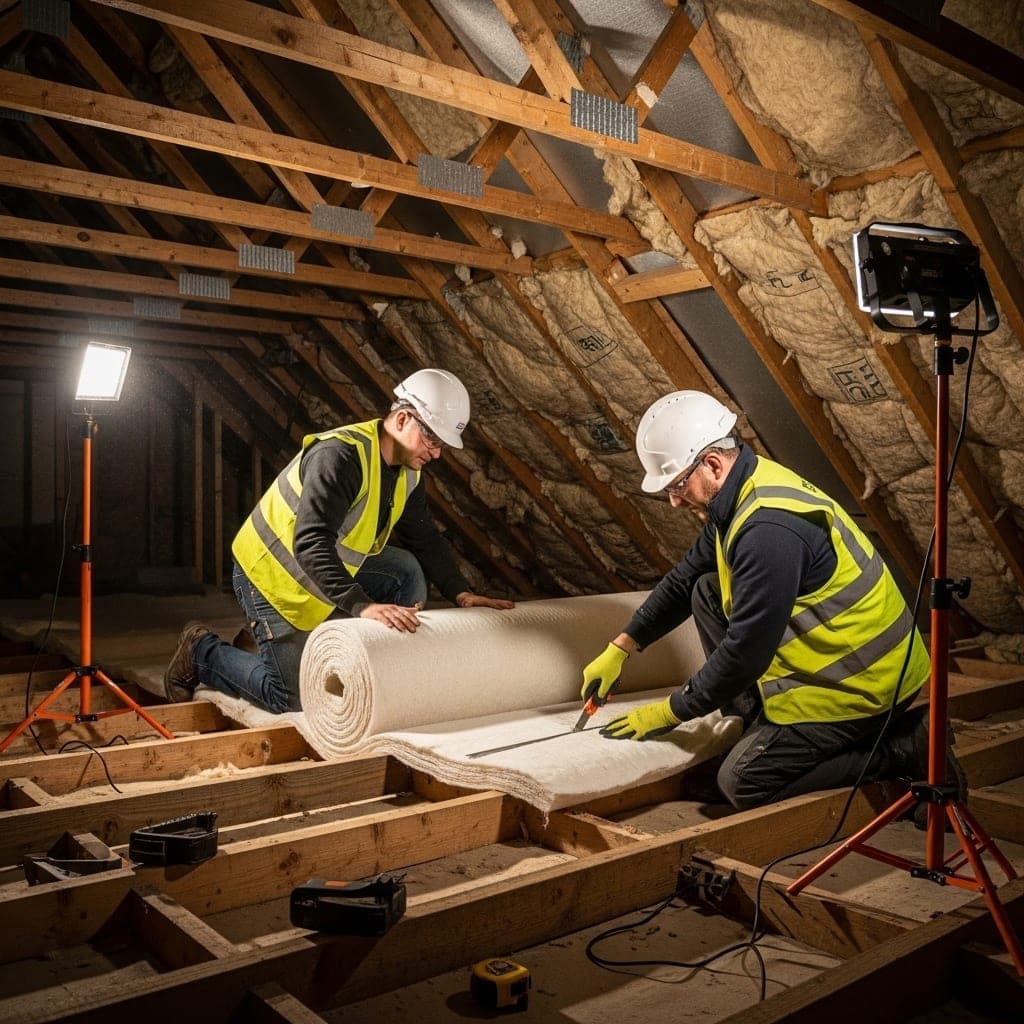
Stage 3: How Long Each Improvement Takes
Before installation can begin, your installer needs to survey the property and provide a written quote. For simple measures (loft insulation, cavity wall), this takes 1–2 weeks from first contact. For complex measures (solid wall insulation, heat pumps), allow 3–8 weeks, MCS-certified heat pump installers in particular have longer lead times due to the specialist qualification requirement.
The table below shows installation times for each major improvement, plus the lead time to get started:
| Improvement | Installation Time | Lead Time Before Works Begin |
|---|---|---|
| Loft insulation | Half day to 1 day | 1–2 weeks |
| Cavity wall insulation | Half day to 1 day | 1–2 weeks |
| Smart heating controls / thermostat | 1–2 hours | Same week in most cases |
| LED lighting | 1–2 hours | Same week (or DIY) |
| Internal wall insulation | 3–5 days | 2–4 weeks (survey + quote) |
| External wall insulation | 7–14 days | 3–6 weeks (survey + scaffolding planning) |
| Air source heat pump (ASHP) | 2–5 days | 4–8 weeks (MCS installer survey + quote) |
| Ground source heat pump (GSHP) | 1–3 weeks | 6–12 weeks (survey + groundworks planning) |
Sources: British Gas; Aira (December 2024); Heat IQ (May 2025); Changeworks; YES Energy Solutions (November 2025); bestheating.com (October 2025).
On solid wall insulation: Victorian and Edwardian properties, and many post-war properties, cannot have cavity wall insulation because there is no cavity. Internal wall insulation requires room-by-room redecoration after installation. External wall insulation involves scaffolding and a render finish that cannot be applied in wet or freezing conditions, which can delay works in winter months.
On heat pumps: An air source heat pump is expected to be the most significant single upgrade in terms of EPC impact under the incoming Home Energy Model. The lead time reflects the requirement for an MCS-certified installer (essential for the £7,500 Boiler Upgrade Scheme grant). For which measures to prioritise, see our D-to-C upgrade guide or cheapest EPC improvements guide.
What If You Are Using a Grant?
If your upgrade qualifies for ECO4 or the Boiler Upgrade Scheme, the timeline extends.
ECO4 (ending December 2026): From application to completed installation typically takes 2 to 6 weeks, though some applications take 4 to 6 weeks for approval before installation is scheduled. If you qualify, apply now, ECO4 ends in December 2026 and has no confirmed direct replacement yet.
Boiler Upgrade Scheme (BUS, £7,500 for heat pumps): The BUS grant is claimed by your MCS-certified installer after installation, not before. But you still need to factor in the MCS installer survey and quote lead time (4–8 weeks), installation (2–5 days), and then post-installation claiming. Total journey from first contact to working heat pump: 8–16 weeks in the current market.
Grant-funded routes add 4–8 weeks to self-funded timelines. For details on the heat pump grant, see our BUS guide for landlords. For ECO4, see what's ending in December 2026.
Stage 4: Post-Improvement Re-Assessment
Once works are complete, you need a new EPC assessment to confirm the improved rating and lodge the certificate on the national register.
The process is identical to Stage 1: book an assessor (1–2 weeks in the current market), have them visit (30–90 minutes), and wait for the certificate (24–48 hours after the visit). Allow 2–3 weeks total from deciding to book to receiving your new lodged certificate.
Important: The assessor must see fully completed works. Do not book until every measure is finished and any building control sign-off is obtained. A certificate issued before works are complete may not reflect the final rating and would need to be replaced.
Once the certificate is lodged, it is immediately valid as MEES compliance evidence. There is no waiting period.
Why 2028 Is Your Real Planning Deadline
The standard advice is "start early." Here is the specific, evidence-backed reason why.
On 30 March 2026, the National Residential Landlords Association published its response to the Home Energy Model consultation. NRLA chief executive Ben Beadle said: "If it doesn't address the 'retrofitting skills gap', the shortfall in those retrofitting professionals qualified to uphold EPC benchmarks, its changes to energy efficiency benchmarks are unlikely to succeed."
Five major property publications covered the warning within 48 hours. This is not a fringe concern.
Two pressures are building simultaneously:
Pressure 1, HEM retraining. From the second half of 2027, assessors must retrain for the new Home Energy Model methodology. Assessors will be partially offline during this transition period. HEM assessments will also take longer per property than the current RdSAP method, reducing daily throughput even from a fully trained workforce.
Pressure 2, Demand surge. Government statistics show 544,000 EPCs were lodged in England and Wales in just Q2 2025 alone, a 20% year-on-year increase. That run rate is still accelerating. Based on the Green Deal precedent (demand spiked 18–24 months before the 2013 deadline), the crunch point for EPC demand is expected in 2027–2028. Every upgrade property requires both a pre-works assessment and a post-works assessment, so installer demand and assessor demand move together.
The practical result: booking lead times currently running at 1–2 weeks could reach 4–8 weeks or more by 2028. Installer queues for solid wall insulation and MCS-certified heat pump installation could be longer still.
For a full breakdown of the assessor supply problem, see our EPC assessor shortage guide.
Your 2030 Start-By Dates
The table below converts the timeline data into planning dates. "Current time" reflects today's lead times. "2028 projected" assumes the bottleneck the NRLA is warning about materialises.
| Upgrade Type | Current Journey Time | 2028 Projected Time | Latest Safe Start |
|---|---|---|---|
| Quick wins (loft + controls + LED) | 3–6 weeks | 6–12 weeks | Aim for 2028 |
| Standard insulation (cavity + loft) | 6–10 weeks | 12–18 weeks | Aim for 2028 |
| Grant-funded (ECO4) | 10–16 weeks | N/A, ends Dec 2026 | Apply now |
| Solid wall insulation | 10–16 weeks | 16–28 weeks | No later than mid-2027 |
| Heat pump (BUS-funded) | 12–20 weeks | 20–32 weeks | No later than 2027 |
| Full deep retrofit | 5–8 months | 7–12 months | Start now |
⚠️ The "aim for 2028" dates in the first two rows are still cutting it fine if lead times extend significantly. Every month of delay on a more complex upgrade narrows your safety margin.
Not sure what work your property actually needs? Use our property cost estimator to get a quick read on upgrade requirements and costs. If you are unsure whether to act now or wait, see our act now vs wait decision guide.
Frequently Asked Questions
Does my tenant need to be home for the EPC assessment? Yes, the assessor needs access to all rooms, the loft, and the heating system. Arrange access in advance and build in time for a failed appointment. Two weeks' notice to the tenant is standard.
Can I start upgrade works before getting an initial EPC assessment? You can, but it is not recommended. The Recommendation Report tells you exactly which measures will improve your rating and by how many SAP points. Works carried out without this may fail to reach EPC C even if they feel significant. Get the assessment first.
How quickly does a post-improvement EPC certificate count for MEES compliance? Immediately, the assessor lodges the certificate on the national EPC register the same day as the inspection. From that moment it is your valid MEES compliance evidence. There is no waiting period or approval process.
Will assessor booking lead times really get worse by 2028? The NRLA's March 2026 warning specifically flags the risk, and the Green Deal precedent supports it. Demand for EPC assessments is already up 20% year on year. Two years of further growth, combined with assessors retraining for HEM, creates a credible bottleneck. Whether lead times reach 4 weeks or 8 weeks is uncertain, but the direction is clear. See our assessor shortage guide for the full picture.