Victorian Terrace EPC Upgrade Guide
Everything landlords need to know about bringing pre-1919 terraced properties up to EPC C standard
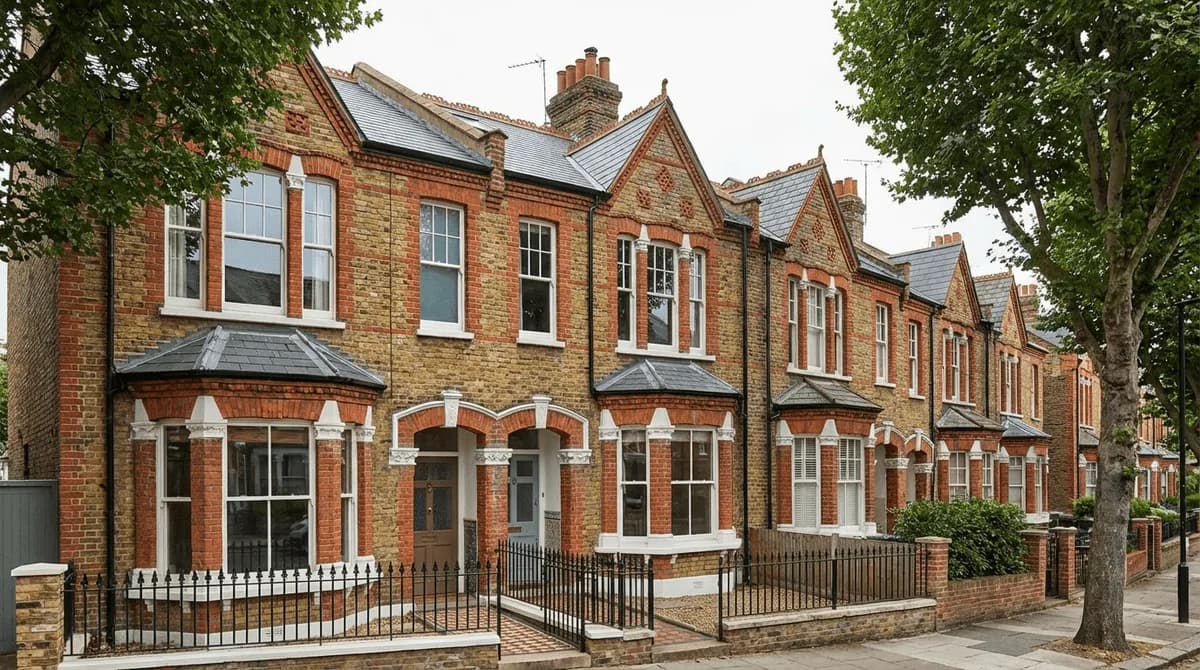
Victorian terraced houses, built between 1837 and 1901, are a common property type in the private rented sector in England and Wales. In EPCGuide's analysis of the full domestic EPC register for England and Wales, pre-1900 homes were the worst-performing construction age band: 86.0% of their certificates sat below EPC C, against 55.4% of all certificates (all tenures; age bands cover 87.6% of the register). With an estimated 4.5 million Victorian properties still standing, and a significant proportion used as rental homes, these characterful properties present real challenges for landlords aiming at the proposed 2030 EPC C deadline. One thing to settle before you spend anything: band E is the legal minimum to let in England and Wales today, so a Victorian terrace rated D is legal to let, and band C by 2030 is a government proposal rather than a rule you are already behind on.
The solid brick construction that makes these homes so durable also makes them among the most difficult to insulate. However, with careful planning and the right approach, it is possible to significantly improve the energy efficiency of a Victorian terrace, often reaching EPC C, or registering an exemption if you cannot reach band E within the £3,500 cost cap. If your property is similar to a pre-1919 semi-detached, many of the same challenges and solutions apply.
Letting a terraced property? Our guide to EPC rules for landlords covers the minimum rating you need today and the 2030 band C proposal.
What Are the Typical Characteristics of a Victorian Terrace?
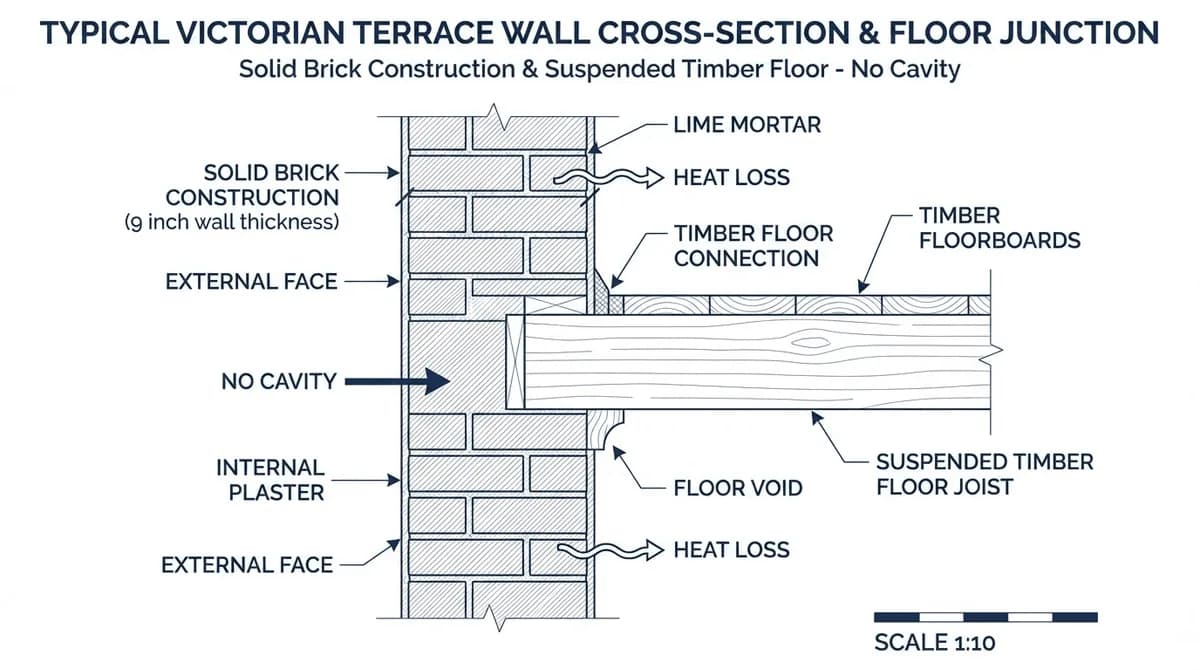
Victorian terraces built between 1837 and 1901 typically have solid 9-inch brick walls with no cavity, single-glazed sash windows, suspended timber floors, and high ceilings of 2.8 to 3.2 metres. These construction features mean most unimproved Victorian terraces score between 30 and 50 EPC points (rating E or F). Here is a breakdown of the typical features.
Wall Construction
- -Solid brick walls, typically 9 inches (225mm) thick
- -Some properties have 13-inch (340mm) walls
- -No cavity between inner and outer layers
- -U-value typically 2.1 W/m2K (very poor)
Common Features
- -High ceilings (typically 2.8m-3.2m)
- -Original single-glazed sash windows
- -Suspended timber ground floors with airbricks
- -Open chimneys (often multiple per room)
Why Do Victorian Terraces Score Poorly on EPC?
1. Solid Walls Cannot Be Cavity Filled
Unlike post-1930s properties with cavity walls, Victorian terraces require either internal or external wall insulation, which is significantly more expensive and disruptive. External insulation may not be permitted in conservation areas or on listed buildings, while internal insulation reduces room sizes.
2. Conservation Area and Listed Building Restrictions
Many Victorian terraces are located in conservation areas or are individually listed. This can prevent external wall insulation, replacement of original windows, and other visible alterations. Internal solutions become the only option, adding complexity and cost.
3. Period Features Limit Options
Original features such as decorative cornices, picture rails, ceiling roses, and dado rails can be damaged or lost during internal wall insulation. Careful design is needed to work around or recreate these features, increasing professional fees.
4. Draughts and Ventilation Balance
Victorian properties were designed to breathe, with deliberate ventilation through chimneys, airbricks, and gaps in construction. While draughtproofing improves energy efficiency, it must be balanced with adequate ventilation to prevent condensation and damp problems.
5. Ageing Heating Systems
Many Victorian terraces still have inefficient boilers, uninsulated pipework, and radiators sized for the original building without considering any insulation improvements. The heating system may need upgrading as part of any comprehensive improvement plan. The Boiler Upgrade Scheme offers £7,500 towards an air source or ground source heat pump (£9,000 until March 2027 if the home is heated by oil or LPG and has no mains gas), making it a practical option for landlords replacing ageing gas boilers.
What Are the Best EPC Upgrades for a Victorian Terrace?
The key to improving a Victorian terraces EPC rating cost-effectively is to prioritise improvements that offer the best points-per-pound return, while working within any planning constraints. Here are the recommended upgrades in priority order:
Priority Order for Maximum Impact
Victorian Terrace Upgrade Costs and EPC Impact
| Improvement | Low Estimate | High Estimate |
|---|---|---|
| Loft Insulation (to 270mm)Quick win if loft is accessible. 4-8 EPC points. | £400 | £600 |
| Draught Proofing (windows, doors, floors)Essential for comfort. 2-4 EPC points. | £200 | £400 |
| Smart Heating ControlsRoom-by-room control. 2-3 EPC points. | £200 | £400 |
| LED Lighting ThroughoutSimple upgrade. 1-2 EPC points. | £100 | £200 |
| Internal Solid Wall InsulationMajor improvement. 10-15 EPC points. Per external wall. | £8,000 | £14,000 |
| Double Glazing (if permitted)Secondary glazing may be alternative. 5-10 EPC points. | £4,000 | £8,000 |
| Condensing Boiler UpgradeIf boiler is 15+ years old. 5-10 EPC points. | £2,500 | £4,000 |
| Estimated Total | £15,400 | £27,600 |
Costs are indicative and vary by region, property size, and specification. Always obtain multiple quotes.
How Do You Draught-Proof Victorian Sash Windows?
Original timber sash windows are one of the defining features of a Victorian terrace, and one of its biggest energy weaknesses. Single-glazed sash windows can have a U-value of 4.8 W/m²K or worse, and the sliding mechanism creates gaps that allow cold air to infiltrate around every edge. However, replacing them is often restricted in conservation areas and listed buildings, making draught-proofing the practical first step.
Professional Sash Draught-Proofing
- Brush pile or compression seals fitted to meeting rail, sides, and sill
- Sashes re-hung or adjusted for smooth operation
- Retains original appearance, ideal for conservation areas
- Cost: £150–£300 per window (professional installation)
- EPC impact: 0.5–1.5 points per window; 2–4 points for a whole house
Secondary Glazing
- Secondary panel fitted on the room side of the original window
- Dramatically reduces heat loss (effective U-value drops to ~1.8 W/m²K)
- Acceptable to most conservation area and listed building authorities
- Cost: £300–£700 per window (slimline systems)
- EPC impact: 3–5 points total for a typical 3-bed terrace
Sash Window Upgrade Options: Cost vs EPC Impact
| Improvement | Low Estimate | High Estimate |
|---|---|---|
| DIY draught-proofing strips (self-adhesive foam)Per window. Temporary fix; degrades quickly. Not rated by EPC assessors. | £30 | £80 |
| Professional sash draught-proofing (brush seals)Per window. Retains original appearance. 0.5–1.5 EPC points per window. | £150 | £300 |
| Slimline secondary glazingPer window. Best thermal improvement without replacement. 0.8–1.5 EPC points each. | £300 | £500 |
| Heritage double-glazed sash replacementPer window. Only if permitted. Needs planning approval in conservation areas. | £800 | £1,800 |
Costs are per window and vary by size. A typical 3-bed Victorian terrace has 8–12 windows.
How Do You Insulate a Suspended Timber Floor?
Most Victorian terraces were built with suspended timber ground floors: floorboards laid over joists with a ventilated void beneath. This was excellent Victorian engineering to prevent rot, but it also allows cold air to circulate directly below your living space. Uninsulated suspended floors account for up to 15% of heat loss in a Victorian terrace, and the draughts they create make rooms feel significantly colder than the air temperature suggests.
From Below (Crawl Space Access)
If there is sufficient access under the floor (typically 600mm+), rigid insulation boards can be fitted between joists from below, without disturbing the floorboards above. This is the least disruptive method.
- • Cost: £400–£900 for a typical ground floor
- • Rigid PIR boards (70–100mm) between joists
- • EPC impact: 3–5 points
- • Minimal disruption to tenants
- • Requires adequate crawl space access
From Above (Lifted Floorboards)
Where crawl space access is too restricted, floorboards are carefully lifted and insulation fitted between the joists from above before boards are replaced. More disruptive but achieves the same result.
- • Cost: £1,000–£2,000 for a typical ground floor
- • Mineral wool batts or rigid boards between joists
- • EPC impact: 3–5 points
- • Boards need careful relaying to avoid squeaks
- • Good opportunity to check for joists issues
How Do You Draught-Proof Victorian Chimneys?
Victorian terraces typically have two, three, or even four working or redundant chimneys, one for each ground-floor reception room and often one per bedroom. Each open chimney acts like a permanent ventilation shaft pulling warm air directly out of the property. Research by the Energy Saving Trust estimates that a single open chimney can account for up to 5% of a home's total heat loss, making chimney draught-proofing the single cheapest and fastest EPC improvement available for Victorian terrace landlords, often delivering 1–3 EPC points for less than £30 per fireplace.
Chimney Balloon
Inflatable balloon fitted in the flue above the fireplace. Deflates when a fire is lit, preventing carbon monoxide build-up.
Cost: £15–£30 per chimney
EPC impact: +0.5–1 point each
Best for fireplaces still occasionally used
Chimney Cap / Cowl
Fitted at the top of the chimney stack to prevent cold air downdraft. Allows some airflow, so less effective than a balloon but permanent.
Cost: £40–£120 (inc. fitting)
EPC impact: +0.5 point each
Good for chimneys prone to downdraft
Fireboard / Register Plate Seal
A fitted board or metal plate blocks the fireplace opening entirely. Ideal for chimneys that will never be used again.
Cost: £30–£150 (DIY or professional)
EPC impact: +0.5–1 point each
Must include a small ventilation slot to prevent damp
How Do You Insulate Victorian Bay Windows?
The projecting bay window, a defining feature of Victorian terraces, creates a unique thermal problem. Three exposed walls meeting in a projecting corner can have heat loss 50–70% higher per square metre than the main front elevation. The triangular or canted floor void beneath the bay is also frequently uninsulated, creating a cold zone that undermines the main ground floor. Addressing the bay specifically, before tackling the rest of the house, is often the highest-return partial insulation project for a Victorian terrace.
Bay Wall Insulation
Internal insulation on the three walls of the bay (two angled cheeks plus the front face) is a compact, self-contained project. Typically only 15–25m² of wall area, far less than whole-house IWI and achievable on a tighter budget.
- • Cost: £2,500–£5,000 (bay walls only)
- • PIR rigid boards or mineral wool in studs
- • EPC impact: 4–7 points
- • 1–2 days disruption (front room only)
- • Can be done with tenant in situ
Bay Floor Insulation
The floor void beneath the bay is often separate from the main suspended floor and uninsulated. Accessing it via the external airbrick or by lifting a few boards is usually straightforward.
- • Cost: £150–£400 (bay floor only)
- • Rigid PIR boards between bay joists
- • EPC impact: 0.5–1.5 points
- • Often accessible without lifting floorboards
- • Can be DIY-friendly if access is good
What Are the Loft Insulation Options?
Victorian terraces typically have pitched roofs with a small accessible loft space above the top floor ceiling. If the loft is cold and unused (the most common scenario), insulating at ceiling joist level to 270mm is the single most cost-effective upgrade available, typically delivering 4–8 EPC points for just £400–£600. If rooms have been converted into the roof space, the insulation approach is more complex and significantly more expensive.
Cold Loft (Most Common)
Loft is unused: insulate at ceiling joist level. The quickest win for any Victorian terrace.
Cost: £400–£600
270mm mineral wool between and over joists
EPC impact: +4 to +8 points
Best value upgrade available
Warm Roof (Rafter Insulation)
If the loft is used as living space or storage, insulation goes between and below the rafters.
Cost: £3,000–£6,000
PIR boards between rafters + boarding
EPC impact: +6 to +10 points
Needed for converted loft rooms
Flat Roof Extensions
Many Victorian terraces have rear flat-roof extensions added in the 20th century. These are often poorly insulated.
Cost: £800–£3,000
Cold deck or warm deck rigid insulation
EPC impact: +2 to +5 points
Best done when re-roofing
How Much Does It Cost to Upgrade a Victorian Terrace EPC?
Upgrading a Victorian terrace from EPC E to EPC C costs between £8,000 and £15,000 for most properties. Quick-win measures (loft insulation, draught-proofing, smart controls, LED lighting) cost under £1,500 and deliver 10 to 17 EPC points. Solid wall insulation, if needed, costs £8,000 to £14,000 for internal and £12,000 to £22,000 for external.
The total cost to reach EPC C depends heavily on your starting point and which improvements are possible for your specific property. For detailed cost breakdowns of all improvement types, see our complete cost guide. Here are realistic cost ranges for Victorian terraces:
Starting at E (42 points)
£8,000 - £15,000
Minimum investment needed to reach C. Likely requires at least partial wall insulation plus all low-cost measures.
Typical Full Upgrade
£15,000 - £30,000
Comprehensive improvement including wall insulation, new boiler, and glazing upgrades for maximum EPC improvement.
Cost Cap Threshold
£3,500
The cap in force today, including VAT. Spend it on qualifying work without reaching band E and you can register an 'all relevant improvements made' exemption. £10,000 is proposed, not yet law.
What Special Rules Apply to Listed and Conservation Area Properties?
Listed Buildings
For listed buildings, focus on reversible, sensitive improvements such as:
- Secondary glazing (usually acceptable)
- Loft insulation between joists (not affecting roof structure)
- Draughtproofing using traditional materials
- High-efficiency boiler replacement (like-for-like location)
- Underfloor insulation where accessible without damage
If listed building restrictions stop you reaching band E, you may not need an EPC at all where the required work would unacceptably alter the building's character or appearance, or you may be able to register a third-party consent exemption if consent is refused. There is no separate listed building exemption on the PRS Exemptions Register. Government has said it intends to remove the exemption from the EPC rules for heritage properties. See our MEES regulations guide for full details on exemption categories.
Conservation Areas
Many Victorian terraces are located within conservation areas, which protect the character of historic neighbourhoods. Conservation area designation does not automatically prevent energy improvements, but it may restrict:
- External wall insulation visible from public areas
- Replacement windows that do not match the original design
- Solar panels on walls that front a highway (in England, roof slopes are generally covered by permitted development, but listed buildings are excluded; check Wales and your local planning authority)
Check with your local planning authority about what requires permission. Many councils have specific guidance for energy improvements in conservation areas.
What Are the Solid Wall Insulation Options?
Internal wall insulation costs £8,000 to £14,000 for a typical 3-bedroom Victorian terrace, adding 10 to 15 EPC points. External wall insulation costs £12,000 to £22,000and adds 12 to 18 points, but in a conservation area it needs planning permission and may be refused. In EPCGuide's analysis of the full domestic EPC register for England and Wales, 33.6% of privately rented homes still had uninsulated solid walls (21.0% of owner-occupied homes), which is why solid wall insulation is typically the single largest EPC improvement available to Victorian terrace landlords, but also the most expensive.
Internal vs External Wall Insulation
| Feature | Internal Wall InsulationRecommended | External Wall Insulation |
|---|---|---|
| Typical Cost (per m2) | 80 - 120 | 100 - 160 |
| Whole House Cost | 8,000 - 14,000 | 12,000 - 22,000 |
| EPC Points Gain | 10-15 points | 12-18 points |
| Disruption Level | High (room by room) | Medium (external only) |
| Effect on Room Size | Reduces by 50-100mm per wall | No internal change |
| Planning Permission | Usually not required | Often required |
| Conservation Area Suitable | Needs planning permission | |
| Listed Building Suitable | Needs listed building consent | Needs listed building consent |
| Moisture Risk | Medium (needs careful design) | Low (if correctly installed) |
Costs vary significantly by property size, access, and specification. Internal insulation is usually the only option for terraces in conservation areas.

Victorian Terrace EPC Upgrade Path: Best Return on Investment
For many Victorian terraces that start close to the C boundary, steps 1 through 7 may get you to EPC C without expensive wall insulation. To reach EPC C as cheaply as possible, work through improvements in order of EPC points gained per £ spent. The table below ranks all main Victorian terrace upgrades by cost-effectiveness. Always complete the cheap, high-impact measures first before committing to expensive works like solid wall insulation.
| Step | Upgrade | Cost Range | EPC Points | Cost per Point | Notes |
|---|---|---|---|---|---|
| 1 | Chimney balloons / draught excluders | £20–£80 | 1–3 | ~£20–30/pt | Biggest bang for buck. Fit to all unused chimneys. |
| 2 | LED lighting throughout | £100–£200 | 1–2 | ~£75–150/pt | Replace all incandescent and halogen fittings. |
| 3 | Hot water cylinder / pipe insulation | £30–£150 | 1–3 | ~£30–100/pt | Cylinder jacket (£20), foam lagging on pipes. |
| 4 | Loft insulation (top up to 270mm) | £400–£600 | 4–8 | ~£75–125/pt | Essential first major measure. Also insulate hatch. |
| 5 | Draught-proofing (doors, windows, floors) | £200–£400 | 2–4 | ~£80–150/pt | Includes sash window sealing and letterbox. |
| 6 | Smart thermostat + TRVs | £200–£400 | 2–3 | ~£100–150/pt | Room-by-room control. Nest, Hive, or Tado. |
| 7 | Suspended floor insulation | £400–£2,000 | 3–5 | ~£100–400/pt | Best value if crawl space access is available. |
| 8 | New condensing boiler (if 15+ years old) | £2,500–£4,000 | 5–10 | ~£300–700/pt | Or consider heat pump via Boiler Upgrade Scheme. |
| 9 | Secondary glazing / sash replacement | £2,400–£8,000 | 3–8 | ~£500–2,000/pt | Whole house secondary glazing; replacement needs planning consent. |
| 10 | Internal solid wall insulation | £8,000–£14,000 | 10–15 | ~£700–1,200/pt | Most expensive per point; only after completing steps 1–9. See full cost guide. |
Example Upgrade Pathway
Here is a realistic example of how a typical 3-bedroom Victorian terrace might progress from EPC rating E to C:
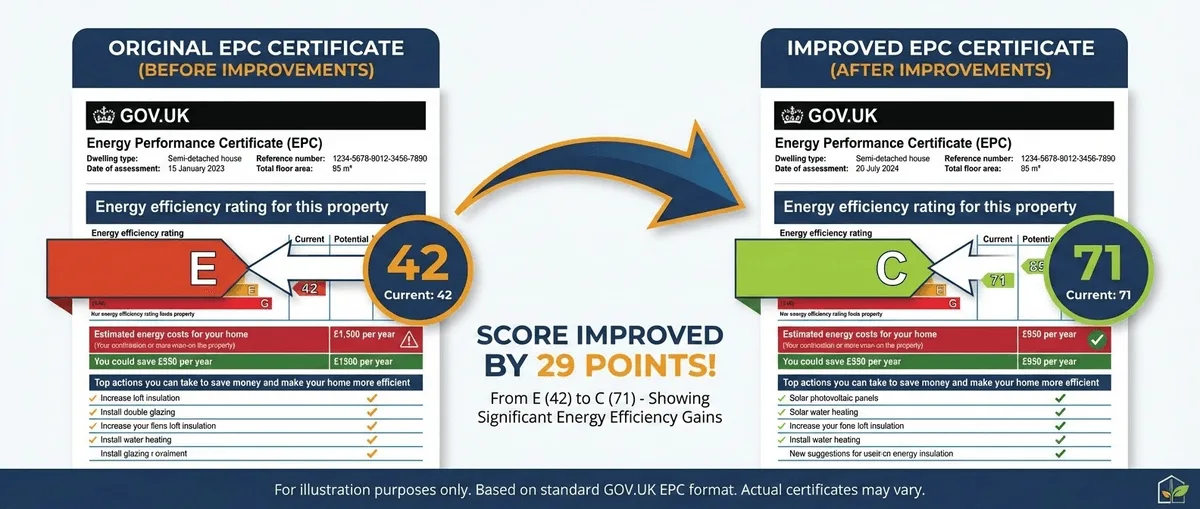
Case Study: 3-Bed Victorian Terrace, North London
Starting
E42 points
Target
C69 points
Heat Pumps in Victorian Terraces: What Landlords Need to Know
Air source heat pumps (ASHPs) are increasingly viable in Victorian terraces. Under the new-style EPCs government has proposed, which will be calculated with the Home Energy Model (HEM), fabric performance would be the primary standard. A heat pump would be one of two ways to meet the secondary standard (the other is the smart readiness metric), if the proposal becomes law. The Boiler Upgrade Scheme (BUS) offers landlords £7,500 off an air source heat pump (£9,000 until March 2027 if the home is heated by oil or LPG and has no mains gas) , with no portfolio limit and no income test.
Air Source Heat Pump (ASHP)
- Outdoor unit typically sited at the rear of the property
- High-temperature units (65°C) avoid need for radiator replacement in most cases
- Mid-terrace: unit at rear garden; end-of-terrace: more placement options
- Cost after BUS grant: £5,000–£10,000 (vs £12,500–£17,500 without grant)
- EPC impact: +8–20 points (highly dependent on existing boiler efficiency)
Air-to-Air Heat Pump (From April 2026)
- Heats rooms directly via warm air (no wet radiator system needed)
- Much cheaper to install than an ASHP (no pipework changes)
- BUS grant: £2,500 from April 2026 (new expansion)
- Total cost: £3,000–£6,000 after grant
- EPC impact uncertain; assessors still confirming methodology for air-to-air units
Home Energy Model 2027: How New Metrics Change the Victorian Terrace Upgrade Strategy
The current RdSAP 10 methodology (which generates today's A–G EPC ratings) is being replaced by the Home Energy Model (HEM), now delayed to H2 2027. This is critical for Victorian terrace landlords because HEM changes what gets you to EPC C, not just the numbers. Understanding the shift now allows you to make upgrade decisions that remain sound under both systems, rather than investments that score well under RdSAP but poorly under HEM.
Under RdSAP 10 (Now)
- Boiler efficiency is a major score driver
- Loft insulation and draught-proofing score well
- Solar PV adds 8–12 points regardless of fabric condition
- Gas boiler upgrade: good score; heat pump: excellent score
Under HEM (From H2 2027)
- Proposed standard: fabric performance would be the primary test, then heating system or smart readiness as the secondary test
- Fabric improvements (loft, floors, walls) still score, but gas boiler upgrades score lower
- If the proposal becomes law, an existing EPC at C or above issued before 1 October 2029 would count as compliant until it expires or is replaced. How a property would band on a new-style EPC has not been confirmed
- Government intends to keep the 10-year validity period for new-style EPCs in England and Wales
How Do Costs and Grants Vary by Region?
EPCGuide's analysis of the domestic EPC register for England and Wales, covering all 318 local authorities, shows significant regional variation in below-C rates, from 60.6% of certificates in Wales to 50.3% in London, and Victorian terraces feel this variation acutely. Victorian terraces are found across the UK, but costs and available support vary significantly by region. Local authority schemes, regional cost variations, and planning constraints all affect your upgrade strategy.
Birmingham & West Midlands
Strong ECO4 Flex participation and Warm Homes Birmingham scheme. Many areas qualify for deprivation-based funding. Costs typically 5-8% below London.
Birmingham GuideManchester & North West
Large Victorian terrace stock with active council energy schemes. Good contractor availability and competitive pricing for solid wall insulation.
Manchester GuideLeeds & Yorkshire
Extensive Victorian housing stock with regional grant schemes available. Lower regional costs but varying conservation area restrictions.
Leeds GuideFrequently Asked Questions
How do I improve my Victorian terrace EPC rating?
+
Start with the cheapest, highest-impact measures first: top up loft insulation to 270mm (4–8 points, ~£500), seal all draughts including chimney openings (2–4 points, ~£300), install a smart thermostat with TRVs (2–3 points, ~£350), and switch to LED lighting (1–2 points, ~£150). These four measures alone can add 10–17 EPC points for under £1,500.
If more points are needed, consider suspended floor insulation (3–5 points, £400–£2,000), a new boiler if your existing one is over 15 years old (5–10 points, £2,500–£4,000), and secondary glazing for sash windows (3–5 points, £2,000–£5,000). Solid wall insulation should be a last resort given its cost, though it delivers the largest single improvement (10–15 points).
Use our EPC Analyser to get a personalised upgrade plan based on your property's current certificate.
How much does it cost to get a Victorian terrace to EPC C?
+
It depends on your starting EPC rating. For a typical Victorian terrace starting at EPC E (39–54 points), reaching C (69 points) costs roughly:
- £3,000–£8,000 if the gap is small (starting at D/high E) and no wall insulation is needed
- £8,000–£15,000 for a typical E-rated property needing some wall insulation
- £15,000–£30,000 for comprehensive improvement of a low-E or F-rated property
Keep those figures in proportion. The cost cap in force is £3,500 including VAT and it is measured against band E, so a terrace already at D or E is under no legal obligation to spend any of it. Where a property does sit at F or G, you should make every recommended measure that fits within the cap, and can then register an exemption if it is still below E. The proposed £10,000 cap against band C would work in a similar way if it becomes law, but it would count most third-party funding (not Boiler Upgrade Scheme grants) towards the cap, add a lower cap for homes under £100,000, and give cost cap exemptions a 10-year life. Grants via ECO4 (which ends on 31 December 2026) and, in England, the Warm Homes Local Grant can significantly reduce these costs for eligible landlords.
How much does solid wall insulation cost for a Victorian terrace?
+
Solid wall insulation for a Victorian terrace typically costs:
- Internal wall insulation: £8,000–£14,000 for a full 3-bedroom terrace (front and rear external walls)
- External wall insulation: £12,000–£22,000 for the same property (in a conservation area it needs planning permission and may be refused)
- Partial internal (front bay only): £3,000–£6,000, a common compromise
Costs are typically quoted per m² of wall area: internal insulation runs £80–£120/m² and external £100–£160/m². A 3-bed Victorian terrace typically has 60–90m² of external wall area (excluding party walls).
ECO4 can fund solid wall insulation in private rented homes rated E, F or G where the tenant qualifies and you give permission. The scheme ends on 31 December 2026. Ofgem's landlord permission form covers blended funding, so ask the installer whether you would be expected to contribute. Check our ECO4 guide for eligibility.
Can I insulate a Victorian terrace in a conservation area?
+
Yes, but with restrictions. In a conservation area, external wall insulation needs planning permission and may be refused, and replacement windows may also be restricted if an Article 4 direction applies. The following usually need no planning permission for an unlisted building (listed buildings need listed building consent for works that affect their character):
- Internal wall insulation (no external change)
- Loft insulation at ceiling joist level
- Suspended floor insulation
- Draught-proofing (including professional sash window treatment)
- Secondary glazing on the room side of original windows
- Boiler replacement (same location)
- Smart heating controls
Always check with your local planning authority before undertaking any works, as policies vary between councils. Some councils now permit sympathetically designed heritage double-glazed sash replacements as like-for-like substitutions.
What EPC rating do most Victorian terraces have?
+
Most unimproved Victorian terraces receive an EPC rating of E or F (roughly 30–54 points). Properties with some improvements (such as a new boiler, loft insulation, or double glazing added at some point) often score in band D (55–68 points). Very few Victorian terraces reach EPC C without deliberate energy improvements.
The solid brick wall construction (no cavity) is the primary reason for the poor baseline rating. Homes built before 1900 have the highest share below EPC C of any construction age band in England and Wales (age bands cover 87.6% of the register): 86.0% of certificates, against 55.4% of all certificates, in EPCGuide's analysis of the EPC register.
How much does sash window draught-proofing cost?
+
Professional sash window draught-proofing using brush pile seals typically costs £150–£300 per window, including re-hanging the sashes for smooth operation. A 3-bed Victorian terrace with 8–10 windows would cost approximately £1,200–£3,000 for a full house treatment.
Slimline secondary glazing, a more effective upgrade that keeps the original sash but adds an inner panel, costs £300–£700 per window. Both options are accepted in conservation areas and by most listed building authorities.
Is underfloor insulation worth it for a Victorian terrace?
+
Yes, especially if your property has accessible crawl space beneath the ground floor. Suspended timber floor insulation costs £400–£900 where access exists from below, and delivers 3–5 EPC points with a cost-per-point of around £100–£250, making it better value than windows or boiler upgrades.
The improvement to tenant comfort is also noticeable: draughts through floorboards are eliminated, and the floor surface temperature rises significantly. If crawl space access is limited, blown insulation through drilled holes (£700–£1,500) or lifting boards from above (£1,000–£2,000) are viable alternatives.
Can I get a grant for improving my Victorian terrace EPC rating?
+
Potentially yes. The main funding routes for Victorian terrace landlords are:
- ECO4 scheme: funds solid wall insulation and other measures in private rented homes rated E, F or G where the tenant qualifies and the landlord gives permission. Ends 31 December 2026.
- Boiler Upgrade Scheme: £7,500 off an air source or ground source heat pump (£9,000 until March 2027 if the home is heated by oil or LPG and has no mains gas).
- Warm Homes: Local Grant: council-administered grants for low-income households in England (cost caps of £16,600 per home for energy performance upgrades and £16,600 per home for low carbon heating, averaged across a council's project). Private landlords can receive one home fully funded, with a 50% contribution for further homes, where the tenant meets the income test.
Use our grant checker tool to find all schemes available for your postcode and property type.
Can a Victorian terrace reach EPC C without solid wall insulation?
+
Yes, many Victorian terraces can reach EPC C without solid wall insulation, depending on the starting point. A property currently at high D (65–68) can often tip into C by combining: loft insulation top-up (4–8 points), draught-proofing (2–4 points), smart heating controls (2–3 points), LED lighting (1–2 points), and suspended floor insulation (3–5 points). That's 12–22 points from measures costing under £3,000.
If the property is currently at mid-D (60–64), a heat pump via the Boiler Upgrade Scheme (£7,500 off, or £9,000 until March 2027 in oil or LPG homes with no mains gas) can add 10–25 points and clear the C threshold without touching the walls. Solar panels are another 8–12 point option. Solid wall insulation is typically only the last resort when all other routes fall short.
Do solar panels improve the EPC rating of a Victorian terrace?
+
Yes. Solar PV panels typically add 8–12 EPC points to a Victorian terrace under the current RdSAP methodology, and are expected to score even better under the incoming Home Energy Model (HEM) from 2027, which weights low-carbon electricity generation more favourably. For a property at EPC D65, a solar installation alone can tip it into C.
A standard 4kWp solar system on a south or southwest-facing Victorian terrace roof costs approximately £6,000–£9,000, significantly less than solid wall insulation and with zero disruption to the interior. Victorian terrace pitched roofs are typically well-suited for solar, though conservation area planning rules and party wall considerations can apply. Check our grant checker to see if any solar funding is available in your area.
Does a heat pump work in a Victorian terrace?
+
Yes, with good installation design. The main challenge for Victorian terraces is the solid wall construction, which causes higher heat loss than modern properties. This means a larger heat pump may be needed to meet the property's heat demand. However, modern high-temperature air source heat pumps (65–70°C flow temperature) are increasingly viable in these properties without requiring full radiator replacement.
For mid-terraces, the outdoor unit is typically sited at the rear of the property. End-of-terrace properties usually have more options for unit placement. Combining insulation improvements (especially loft and floor) before installation allows a smaller, more efficient heat pump to be specified. The Boiler Upgrade Scheme provides £7,500 off an air source heat pump for landlords (£9,000 until March 2027 if the home is heated by oil or LPG and has no mains gas), with no income test and no portfolio limit.
Can I claim the cost cap exemption for my Victorian terrace?
+
Possibly, but check what you are actually being measured against first. The 'all relevant improvements made' exemption applies where you have made the recommended improvements that fit within £3,500 including VAT and the property still cannot reach band E, the legal minimum in England and Wales. If your terrace is already at D, there is nothing to be exempt from.
Government has proposed replacing that with a £10,000 cap measured against band C from October 2030, or 10% of property value where the property is worth under £100,000. That proposal needs an Act of Parliament and then a statutory instrument amending the 2015 regulations, and neither has happened. Under the current rules you document every work item and register on the PRS Exemptions Register. The exemption lasts 5 years, after which you have to try the improvements again. Government has proposed 10 years for cost cap exemptions under the new rules. Read our cost cap exemption guide for the full documentation checklist.
What happens if my Victorian terrace can't reach EPC C by 2030?
+
Right now, if your terrace is rated E or above, nothing happens. Band C by 2030 is a government proposal that has not been made law, and the standard you are held to is band E. A Victorian terrace at D is compliant today and stays compliant unless Parliament changes the rules.
If the proposal does become law, you have three routes: keep improving, because a heat pump or solar alongside fabric measures often reaches C without solid wall insulation; register a cost cap exemption once you have spent the threshold and still fall short; or sell. On penalties, the maximum a local authority can impose today is £5,000 in total per property across all breaches combined, and government has proposed raising that to £30,000 per property per breach under the new rules. The MEES regulations include a formal exemptions register either way. Get a professional assessment before assuming you are trapped.
Solar Panels: the Overlooked Route to EPC C for Victorian Terraces
A standard 4kWp solar installation adds 8–12 EPC points to most Victorian terraces, often enough to push a D65 property into C without touching the walls. Under the incoming Home Energy Model (2027), solar becomes even more valuable as a low-carbon electricity source. Victorian terrace pitched roofs are typically ideal for south/southwest-facing panels.
Next Steps
1. Get Your Current EPC
If you do not have a recent EPC (within 10 years), commission one from a qualified assessor. This gives you your baseline score and identifies recommended improvements.
Check your EPC on GOV.UK2. Check Planning Constraints
Before planning improvements, check if your property is listed or in a conservation area. This determines which improvements are feasible.
Search the Listed Buildings register3. Analyse Your EPC
Upload your current EPC certificate to get a personalised improvement plan with prioritised recommendations for your Victorian terrace.
Use the EPC Analyser4. Calculate Your Costs
Use our calculator to get a personalised estimate based on your specific property details and current EPC rating.
Use the Cost Calculator5. Get Professional Quotes
For major works like wall insulation, obtain at least three quotes from TrustMark-registered installers who have experience with Victorian properties.
Find TrustMark tradespeople