RdSAP 10 Changes: What Landlords Need to Know
The new EPC assessment methodology is now in use. Here is how it works, what has changed, and whether you should wait to get your property assessed.
RdSAP 10 Status
Launched June 2025
RdSAP 10 is now the methodology for every new EPC on an existing home in England and Wales. If you get a new EPC on an existing home today, it will be calculated using RdSAP 10. Existing EPCs calculated under RdSAP 2012 remain valid until their expiry date (10 years from assessment).
The Reduced Data Standard Assessment Procedure (RdSAP) is the methodology used to calculate EPC ratings for existing dwellings in England and Wales. RdSAP 10 is the first new version of this methodology since RdSAP 2012 version 9.94 in September 2019, bringing changes that affect how properties are rated and which improvements are recommended.
For landlords, understanding RdSAP 10 is important because your property might receive a different rating under the new methodology compared to the old one. This could affect your compliance strategy for the proposed 2030 deadline.
What is RdSAP?
RdSAP (Reduced Data Standard Assessment Procedure) is a simplified version of the full SAP (Standard Assessment Procedure) used to calculate energy performance for existing homes. While SAP is used for new builds where detailed specifications are known, RdSAP uses standardised assumptions to assess existing properties based on observable characteristics.
An EPC assessor visits the property, records observable features (wall construction, insulation presence, heating system, glazing, etc.), and inputs this data into RdSAP software. The software then calculates the energy efficiency score and rating.
Previous methodology (version 9.94, until June 2025)
Current methodology (from June 2025)
Full methodology for new builds
Key Changes in RdSAP 10
RdSAP 10 introduces several significant changes to how properties are assessed and scored. The government's impact assessment rates two individual changes as having the biggest effect on scores: the assumed heating pattern and the default U-values of brick walls. Fuel prices are unchanged from SAP 2012.
New Heating Pattern
RdSAP 10 follows the heating regime in SAP 10.2: homes are assumed to be heated in two periods (morning and evening) on all seven days of the week. SAP 2012 assumed a different pattern at the weekend, 16 hours on and 8 hours off.
Revised Default Assumptions
Default assumptions for older properties have been updated. This affects how properties are scored when specific details are unknown or unobservable.
Changed Improvement Valuations
The relative value of different improvements has changed. Some measures may contribute more or fewer EPC points than before.
New Data Collection Requirements
Assessors may need to record additional data points or provide more evidence for certain features. This improves accuracy but may require more thorough inspections.
How Ratings May Change
The same property assessed under RdSAP 2012 and RdSAP 10 may receive different scores. The direction and magnitude of change depends on the property's characteristics, particularly its insulation levels and wall construction.
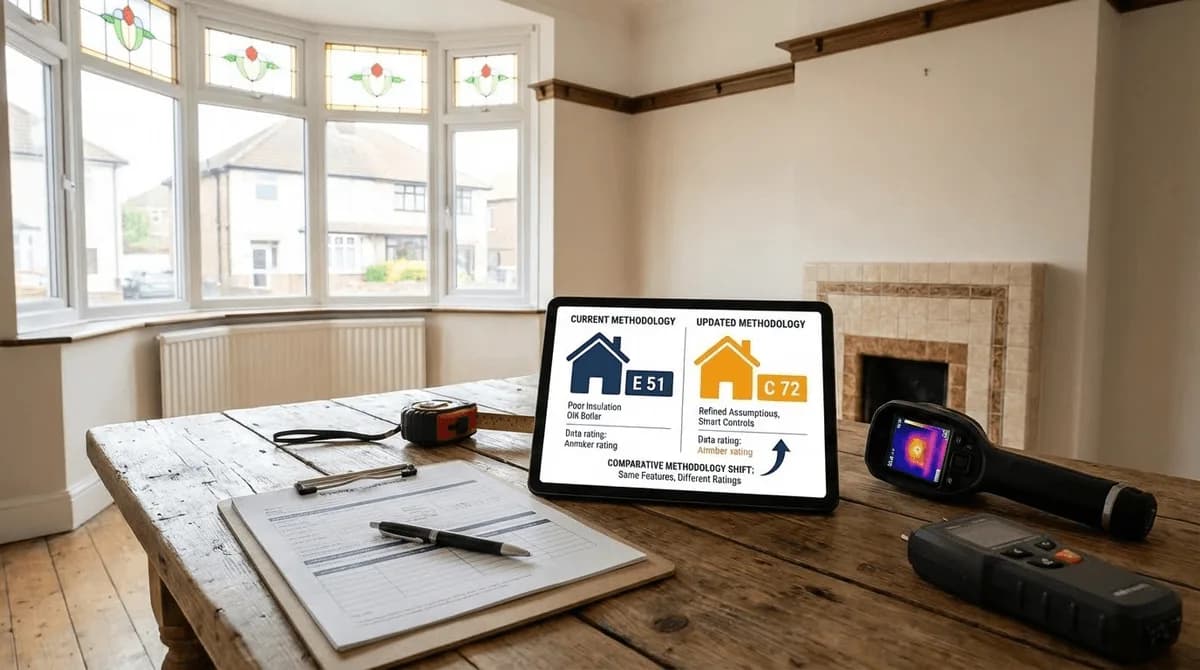
Can Score Higher
- Poorly insulated homes (the new heating pattern has its biggest effect here)
- Homes with uninsulated solid brick walls 280 mm thick or more (lower default U-value)
Could Go Either Way
- Homes with uninsulated solid brick walls up to 200 mm thick (default U-value now 2.5, previously 1.7)
- Homes with stone walls (the U-value equation was modified)
- Homes with heat pumps, solar PV, PV diverters or batteries (calculated under SAP 10.2 rules)
Impact by Property Type
Different property types will experience RdSAP 10 differently, depending on their typical heating systems and construction characteristics.
Victorian and Edwardian Properties
Impact depends mainly on wall construction and insulation. Updated default U-values for solid brick and stone walls may change scores, particularly where insulation status is uncertain.
1930s Semi-Detached
Typically gas-heated with cavity walls. Scores can move by a few SAP points in either direction under RdSAP 10. If your property was borderline C, consider a new assessment to check your position.
Purpose-Built Flats
Modern purpose-built flats often already score well. Communal heating systems are assessed differently; results depend on the specific system type.
Rural Properties (Oil Heated)
RdSAP 10 uses the same fuel prices as RdSAP 2012 to calculate the SAP rating, so oil-heated properties should not expect a score change from fuel prices. Heat pump calculations now follow SAP 10.2.
Should You Wait or Act Now?
A common question from landlords has been whether to wait for RdSAP 10 before getting a new EPC or making improvements. Now that RdSAP 10 is in use, the question is simpler: any new EPC you get will use RdSAP 10.
Get a New EPC Now If...
- Your current EPC is more than 5 years old and you have made improvements
- You have installed electric or renewable heating since your last EPC
- You are borderline D/C and think RdSAP 10 might help your rating
- You need an accurate baseline for planning improvements
- Your EPC will expire before 2030 anyway
Keep Your Current EPC If...
- Your current EPC shows C or above and is still valid (under the proposals, a C or above issued before 1 October 2029 would stay compliant until it expires)
- You have not made any changes since your last assessment
- You suspect RdSAP 10 might lower your score
- Your EPC does not expire until after 2030
Practical Advice for Landlords
Here is how to approach RdSAP 10 pragmatically:
Check Your Current EPC Expiry
An EPC is valid for 10 years. Under the proposals, landlords whose property has not reached C on an EPC issued before 1 October 2029 would need a new-style EPC before and after works. Plan when to get this done based on your improvement timeline.
Understand Your Insulation and Walls
The biggest effects the government identifies are the new heating pattern, which mainly lifts scores for poorly insulated homes, and revised brick-wall U-values. Fuel prices are unchanged. Know where you stand.
Review Old Improvement Recommendations
Improvement recommendations on EPCs calculated under RdSAP 2012 may be less accurate under RdSAP 10. If planning major improvements, consider getting a fresh assessment first.
Document All Improvements
Keep records of all energy efficiency improvements. When getting a new EPC, provide this documentation to the assessor to ensure improvements are correctly recorded.
Consider the Long-Term Direction
RdSAP 10 did not change fuel prices. The next change is new-style EPCs with new headline metrics, now due in the second half of 2027. The proposed 2030 standard is set against those new metrics, not the RdSAP 10 band.
Plan Your Improvements
Use our calculator to estimate costs and see what improvements make sense for your property.
Related Guides
EPC C 2030 Deadline
Everything you need to know about the proposed October 2030 standard.
MEES Regulations Guide
Complete guide to Minimum Energy Efficiency Standards and how they apply.