Yes. Taking an uninsulated loft to 270mm of mineral wool adds roughly 5 to 12 SAP points, for £300 to £750 installed, which makes it the best-value fabric measure on almost any EPC. Topping up a loft that already has 100mm buys far less: assessor worked examples put that step at 1 to 3 points, because the SAP calculation rewards the first layer heavily and the later layers barely at all.
Whether loft insulation gets your rental from D to C depends on how much is up there now, whether the assessor can see and measure it, and what else the property needs.
How many SAP points does loft insulation add?
An EPC band is a SAP score. Band E runs from 39 to 54, band D from 55 to 68, band C from 69 to 80. Loft insulation moves the score by cutting the modelled heat loss through the roof. The size of the move depends on the starting depth.
| Starting depth | Target depth | Typical SAP gain | Typical installed cost |
|---|---|---|---|
| 0mm (nothing between the joists) | 270mm | 5 to 12 points | £300 to £750 |
| 50mm to 100mm (1970s to 1980s standard) | 270mm | 1 to 5 points | £300 to £600 |
| 150mm to 200mm | 270mm | 0 to 2 points | £300 to £600 |
| 270mm | 400mm | 0 points | Not worth doing for the EPC |
The 5 to 12 point range for an empty loft comes from our band E to C upgrade guide, drawn from BRE's SAP documentation. Our cost-per-point ranking gives a wider 5 to 15 point band for a full top-up on a typical 3-bed terrace. The top-up rows are lower because the roof U-value curve flattens fast. In one assessor case study for a 3-bed end terrace, the first 50mm added 11 points, 100mm added 13, and 270mm added 15.
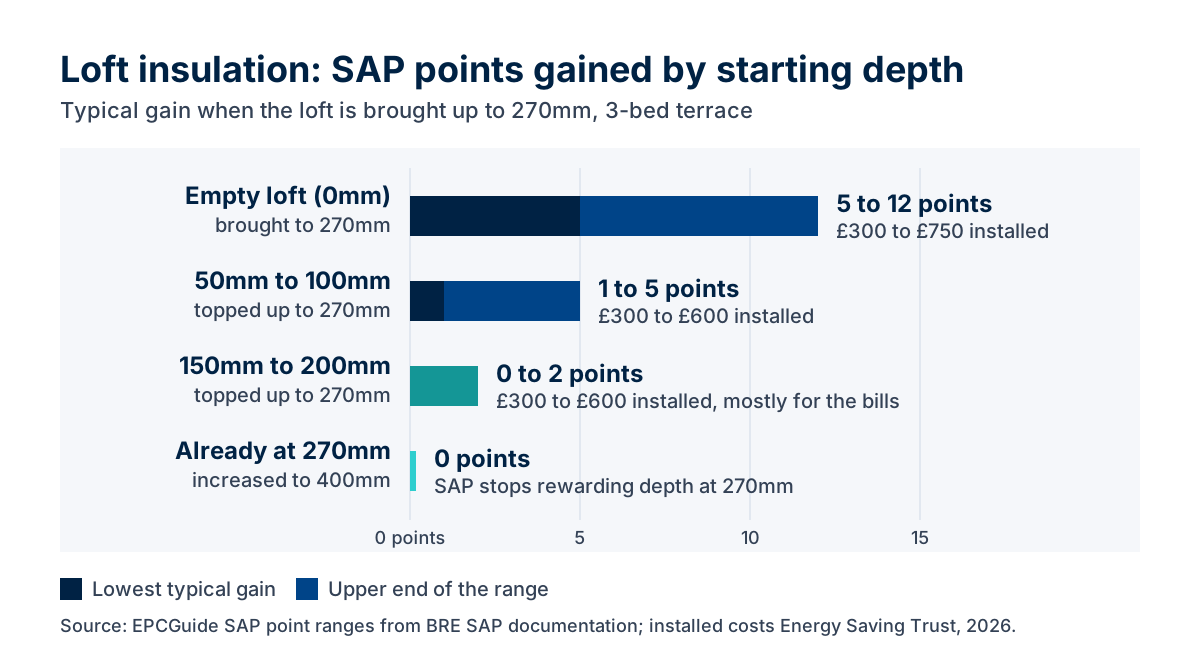 Loft insulation improves an EPC rating most when the loft starts empty. Each extra layer beyond 100mm adds fewer points. Nothing above 270mm counts.
In practice: if the current EPC says "no insulation (assumed)" or "0mm", loft insulation is the first cheque you write. If it says 100mm, do the top-up, then budget for a second measure to cross the band.
Will loft insulation alone move my property up a band?
Sometimes. The deciding number is where the score sits inside the band. A band D property at 65 needs 4 points to reach C: an empty loft brought to 270mm would very likely do it alone. A band D property at 56 needs 13 points, which is the top of the loft insulation range and unlikely without a second measure. A band E property at 45 needs 24 points. No amount of loft insulation gets there by itself.
The certificate shows your exact score as well as the letter. Check it before you buy anything. For the typical D-rated rental, our register analysis puts the median gap to band C at about 9 points, exactly the zone where an uninsulated loft can close the whole gap. Our D to C guide covers the pairings that close a 9 to 14 point gap.
Which second measure pairs best with loft insulation?
For a cavity-wall property built between the 1930s and the 1990s: cavity wall insulation (5 to 20 points, £500 to £1,500). For a gas-heated property with an old boiler: heating controls (1 to 8 points, £200 to £500), then the boiler itself, sized for the newly insulated building.
Why does 270mm matter more than 100mm?
The SAP calculation converts insulation depth into a roof U-value. That curve has a long flat tail. The first 100mm removes most of the achievable roof heat loss. The step from 100mm to 270mm removes a much smaller slice. The step from 270mm to 400mm is within rounding.
The Energy Saving Trust puts the bill side of this bluntly. Its roof and loft insulation guidance says topping up from 120mm to 270mm saves around £17 a year in Great Britain, against an installation cost of £600. Going from nothing to 270mm costs £750 in Great Britain. The same page notes that current Building Regulations recommend a minimum of 270mm for mineral wool. Correctly installed, it lasts around 40 years.
So why top up at all if the loft already has 100mm? Because the assessor records whatever depth is there. At 100mm the certificate keeps recommending loft insulation, so a top-up clears that line on every future certificate. For a property sitting 1 to 3 points below a band boundary, those points are the difference.
How much does loft insulation cost and what is the payback?
| Scenario | Cost (installed) | Annual bill saving | SAP gain | Cost per point |
|---|---|---|---|---|
| Empty loft to 270mm, 3-bed terrace | £300 to £750 | £150 to £250 | 5 to 12 | £25 to £150 |
| 100mm to 270mm top-up | £300 to £600 | Around £17 (EST, GB) | 1 to 3 | £100 to £600 |
| DIY roll, empty loft, accessible | £200 to £400 in materials | £150 to £250 | 5 to 12 | £17 to £80 |
The £150 to £250 annual saving for an uninsulated loft is the figure we use in our ECO4 grants guide for a typical rental. It is the tenant's saving unless bills are included in the rent, so the landlord's payback arrives on the certificate: a band jump that keeps the property lettable under the current rules, protects it against the proposed 2030 standard, and can shave a buy-to-let mortgage rate. Compare that with double glazing at roughly £650 per SAP point. Loft insulation is 5 to 25 times better value per point.
Can I get a grant for loft insulation as a landlord?
Two routes existed in 2026. One of them has already shut.
ECO4. The Energy Company Obligation funds loft insulation in privately rented homes at no cost to the landlord where the tenant qualifies. GOV.UK's ECO page lists the qualifying benefits (Universal Credit, Pension Guarantee Credit, Pension Savings Credit, Income Support, income-based JSA, income-related ESA, Child Benefit subject to income thresholds, and Housing Benefit) and names "insulation work, for example to your loft or cavity walls" as a covered measure. The same page says a privately rented home must be rated E, F or G to qualify through the benefits route. The local authority LA Flex route is wider; our ECO4 guide sets out both.
Ofgem confirms ECO4 runs until 31 December 2026 after a nine-month extension. Work must be complete by that date, so a loft job started in October is cutting it fine. Loft insulation is the quickest ECO4 measure to deliver, usually one day on site, which is why it is still worth chasing this late.
Great British Insulation Scheme. Closed. GOV.UK states that installations had to be complete by 31 March 2026. If an installer offers you "GBIS loft insulation" in late 2026, ask which scheme is paying.
Run your property and tenant through the grant checker before you pay anyone. What replaces ECO4 from 2027 is covered in our Warm Homes Plan guide.
What if the property has a room in the roof?
A loft conversion or any room where the ceiling follows the rafters is a "room in roof" for EPC purposes. The assessor scores the sloping ceilings, the stud walls to the eaves, the gable walls and any flat ceiling section separately. Insulating it means treating those surfaces, which costs £1,500 to £5,000 and adds 4 to 8 SAP points.
Two things catch landlords out. First, the BRE conventions tell the assessor to assume "as built" insulation for a roof room with no access and no documentary evidence, which for a Victorian terrace means none. Second, a conversion done without Building Control sign-off gets scored on the original property's age band, which can cost around 11 points against a properly evidenced conversion. If you hold the completion certificate, showing it to the assessor can lift the score with no physical work. Our room-in-roof insulation guide covers the costs, the ECO4 route and that documentation trap.
How do I make sure the assessor records the loft insulation?
This is the part every other guide skips. It is where landlords lose points they have already paid for. The EPC records what the assessor could measure and photograph on the day. The rules are set out in BRE's RdSAP conventions v12.1, in force from 21 August 2025. Four of them decide your outcome.
Convention 3.04: the loft must be accessible and measurable
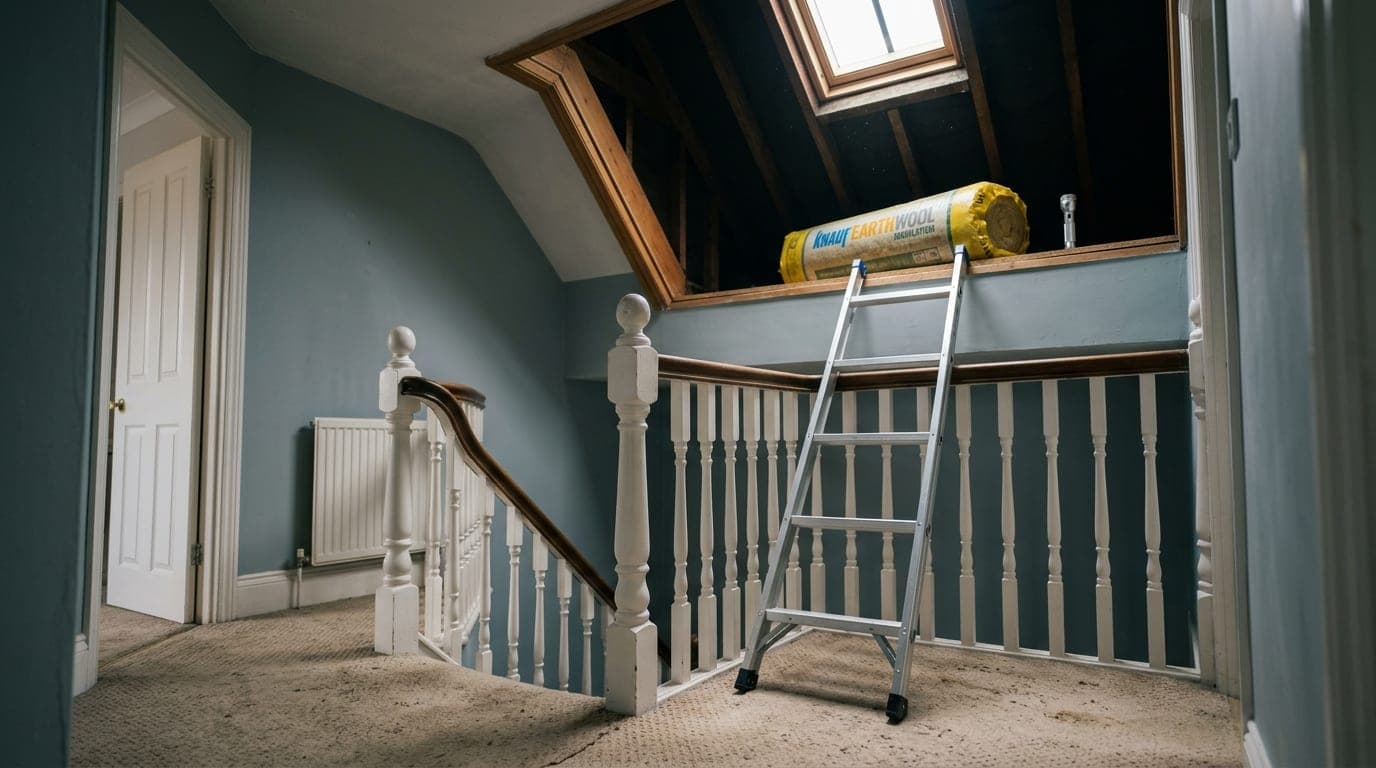
Where safe access is possible, the assessor must measure the insulation and provide photographic evidence of the measured thickness. If there is a hatch but it cannot be used on the day (painted shut, blocked by furniture, unsafe to reach), the assessor records "access, loft insulation unknown", which earns no credit for the 270mm you paid for. Before the visit: unstick the hatch, clear the landing beneath it, leave a ladder out.
Convention 3.04 again: boarded lofts score what can be proved
If the loft is fully boarded or covered in stored items, the assessor enters "loft insulation unknown" unless you lift the boards or hold documentary evidence. Where insulation is visible under the boards at multiple points, the boarded area is treated as insulated to the depth the evidence proves. If your tenant stores boxes up there, ask them to clear a strip along two edges so the depth can be seen and photographed.
Convention 3.03b: "unknown" suppresses the recommendation
The conventions restrict "unknown" to exceptional circumstances, because it automatically suppresses the loft insulation recommendation. An "unknown" loft is scored on the age-band default, so a 1930s semi with an unmeasurable loft is treated as though it holds a fraction of what is there.
Convention 9.02: what counts as documentary evidence
Acceptable evidence includes certificates, warranties, guarantees or any documents verifying the work was carried out, provided the assessor can show they relate to this property. A quote, an order confirmation or a receipt for rolls of insulation is "evidence of intent to install" and does not count on its own. Ask the installer for a dated completion certificate or guarantee that names the address and the installed depth.
A new EPC is the only way the points reach the certificate. Budget £60 to £120 for the reassessment and book it after every planned measure is in. Run the property through the EPC predictor first so you know what score to expect. If the new certificate shows the loft as "unknown" or "assumed", query it with the assessor before accepting it.
Where does loft insulation fit in the law today and the proposed 2030 standard?
The legal minimum to let a property in England and Wales is band E, under the Energy Efficiency (Private Rented Property) (England and Wales) Regulations 2015. GOV.UK's landlord guidance, last updated 5 May 2026, confirms the cost cap at £3,500 including VAT and the maximum penalty at £5,000 per property. A band D or E rental is legal today.
Band C from 1 October 2030 is a proposal from the government's response of 21 January 2026. So are the proposed £10,000 cost cap and the proposed £30,000 penalty. None of it is law: government has to pass an Act and then lay a statutory instrument. Neither has happened. Our 2030 deadline guide tracks the status.
Loft insulation is the sensible move under either regime: cheap, counted toward the current cost cap, and the first measure any ECO4 surveyor or Action Plan will specify. A property that still cannot reach the required band can be registered on the PRS Exemptions Register: see the exemptions guide.
Frequently Asked Questions
Does loft insulation improve EPC rating enough to reach band C? On its own, only if the property is already within 5 to 12 points of the boundary and the loft starts empty. A band D property at 60 or above with no loft insulation has a good chance. Lower in band D, or anywhere in band E, a second measure such as cavity wall insulation or heating controls is needed alongside the loft.
How much loft insulation do I need for the EPC? 270mm of mineral wool. That is the depth current Building Regulations recommend and the depth at which the SAP calculation stops rewarding further layers. Anything above 270mm adds no points, so do not pay for 400mm.
Is it worth topping up 100mm to 270mm? For the EPC, it is worth 1 to 3 points and removes loft insulation from the recommendations list. The Energy Saving Trust puts the bill saving for a 120mm to 270mm top-up at about £17 a year, so the case rests on the certificate. Do it if you are 1 to 3 points short of a band, or if an installer is already on site for other work.
Can I fit loft insulation myself and will the assessor count it? Yes, if the loft is accessible and dry. The assessor counts what they can measure and photograph, so DIY insulation scores the same as a professional install. DIY work does not qualify for ECO4 funding, which requires a TrustMark-registered installer.
Does loft insulation count toward the MEES cost cap? Yes. Money you spend on loft insulation counts toward the £3,500 cap in force today. Grant-funded work does not count, because that cap only covers your own spend. Reaching the cap without hitting the required band supports a high-cost exemption.
Will ECO4 pay for loft insulation in my rental? Yes, at no cost to you, if your tenant receives a qualifying benefit or is referred by the council under LA Flex and the property is in an eligible band. ECO4 closes on 31 December 2026 and the work must be finished by then. Loft insulation is the fastest measure to deliver, so it is still achievable in autumn 2026 if you start now.
My EPC says "loft insulation: no insulation (assumed)". What does that mean? The assessor could not see or access the loft, so the software used the default for the property's age. If insulation is actually there, you are losing points to a default. Get access sorted, find any installer certificate or guarantee, and commission a new assessment.
Do I need a new EPC after adding loft insulation? Yes. An existing certificate is never updated; improvements only count when a new assessment records them. Reassessments cost £60 to £120, so book one after all planned measures are complete.