Warm Homes Plan: What It Means for Landlords
The government's Warm Homes Plan, published 21 January 2026, set out how it intends to raise the rented-sector minimum to EPC C. Here is what changed, what did not, and what binds you today.
Document Details
Overview
The Warm Homes Plan is the government's policy document setting out how England will upgrade the energy efficiency of its housing stock. For landlords, it is the document in which government committed to raising the private rented minimum to EPC band C from 1 October 2030.
That commitment is policy, not law. Government must first take new powers through an Act of Parliament, then lay a statutory instrument amending the Energy Efficiency (Private Rented Property) (England and Wales) Regulations 2015. The target is for the new rules to be in force during 2027. Nothing has been laid yet. Until it is, the standard you are bound by is unchanged: band E or above, as it has been since 1 April 2020. Band D is legal to let. Only F and G are barred without a registered exemption.
That distinction is worth holding on to, because it is the difference between planning for band Cand panic-buying it. Work done now still counts and still cuts your tenants' bills. Work done in a rush against a date nobody has legislated is how landlords overspend.
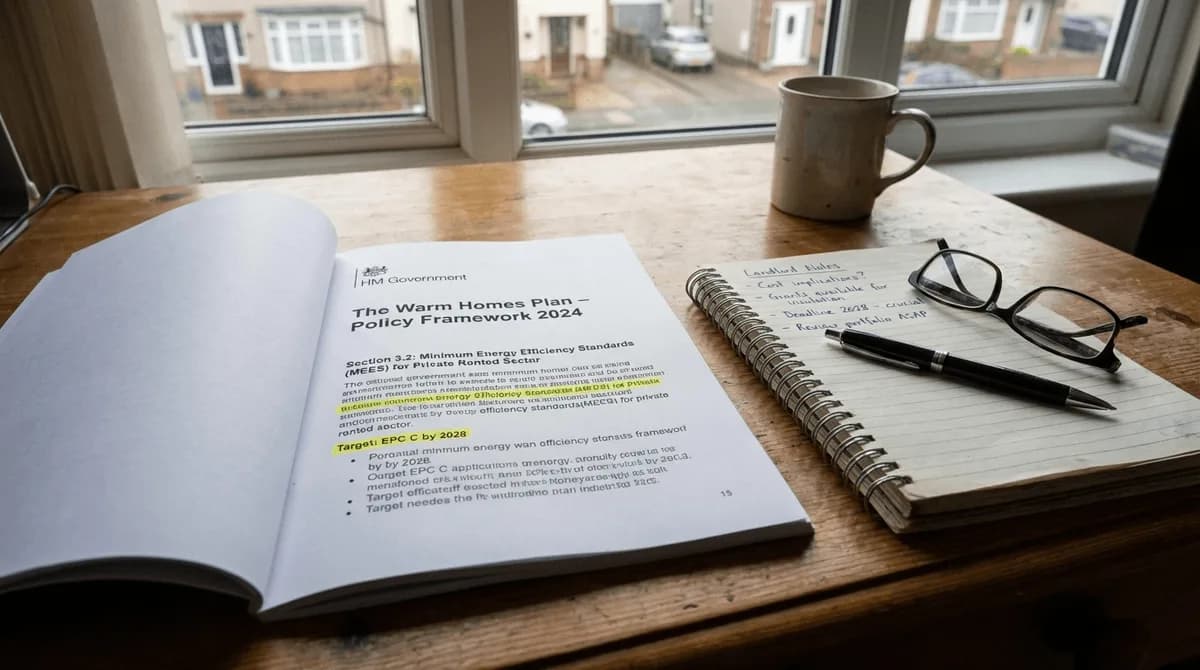
What the Plan Proposes for Landlords
Four proposals in the plan affect private landlords directly. None of them binds you yet. Each one needs the statutory instrument described above before it becomes a duty.
Proposed EPC C minimum from 1 October 2030
Government has proposed that privately rented properties in England and Wales would need an EPC rating of C or above from 1 October 2030, covering new and existing tenancies alike. The minimum in force until then is band E.
Proposed, not yet lawCost cap: £3,500 today, £10,000 proposed
The most you are required to spend before you can register a high-cost exemption is £3,500 including VAT. Government has proposed that this would rise to £10,000, or 10% of the property value where that value is below £100,000.
Would rise from £3,500Maximum penalty: £5,000 today, £30,000 proposed
The maximum civil penalty a local authority can impose is £5,000 in total per property, across every breach combined. Government has proposed raising that ceiling to £30,000 (proposed, not yet law).
Proposed increaseSingle proposed date for all tenancies
MEES was phased in during 2018 and 2020, new tenancies first. Government has said the band C standard would instead apply to new and existing tenancies from the same date, with no grace period for a tenancy already running.
Proposed change of approachFunding Provisions
The Warm Homes Plan includes several funding mechanisms to help achieve its energy efficiency goals. While most funding is targeted at owner-occupiers and social housing, landlords may benefit in certain circumstances.
ECO4 Scheme
The Energy Company Obligation (ECO4) provides funding for energy efficiency improvements in properties where the tenant receives certain means-tested benefits. Landlords can access this funding to improve rental properties.
- Available for properties with EPC D, E, F, or G
- Tenant must receive qualifying benefits
- Can cover insulation, heating, and more
Warm Homes: Local Grant
Local authority-administered grants for home energy improvements. Eligibility varies by location and is primarily targeted at owner-occupiers, but some councils include private landlords in their schemes.
- Administered by local councils
- Eligibility varies by area
- Check your local council for details
Boiler Upgrade Scheme
Grants of up to £7,500 towards heat pump installation. Available to landlords for rental properties, providing a significant contribution towards the cost of switching from gas or oil to a heat pump.
- £7,500 for air source heat pump
- £7,500 for ground source heat pump
- Property must not be on gas grid (for some schemes)
Great British Insulation Scheme (closed)
GBIS closed to new applications in January 2026 and ended on 31 March 2026, so it is no longer available. It offered targeted support for insulation improvements in less energy-efficient homes, with provisions for both owner-occupiers and private rented sector properties.
- Targets properties rated D-G
- Cavity wall and loft insulation focus
- Some schemes include PRS properties
What Government Has Committed To
Everything in this list is government policy announced on 21 January 2026. It settles what ministers intend to legislate, which is genuinely useful for planning. None of it is in force, and the detail can still move as the regulations are drafted.
Settled policy, still to be legislated
- EPC C minimum:Band C (score 69 or above) proposed from 1 October 2030, replacing the band E minimum in force.
- Cost cap of £10,000, proposed:Including VAT, for exemption eligibility, or 10% of value below £100,000. The cap in force is £3,500.
- Maximum penalty of £30,000, proposed:Per property. The maximum in force is £5,000 in total per property.
- Single date for all tenancies:New and existing tenancies would be covered from 1 October 2030, with no phasing.
- Exemption categories kept:Cost cap, consent, devaluation and wall insulation grounds would carry over, with a new property value adjustment ground for low-value properties.
- Longer exemptions on three grounds:Cost cap, property value adjustment and negative impacts would run for 10 years under the proposals. Every exemption today lasts 5 years, except the new-landlord ground at 6 months.
- Spend clock backdated, in principle:Government has proposed that qualifying spend from 1 October 2025 would count towards the new cap. Because the rules are not law, that start date is not guaranteed. Keep every invoice regardless.
- Public exemptions register:Non-compliance and exemptions publicly recorded.
What Remains Uncertain
While the Warm Homes Plan provides significant clarity, some questions remain open or subject to further guidance. Landlords should be aware of these uncertainties:
Areas of Uncertainty
- Whether the 2030 standard becomes law, and in what form:It needs an Act of Parliament and then a statutory instrument, targeted for 2027. Neither has happened. The previous parliament's band C proposal was dropped in September 2023 at a similar stage. The figures can also change during drafting.
- Enforcement approach:How actively local authorities will enforce remains to be seen. Resources and priorities vary by council.
- Future cost cap changes:The cost cap may be reviewed in future. What applies when your exemption expires in 5 years is not guaranteed.
- EPC methodology future changes:RdSAP 10 is current, but methodology continues to evolve. Future changes could affect ratings.
- Specific local funding availability:Local grant schemes vary and change. What is available in your area today may differ tomorrow.
- Interaction with other regulations:How MEES interacts with Renters' Rights reforms and other tenancy changes may create additional complexity.
Impact on Landlords
The Warm Homes Plan has significant implications for landlords across England and Wales. Understanding these impacts helps you plan effectively.
Budget on a range, not a number
The cap you can actually be held to is £3,500. The proposed cap is £10,000. Budgeting somewhere between the two, and spending it on measures that pay for themselves in lower bills and better tenant retention, leaves you covered either way without gambling on a rule that does not exist yet.
A date to plan against
1 October 2030 is the date government has committed to, which is enough to plan against even though it is not yet law. Roughly four years is a comfortable runway for a portfolio if you start sequencing work now, and an uncomfortable one if you wait for the statutory instrument to appear.
Portfolio Decisions
Some landlords may need to make strategic decisions about their portfolios. Properties that cannot be economically improved to EPC C may need to be sold or converted to alternative uses. The clarity provided by this plan enables informed decision-making.
Enforcement exposure
Today the ceiling is £5,000 in total per property, and penalties are published on the PRS Exemptions Register for at least 12 months. Government has proposed a ceiling of £30,000 (proposed, not yet law). The public listing is often the part that costs more, through letting agents and buyers who read it.
Next Steps for Landlords
With the Warm Homes Plan now published, here is what landlords should do:
Review Your Portfolio
Check current EPC ratings for all properties. Identify which are below C and will need improvement. Note EPC expiry dates.
Estimate Improvement Costs
For each property below C, estimate what improvements will be needed and their cost. Use our calculator and property guides for guidance.
Explore Funding Options
Check ECO4 eligibility (tenant benefits), Boiler Upgrade Scheme, and local council schemes. Factor any available funding into your budget.
Create a Compliance Timeline
Plan when to make improvements for each property. Consider tenancy cycles, tax year planning, and contractor availability. Avoid leaving everything until 2029-2030.
Make Strategic Decisions
For properties where compliance is uneconomic, consider whether to sell, convert to alternative use, or invest in major renovation. The clarity from this plan enables informed choices.
Start Planning Your Compliance
Use our tools and guides to understand what the Warm Homes Plan means for your specific properties and create your compliance action plan.
Related Guides
EPC C 2030 Deadline
Full details on the October 2030 deadline and what it means for your properties.
Cost Cap and Exemptions
The £3,500 cap in force, the £10,000 proposal, and every exemption ground.