1950s House EPC Upgrade Guide
Everything landlords need to know about bringing 1950s properties up to EPC C standard
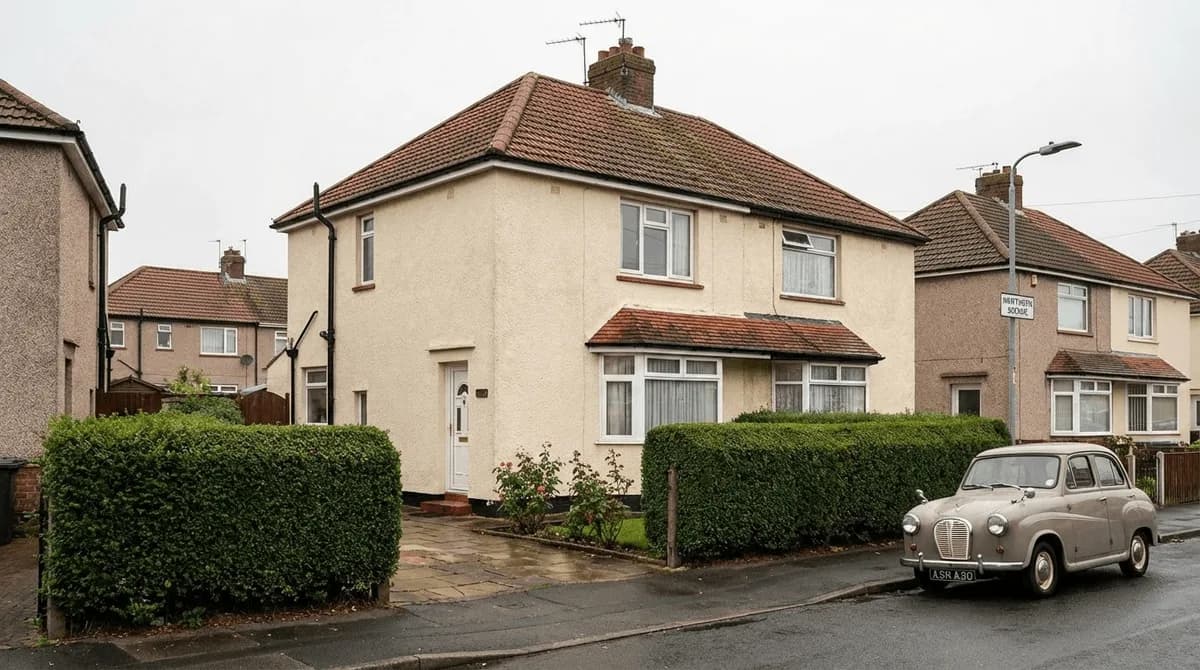
Houses built in the 1950s represent a transitional period in UK construction. The post-war housing boom saw a mix of traditional and modern building methods, with some properties having cavity walls while others retained solid wall construction. This variation means that improvement strategies differ significantly depending on your specific property.
Crucially, 1950s properties were built before the national Building Regulations of 1965, so construction standards and insulation levels vary from house to house. A professional survey is essential to determine your wall type and the most effective upgrade pathway.
If you are not sure where your property currently sits, you can work out what a post-war build like yours would score today before you commit to any survey or quote.
Renting out a 1950s house? See our guide to EPC rules for landlords for the band you must hold today and what is proposed for 2030.
Property Characteristics
The 1950s was a transitional era in UK housing construction. Post-war rebuilding required rapid construction, leading to a mix of traditional methods and new approaches. Understanding your specific property's construction is crucial for planning effective improvements.
Wall Construction (Variable)
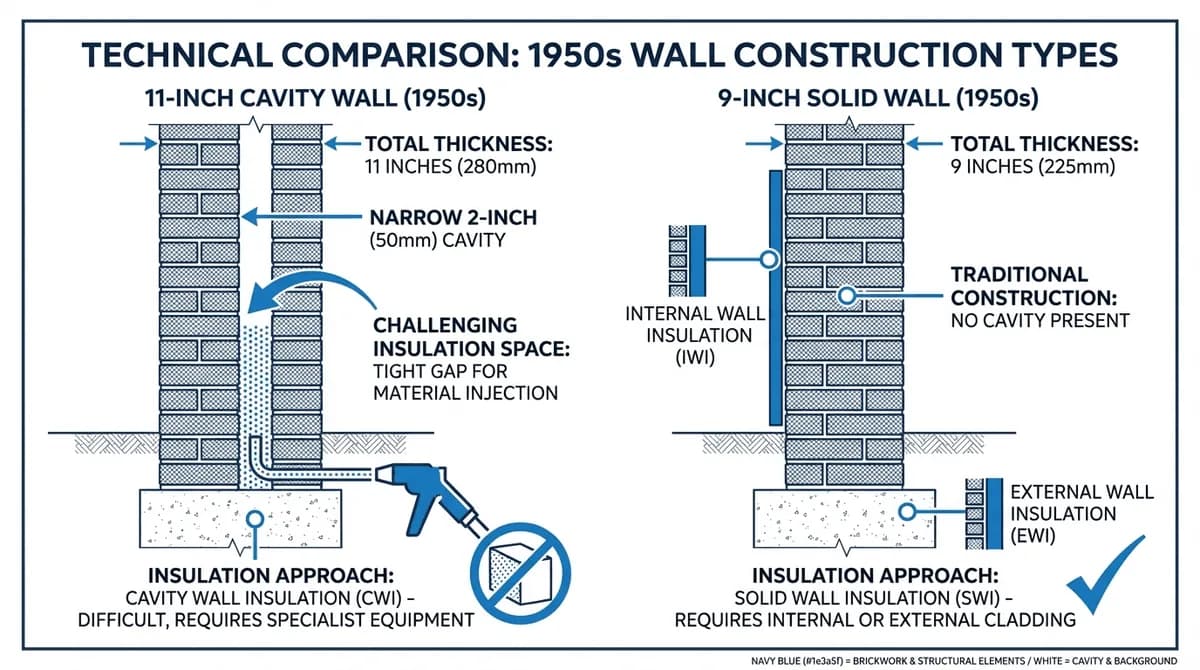
- -11-inch (280mm) cavity walls with 2-inch (50mm) cavities
- -Or 9-inch (225mm) solid brick walls
- -Some non-traditional prefab or system-built
- -U-value typically 1.4-2.1 W/m2K depending on type
Common Features
- -Hipped roofs with clay or concrete tiles
- -Ground floor bay windows (often)
- -Suspended timber or solid concrete floors
- -Original metal or wooden casement windows
Pre-Regulations Construction
- -No national Building Regulations until 1965
- -Insulation levels vary from house to house
- -Variable construction quality
Typical Starting Condition
- -Some loft insulation (25-100mm if present)
- -Walls usually uninsulated
- -Original or aged boiler systems
- -Single glazing common on original windows
Common EPC Challenges
1. Narrow Cavity Walls
Many 1950s properties have 11-inch cavity walls, but with only a 2-inch (50mm) cavity. Ofgem's 2018 ECO guarantees document lists a cavity narrower than 50mm as non-standard for cavity wall insulation under the CIGA 25-year guarantee, and standard cavity wall insulation may not suit one. Check the clear width with a borescope survey.
2. Unknown Construction Type
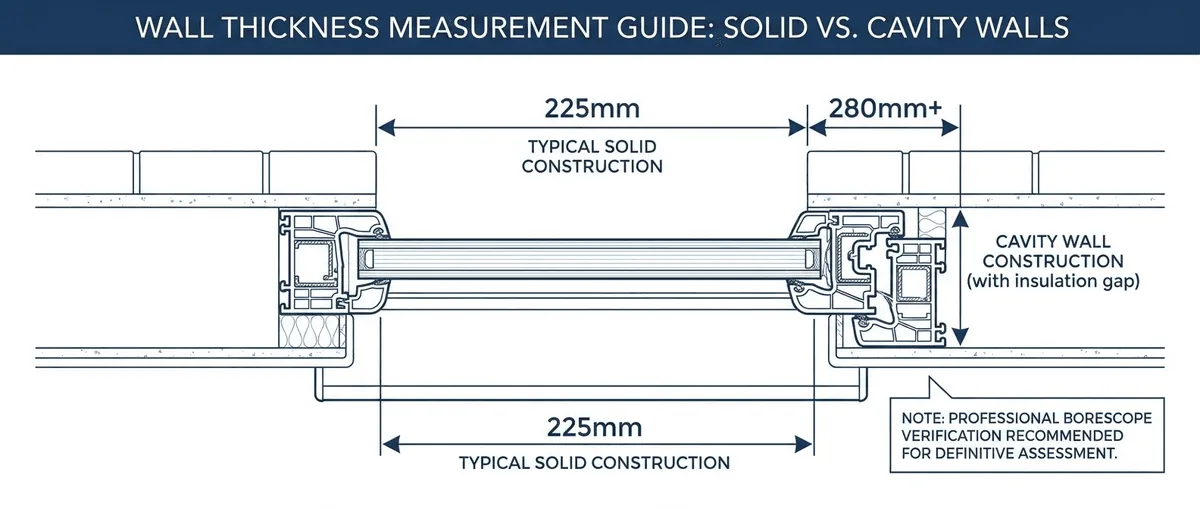
Without professional inspection, it can be difficult to determine whether walls are solid or cavity. The wall thickness at window reveals, and the brick pattern, can provide clues but are not definitive. Borescope inspection is often required.
3. Pre-Building Regulations Construction
Built before the national Building Regulations of 1965, 1950s properties may have inconsistent construction quality, leading to variation even within similar property types.
4. Exposed Locations
Cavity wall insulation in exposed locations (high wind-driven rain exposure) can cause damp problems. Many 1950s council estates were built in exposed locations on the edges of towns, requiring careful assessment before filling cavities.
5. Original Services
Properties that have not been modernised may still have original electrical wiring, plumbing, and heating systems. While improving the EPC, you may need to factor in the cost of updating these services to meet current standards.
Recommended Upgrades
The upgrade pathway for a 1950s property depends critically on wall type. Properties with standard cavity walls can follow a similar approach to 1960s-70s houses, while solid wall properties need the more expensive solutions required for Victorian homes.
Priority Order for Maximum Impact
1950s House Upgrade Costs and EPC Impact
| Improvement | Low Estimate | High Estimate |
|---|---|---|
| Cavity Wall Insulation (if suitable)If cavity width allows. 8-12 EPC points. | £450 | £1,500 |
| Internal Wall Insulation (if solid walls)For solid wall properties. 10-15 EPC points. | £8,000 | £14,000 |
| Loft Insulation (to 270mm)Quick win. 4-8 EPC points. | £300 | £500 |
| Condensing Boiler UpgradeIf boiler is 15+ years old. 5-10 EPC points. | £2,500 | £4,000 |
| Double GlazingReplacing original single glazing. 5-10 EPC points. | £3,500 | £7,000 |
| Smart Heating ControlsRoom thermostat + TRVs. 2-4 EPC points. | £200 | £400 |
| Draught ProofingWindows, doors, floors. 1-3 EPC points. | £150 | £350 |
| LED LightingSimple upgrade. 1-2 EPC points. | £100 | £200 |
| Estimated Total | £15,200 | £27,950 |
Costs depend heavily on wall type. Cavity wall properties will have significantly lower total costs than solid wall properties. Do not add the rows: cavity wall and solid wall insulation are alternatives for the same wall, and most houses need only some of the rest.
If upgrading to a heat pump rather than replacing like-for-like, the Boiler Upgrade Scheme can cover up to £7,500 toward installation costs.
Cost Estimates
The cost to reach EPC C for a 1950s house varies significantly depending on wall construction. This makes an accurate survey essential before budgeting for improvements. Most unimproved post-war stock starts at D or E, and if yours is already a D then what it actually costs to close that last band gives you a tighter figure to work from than the ranges below.
Cavity Wall Property
£4,000 - £8,000
If cavity walls are suitable for insulation, costs are similar to 1960s-70s properties with good upgrade potential.
Solid Wall Property
£8,000 - £12,000
Solid wall properties require internal or external insulation, significantly increasing costs and complexity.
Cost Cap Threshold
£3,500
The cap in force today, including VAT. £10,000 is proposed, not yet law. Solid wall 1950s properties can exceed the current figure. Today that only matters if the house is rated below band E (F or G): the high-cost exemption applies where the cheapest recommended measure would cost more than £3,500.
Special Considerations
Narrow Cavity Walls
Many 1950s properties have cavity walls with only a 50mm (2-inch) gap between the inner and outer leaves. This presents specific challenges:
- Standard mineral wool - typically needs 50mm minimum clear cavity, so may not be suitable if there are wall ties or debris
- Blown bead insulation - can work in narrower cavities but requires specialist assessment
- Foam insulation - can fill narrow cavities but has higher failure rates and potential damp issues
If cavity fill is not suitable, the alternatives are internal or external wall insulation, both significantly more expensive than cavity fill.
Pre-Building Regulations Issues
Properties built before the national Building Regulations of 1965 can vary significantly in construction standards. Common issues include:
- Inconsistent cavity width - may vary across the building
- Missing or inadequate DPCs - damp-proof courses may be absent or failed
- Wall tie issues - original ties may be corroding
- Variable brick quality - some may be more porous
These issues should be addressed before or alongside energy improvements to avoid creating or exacerbating damp problems.
Identifying Wall Type
Before planning improvements, you need to determine your wall construction type. Here are some methods to help identify whether you have solid or cavity walls:
Solid vs Cavity Wall Identification
| Feature | Solid Wall (9 inch) | Cavity Wall (11 inch)Recommended |
|---|---|---|
| Wall Thickness | 225mm (9 inches) | 280mm (11 inches) |
| Brick Pattern (if visible) | Mix of headers and stretchers | Usually stretcher bond only |
| Age Indicator | More common pre-1930, but some 1950s | Standard for most 1950s builds |
| Definitive Test | Borescope inspection | Borescope inspection |
These are indicators only. The only definitive way to confirm wall type is a borescope inspection through a small drilled hole.
Example Upgrade Pathway
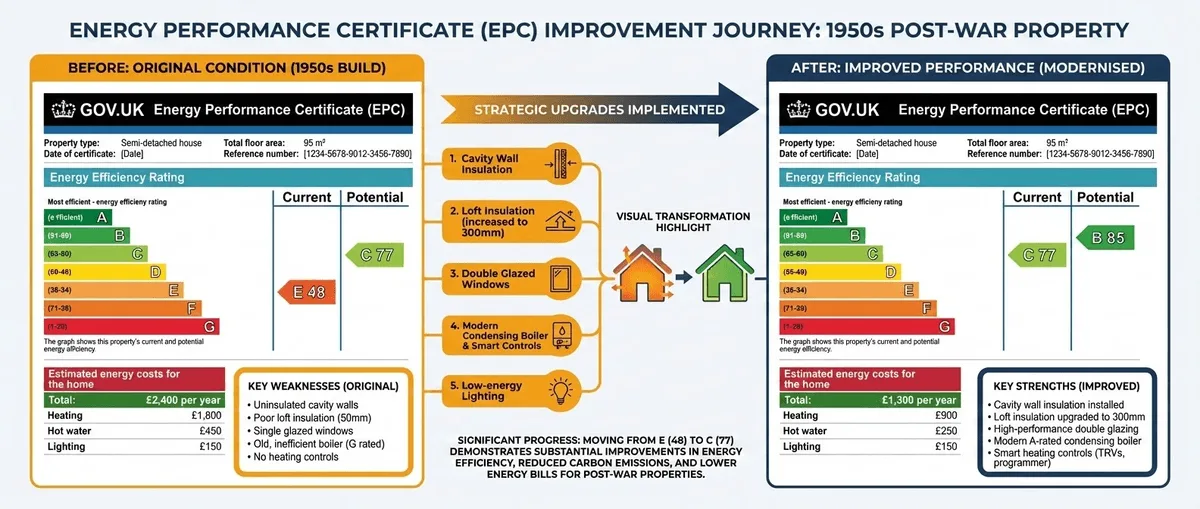
Here is a realistic example of how a 1950s semi-detached house with cavity walls might progress from EPC rating E to C:
Case Study: 3-Bed 1950s Semi, Leeds (Cavity Walls)
Starting
E48 points
Target
C69 points
Next Steps
1. Get Your Current EPC
If you do not have a recent EPC (within 10 years), commission one from a qualified assessor. This gives you your baseline score and starting point.
Check your EPC on GOV.UK2. Commission a Wall Survey
For 1950s properties, a professional survey to determine wall type is essential before planning improvements. This will determine your upgrade pathway.
Find a CIGA registered surveyor3. Calculate Your Costs
Use our calculator to get a personalised estimate based on your specific property details and current EPC rating.
Use the Cost Calculator4. Get Professional Quotes
Once you know your wall type, obtain at least three quotes from TrustMark-registered installers for the appropriate insulation method.
Find TrustMark tradespeople