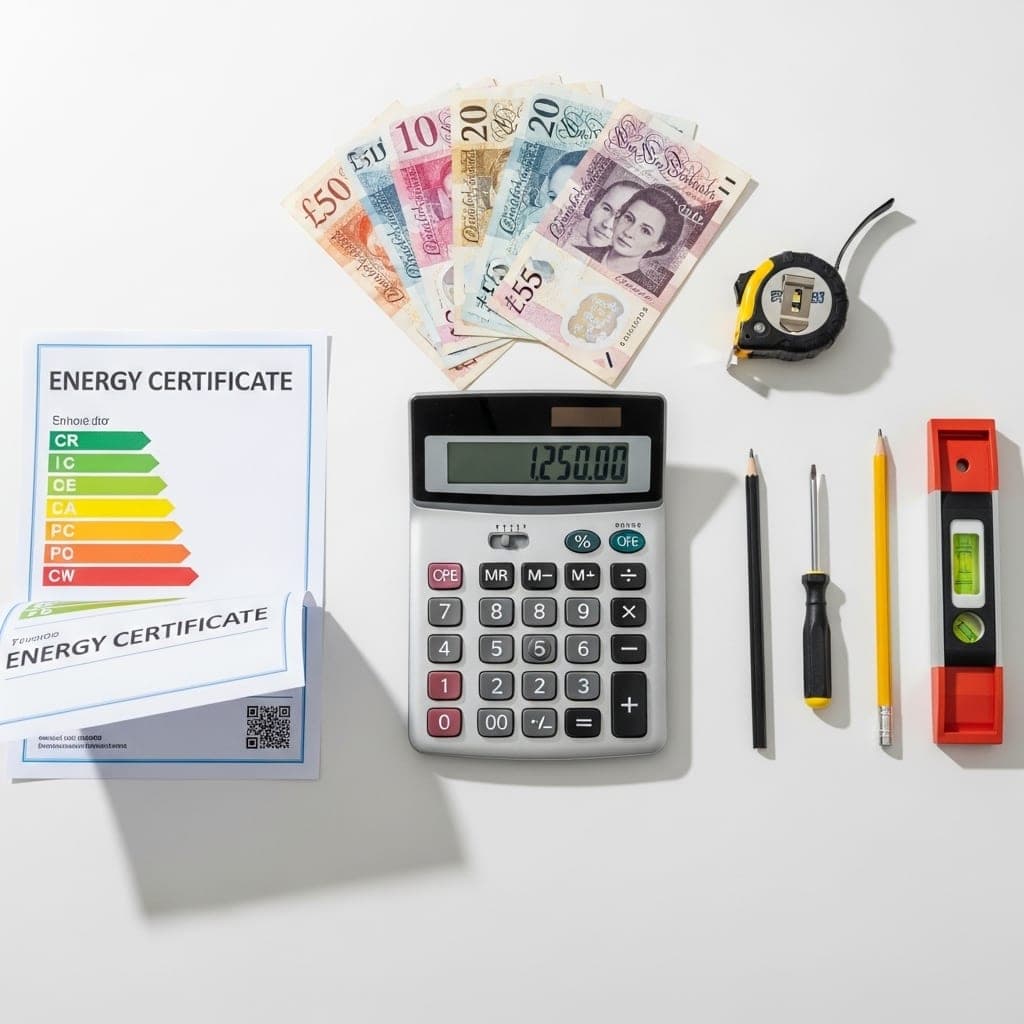
Upgrading a rental property to EPC C in the UK costs between £500 and £15,000, depending on the starting band, property type, and which measures are needed. The most common upgrade, D to C, typically costs £500 to £3,500 for cavity-wall properties or £5,000 to £12,000 for solid-wall buildings, with the typical cost to reach band C sitting toward the middle of that range for most property types.
Typical cost to upgrade a rental property to EPC C (2026):
| Starting point | Typical cost to reach C |
|---|---|
| Band D, cavity walls | £500 to £3,500 |
| Band D, solid walls | £5,000 to £12,000 |
| Band E (any walls) | £5,000 to £15,000 |
| Modern flat (post-2000) | £800 to £3,000 |
| 1930s semi-detached | £1,500 to £5,000 |
| Detached house | £3,000 to £12,000 |
| Victorian terrace (pre-1919) | £5,000 to £15,000 |
| Pre-1919 cottage or rural property | £8,000 to £15,000+ |
Ranges are indicative and based on typical installer pricing in 2026. Get quotes for your own property before budgeting.
Before you spend anything, be clear on what is required and what is optional. The minimum band in force in England and Wales is E, under the Energy Efficiency (Private Rented Property) (England and Wales) Regulations 2015. Band D is legal to let. Only F and G are barred without a registered exemption, and the cost cap in force is £3,500 including VAT. Government said in January 2026 that it intends to raise the minimum to band C from 1 October 2030 with a £10,000 cap, but that needs an Act of Parliament and then a statutory instrument amending the 2015 Regulations, and no such instrument has been laid. So reaching C is a commercial decision for most landlords today, not a legal duty.
This guide breaks down the real cost of every EPC improvement measure available in 2026, with figures by property type, upgrade path, and grant eligibility.
Complete EPC Improvement Cost Breakdown
Every EPC improvement delivers a different number of SAP points (the scoring system behind EPC bands) at a different price. The table below covers every common measure, ranked from cheapest to most expensive.
| Improvement | Typical Cost | EPC Points Gained | Best For |
|---|---|---|---|
| Hot water cylinder jacket | £15--£25 | 1--3 points | Properties with hot water tanks |
| LED lighting (full house) | £50--£200 | 1--3 points | Quick win, any property |
| Draught-proofing (doors, windows, letterbox) | £100--£400 | 2--5 points | Older properties with gaps |
| Loft insulation (top-up to 270mm) | £300--£600 | 5--15 points | Most properties |
| Smart thermostat + TRVs | £200--£500 | 3--8 points | Any property |
| Cavity wall insulation | £500--£1,500 | 10--20 points | Pre-1990 cavity-wall builds |
| Floor insulation | £500--£1,500 | 2--5 points | Suspended timber floors |
| New condensing boiler | £1,500--£3,500 | 5--10 points | Pre-2005 boilers |
| Double or triple glazing | £3,000--£8,000 | 5--10 points | Single-glazed properties |
| Solar PV panels | £4,000--£8,000 | 10--20 points | Suitable south-facing roofs |
| External wall insulation | £5,000--£15,000 | 15--30 points | Solid-wall properties |
| Air source heat pump | £8,000--£15,000 | 15--40 points | Off-gas-grid properties |
Source: EPCGuide analysis of 75,000 lodged certificates across 15 local authorities, cross-referenced with Energy Saving Trust cost data and TrustMark installer pricing (2026).
How to read the table
SAP points gained vary significantly by property. A loft with zero insulation gaining 270mm will see a much larger jump than one going from 100mm to 270mm. The ranges above reflect the typical spread across the national dataset. To estimate the impact on your specific property, use EPCGuide's cost calculator.
How Much Does It Cost to Go from D to C?
This is the most common upgrade path. Around 2.1 million rental properties in England currently sit in band D, according to the English Housing Survey 2023. Band D covers SAP scores 55 to 68, and band C starts at 69. That means most D-rated properties need between 9 and 14 SAP points to cross into C.
Typical D-to-C cost: £500 to £3,500
For a cavity-wall property scoring D 60 or above, the cheapest path to C usually involves two or three low-cost measures:
- Loft insulation top-up (£300--£600, +5--10 points)
- Heating controls upgrade (£200--£500, +3--8 points)
- LED lighting (£50--£200, +1--3 points)
Combined cost: £550 to £1,300. Combined SAP gain: 9 to 21 points.
For many D-rated properties, that combination is enough. Commission a new EPC assessment (£60--£120) after completing these measures before spending anything further. You may already be at C.
When D to C costs more
Solid-wall properties, older builds with no cavity, and properties with single glazing face higher bills. If your EPC assessor recommends wall insulation as the primary route to C, expect to spend £5,000 to £15,000 depending on whether you choose internal or external insulation. Our Victorian terrace EPC guide covers this scenario in detail.
How Much Does It Cost to Go from E to C?
E-rated properties (SAP 39 to 54) need 15 to 30+ SAP points to reach band C. This nearly always requires multiple measures, including at least one major upgrade.
Typical E-to-C cost: £5,000 to £15,000
A realistic E-to-C upgrade package for a 3-bed semi might include:
| Measure | Cost | SAP Gain |
|---|---|---|
| Loft insulation (new or top-up) | £400--£800 | +5--15 |
| Cavity wall insulation | £500--£1,500 | +10--20 |
| New condensing boiler | £2,000--£3,500 | +5--10 |
| Heating controls + TRVs | £200--£500 | +3--8 |
| LED lighting | £50--£200 | +1--3 |
| Total | £3,150--£6,500 | +24--56 |
For properties without cavity walls, replace cavity wall insulation with external wall insulation (£5,000--£15,000) and the total rises to £7,650--£20,000.
E-rated landlords should explore grant funding before committing to full-price installation. The Boiler Upgrade Scheme knocks £7,500 off a heat pump, and ECO4 can fund insulation at zero cost if your tenant qualifies. Our complete guide to EPC grants for landlords covers every available scheme and how to stack them.
Cost by Property Type
EPCGuide's analysis of 75,000 lodged certificates across 15 local authorities reveals significant cost variation by property type. The same EPC band means very different upgrade bills depending on the building.
Victorian terrace (pre-1919)
Typical upgrade cost to C: £5,000 to £15,000
Victorian terraces are the most expensive property type to upgrade. Solid walls, single-glazed sash windows, uninsulated suspended floors, and older heating systems all drag down SAP scores. The primary cost driver is wall insulation: internal wall insulation runs £2,000 to £8,000, external wall insulation £5,000 to £15,000. Listed or conservation area properties face further restrictions.
The good news: non-wall measures often close the gap more cheaply than expected. See our full Victorian terrace EPC improvement guide and our Victorian terrace property type guide for a costed upgrade path that avoids wall insulation where possible.
1930s semi-detached
Typical upgrade cost to C: £1,500 to £5,000
Semi-detached houses from the 1930s to 1960s are the sweet spot for cost-effective upgrades. Most have cavity walls (cheap to insulate), accessible lofts, and space for modern heating controls. A typical upgrade path: cavity wall insulation (£500--£1,500) + loft insulation (£300--£600) + heating controls (£200--£500) = £1,000 to £2,600 total.
Modern flat (post-2000)
Typical upgrade cost to C: £800 to £3,000
Modern flats benefit from better baseline insulation and shared structural elements with neighbouring units. The most common upgrades are heating controls, LED lighting, and boiler replacement. Our flat upgrade cost guide has the full breakdown by starting band.
Detached house
Typical upgrade cost to C: £3,000 to £12,000
Detached houses have the most exposed surface area, meaning heat loss through walls, roof, and floor is highest. Loft insulation, wall insulation, and glazing all deliver strong returns, but the total bill is higher than for terraced or semi-detached homes because there are more square metres of each element to cover.
Pre-1919 cottage or rural property
Typical upgrade cost to C: £8,000 to £15,000+
Stone-built cottages and rural properties often have solid walls, off-grid heating (oil or LPG), and limited access for installers. These properties are the most likely to hit the £10,000 cost cap and qualify for a cost cap exemption.
The £10,000 Government Cost Cap
The government confirmed in its January 2026 consultation response that landlords are required to spend a maximum of £10,000 per property on recommended EPC improvements. If you spend £10,000 and the property still cannot reach EPC C, you can register a cost cap exemption and continue letting legally.
Key rules:
- Start date: qualifying spend from 1 October 2025 onward counts toward the cap
- What counts: all measures recommended by your EPC assessor, plus the cost of the EPC assessment itself
- What doesn't count: general maintenance, cosmetic work, or upgrades not on the EPC recommendation list
- Documentation: keep receipts, invoices, and the EPC report. You will need these if challenged
The full list of qualifying measures and documentation requirements is covered in our £10,000 cost cap guide.
Will you actually hit the cap?
Most properties will not. EPCGuide's data analysis shows that 72% of D-rated properties can reach C for under £5,000. The cost cap primarily protects landlords with solid-wall period properties, rural off-grid builds, and listed buildings where the cheapest compliant route is expensive. If you do hit the cap, you can register a cost cap exemption and continue letting legally. Our complete guide to EPC exemptions explains every exemption type and how to register.
Grants and Funding That Reduce Your Costs
Three main schemes can reduce or eliminate EPC improvement costs in 2026.
Boiler Upgrade Scheme (BUS): £7,500 off a heat pump
The Boiler Upgrade Scheme provides £7,500 toward installing an air source heat pump or ground source heat pump in properties that currently use fossil fuel heating. This brings the net cost of an ASHP from £8,000--£15,000 down to £500--£7,500.
The scheme is available until March 2028 (subject to budget) and applies to rental properties as well as owner-occupied homes. Your installer applies on your behalf, so the grant is deducted from the quote.
Who it's best for: landlords with off-gas-grid properties or ageing boilers where a heat pump is the most practical long-term heating solution.
ECO4: free insulation and heating for eligible tenants
The Energy Company Obligation (ECO4) scheme funds insulation, heating, and ventilation upgrades at no cost to the landlord, provided your tenant receives qualifying benefits such as Universal Credit, Pension Credit, or certain tax credits. Eligibility is based on the tenant's circumstances, not the landlord's income.
ECO4 is ending in December 2026. If your tenant qualifies, act now. The successor scheme, the Warm Homes Plan, is expected to launch in 2027 but details remain unconfirmed.
Warm Homes: Local Grant
Council-administered funding for energy efficiency improvements in eligible areas. Coverage varies by local authority and changes regularly. Use EPCGuide's grant checker tool to see what is available in your postcode.
Stacking grants
You can combine grants in some cases. For example, a landlord could use ECO4 for loft and cavity wall insulation (free) and the Boiler Upgrade Scheme for a heat pump (£7,500 off). The only restriction is that you cannot use two grants for the same measure.
ROI Analysis: When Do EPC Improvements Pay for Themselves?
EPC improvements are not just a compliance cost. They reduce energy bills, increase property value, and protect rental income.
Energy bill savings
| Improvement | Typical Annual Saving | Payback Period |
|---|---|---|
| Loft insulation (0 to 270mm) | £150--£300 | 2--3 years |
| Cavity wall insulation | £100--£250 | 3--6 years |
| LED lighting | £40--£80 | 1--2 years |
| Smart thermostat + TRVs | £80--£150 | 2--4 years |
| New condensing boiler | £200--£400 | 5--10 years |
| Air source heat pump | £300--£600 | 8--15 years (before grant) |
| Solar PV panels | £300--£700 | 7--12 years |
Energy bill savings accrue to the tenant, not the landlord, unless the landlord pays the energy bills directly. However, lower energy bills make the property more attractive to tenants and reduce void periods.
Property value uplift
Research from the Department for Energy Security and Net Zero (2024) shows that properties rated EPC C or above sell for 3% to 5% more than equivalent D-rated properties. On a £250,000 property, that is a £7,500 to £12,500 increase in value, often exceeding the cost of the upgrades themselves.
Rental premium
Rightmove data from 2025 indicates that energy-efficient properties let faster and command slightly higher rents. The effect is strongest in areas with high energy costs, where tenants actively seek properties with lower running costs.
Compliance protection
From 2030, non-compliant properties cannot be legally let. Fines of up to £30,000 apply, and the Renters' Rights Act has removed most of the workarounds landlords previously used. The cost of compliance is always cheaper than the cost of non-compliance.
When to DIY vs. Hire a Professional
Some EPC improvements are straightforward DIY jobs. Others require certified installers, both for safety and to qualify for grants.
Safe to DIY
- LED lighting: Replace halogen or CFL bulbs with LEDs. No tools required beyond a stepladder.
- Draught-proofing strips: Self-adhesive strips for doors and windows. £20--£50 in materials from any DIY store.
- Hot water cylinder jacket: Wrap-around insulation jacket. Takes 10 minutes, costs £15--£25, and pays for itself within weeks.
- Loft insulation top-up: Adding rolls of mineral wool on top of existing insulation is feasible as DIY if the loft is accessible, dry, and you can work safely at height. Wear a mask, goggles, and long sleeves.
Must hire a professional
- Cavity wall insulation: requires specialist drilling and injection equipment. Must be installed by a TrustMark-accredited installer to count toward grants and the cost cap.
- External or internal wall insulation: structural work requiring planning consideration and professional installation.
- Boiler replacement: Gas Safe registered engineer only. Non-negotiable.
- Heat pump installation: MCS-certified installer required for Boiler Upgrade Scheme eligibility.
- Solar PV panels: MCS-certified installer for SEG payments and grant eligibility.
- Double or triple glazing: professional fitting for warranty and building regulations compliance.
Important: for any measure to count toward the £10,000 cost cap, you need receipts from a recognised installer. DIY work is harder to evidence if you later need to register a cost cap exemption.
The Right Order: Start Cheap, Reassess, Then Decide
The single most common mistake landlords make is jumping straight to expensive measures. A new boiler costs £2,000 to £3,500. If loft insulation, heating controls, and LED lighting would have closed the gap for £800, that boiler was wasted money.
The EPCGuide recommended sequence
- Read your current EPC report. Check your SAP score and the assessor's recommended measures.
- Complete all sub-£500 measures first. LED lighting, draught-proofing, hot water cylinder jacket, loft insulation top-up.
- Get a new EPC assessment (£60--£120). You may already be at C.
- If still below C: proceed with the next cheapest recommended measure (typically cavity wall insulation or heating controls).
- Reassess again before committing to anything over £3,000.
- Check grants before paying full price for major works. Use the grant checker.
This approach minimises spend and avoids overinvestment. Use the EPC cost calculator to model your specific property.
Predicting Your Costs Before You Spend
Two free tools on EPCGuide help you estimate costs before committing:
- Cost calculator: enter your property details and current EPC band to get a personalised cost estimate for reaching band C.
- EPC predictor: model the SAP score impact of different improvement combinations to find the cheapest route.
Both tools draw on EPCGuide's analysis of 75,000 lodged certificates across 15 local authorities, giving estimates grounded in real assessment data rather than industry averages.
Regional Cost Variation
EPC improvement costs are not uniform across the UK. Labour costs, installer availability, and property stock all affect pricing. Our regional cost analysis shows:
- London and South East: 10--20% above national average for labour, but strong grant availability and high property values improve ROI.
- Wales and rural England: lower labour costs, but higher proportion of solid-wall properties pushes average upgrade costs above the national median.
- Scotland: separate EPC regulations and timeline. See our Scottish landlord EPC guide.
- Northern Ireland: its own regulatory framework with different MEES thresholds.
The repair-to-rent ratio, a metric comparing upgrade cost to annual rental income, varies from 20% in Kensington to over 148% in Powys. Where you own property matters as much as what you own.
Frequently Asked Questions
How much does it cost to improve an EPC rating from D to C?
For a typical property with cavity walls, improving from EPC D to C costs between £500 and £3,500. The most common route is loft insulation (£300 to £600), heating controls (£200 to £500), and LED lighting (£50 to £200). Solid-wall properties cost more, typically £5,000 to £12,000, because wall insulation is significantly more expensive. EPCGuide's analysis of 27.6 million EPC certificates covering 19.7 million homes confirms this range across the national stock.
How much does it cost to improve an EPC rating from E to C?
An E-to-C upgrade typically costs between £5,000 and £15,000 depending on the property type. E-rated properties usually need multiple measures: insulation, a heating system upgrade, and often glazing or renewable energy. The government's own impact assessment puts the average landlord cost at £5,387 per property across all property types, under its preferred policy option. For a detailed breakdown, see the E-to-C section above.
What is the cheapest way to improve an EPC rating?
The cheapest EPC improvement is a hot water cylinder jacket at £15 to £25, which adds 1 to 3 SAP points. LED lighting costs £50 to £200 and adds 1 to 3 points. Draught-proofing costs £100 to £400 and adds 2 to 5 points. These small measures often push a borderline D rating into C without needing expensive work. Our full guide to the cheapest ways to improve your EPC rating ranks every measure by cost per SAP point.
Is there a maximum I have to spend on EPC improvements?
Yes. The government's cost cap is £10,000 per property. If you spend £10,000 on recommended EPC improvements and the property still cannot reach EPC C, you can register a cost cap exemption with the PRS Exemptions Register. Qualifying spend from 1 October 2025 onward counts toward this cap, including the cost of the EPC assessment itself. Full details in our cost cap guide.
Can I get a grant to cover EPC improvement costs?
Several grants are available in 2026. The Boiler Upgrade Scheme provides £7,500 toward an air source heat pump. ECO4 can fully fund insulation and heating upgrades if your tenant receives qualifying benefits such as Universal Credit or Pension Credit. The Warm Homes: Local Grant offers council-administered funding in eligible areas. Use EPCGuide's grant checker tool to see what applies to your property and postcode.
How long does it take to improve an EPC rating?
Simple measures like LED lighting and draught-proofing take a few hours. Loft insulation and heating controls take one to two days. Major works like wall insulation or heat pump installation take one to three weeks. Most D-to-C upgrades can be completed within a week. Allow two to four weeks for a new EPC assessment booking after completing works, as assessor wait times vary by region.
Do EPC improvements increase property value?
Yes. Research from the Department for Energy Security and Net Zero shows properties rated EPC C or above sell for 3% to 5% more than equivalent D-rated properties. On a £250,000 property, that represents a £7,500 to £12,500 value increase. Rightmove data from 2025 shows energy-efficient homes also let faster and command marginally higher rents, particularly in areas with high energy costs.
Should I DIY or hire a professional for EPC improvements?
LED lighting, draught-proofing strips, and hot water cylinder jackets are safe DIY jobs. Loft insulation top-ups are feasible as DIY if the loft is accessible and dry. Cavity wall insulation, heating systems, glazing, wall insulation, heat pumps, and solar panels must be installed by certified professionals. For grant eligibility, most measures require TrustMark or MCS-accredited installers.
What to Do Next
- Check your current EPC on the government's EPC register. Note your SAP score and the recommended improvements.
- Run the numbers with EPCGuide's cost calculator to estimate your total spend.
- Check grants using the grant checker. Many landlords are surprised by what they qualify for.
- Start with the cheap measures. LED lighting, draught-proofing, and loft insulation can be done this week.
- Reassess before committing to major works. A £60--£120 EPC assessment is cheap insurance against unnecessary spend.
The 2030 EPC C deadline is confirmed. Costs are stable in 2026, but assessor availability and installer capacity will tighten as the deadline approaches. Landlords who act now pay less and avoid the rush. Those who wait until 2028 or 2029 will face higher prices and longer EPC assessor wait times that could make compliance impossible on time.