1930s Semi-Detached EPC Upgrade Guide
How to bring your inter-war semi up to EPC C standard cost-effectively
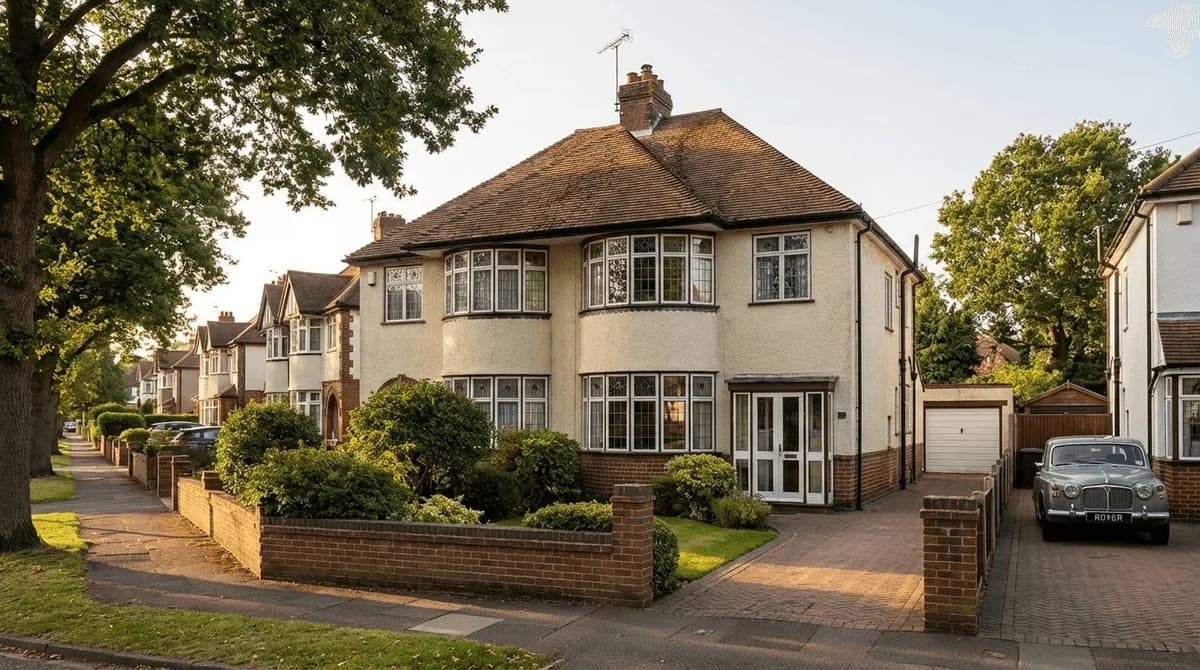
The 1930s semi-detached house is one of the most common property types in the UK, with millions built during the inter-war housing boom. In EPCGuide's analysis of the full domestic EPC register for England and Wales, 76.6% of certificates for homes built 1930 to 1949 sit below band C, against 81.1% for 1900 to 1929 and 86.0% for homes built before 1900 (all tenures and property types, March 2026 extract of 29,207,013 certificates, age bands cover 87.6% of the register). They represent some of the best opportunities for landlords to achieve EPC C compliance at reasonable cost, thanks to their cavity wall construction and generally accessible design.
Unlike Victorian terraces with their solid walls, 1930s semis were built with cavity walls that can be insulated relatively cheaply and with minimal disruption. Combined with other straightforward improvements, many of theseproperties can reach EPC C for under the £10,000 cap that government has proposed on indicative quotes, and the cheapest individual measures cost less than the £3,500 cap in force today. The minimum band you must meet to let in England and Wales right now is E, and government has proposed raising that to C from 1 October 2030 on a single date covering every tenancy. A 1930s semi is one of the easier property types to get there early, and cheaply enough that it is worth doing whether or not the proposal passes.
For the full picture on a semi-detached let, read our landlord EPC requirements guide: what binds you today, and what is only proposed.
Property Characteristics
A 1930s semi-detached house is an inter-war property typically built with cavity walls, suspended timber floors, and bay windows. In EPCGuide's analysis of the full domestic EPC register for England and Wales, 23.4% of certificates for homes built 1930 to 1949 are band C or better (age bands cover 87.6% of the register; all tenures and property types, March 2026 extract, 100% less the 76.6% below band C). They reach EPC C more cheaply than Victorian or Edwardian stock thanks to the cavity wall, which accepts injected insulation at an indicative cost of £800 to £1,500.
Wall Construction
- +Cavity walls with 50mm gap (typically unfilled)
- +Outer leaf: brick or rendered brick
- +Inner leaf: brick or breeze block
- +Excellent for cavity wall insulation
Common Features
- -Bay windows (ground floor, often first floor)
- -Suspended timber ground floors
- -Accessible loft space (often boarded)
- -Original single-glazed windows (if not replaced)
2026 Update: What Has Changed for 1930s Semi Landlords
Nothing binding has changed. Government has said it intends to require EPC C across the private rented sector from a proposed date of 1 October 2030, and its January 2026 response removed the earlier 2028 trigger for new tenancies, so the proposal is now a single date. Turning that into law needs new powers from an Act of Parliament and then a statutory instrument amending the 2015 regulations, with the aim of that instrument coming into force in 2027, so band E remains the minimum you have to meet.Alongside that, the MEES cost cap is proposed to rise from £3,500 to £10,000 per property, and the maximum civil penalty is proposed to rise from £5,000, which is the total per property across all breaches combined, to £30,000. Both of those are proposals, so the figures binding on you today remain £3,500 and £5,000. None of it is bad news for a 1930s semi: many reach EPC C for less than the proposed £10,000 cap.
What the proposed rules mean
- EPC C proposed by 1 October 2030 for all private rentals, with band E the legal minimum until then
- No earlier proposed compliance date for new tenancies
- Cost cap proposed to rise from £3,500 to £10,000
- Maximum penalty proposed to rise from £5,000 per property to £30,000
Sequencing that ages well
- 1.Fill the cavity and top up the loft first, the cheapest points
- 2.Re-test the EPC before touching windows or the boiler
- 3.Only go beyond the cheap fabric measures if the proposed standard still needs them
- 4.Book work now while installer capacity is easier to secure
Common EPC Challenges
1930s semis lose most heat through unfilled cavity walls, suspended timber floors, single-glazed or early double-glazed windows, and draughty bay window junctions. On 1930s stock, the most common SAP deductions come from wall U-values above 1.5 W/m2K (unfilled cavity) and floor U-values above 0.7 W/m2K (uninsulated suspended timber). Five specific issues account for the majority of EPC score loss:
1. Unfilled Cavity Walls
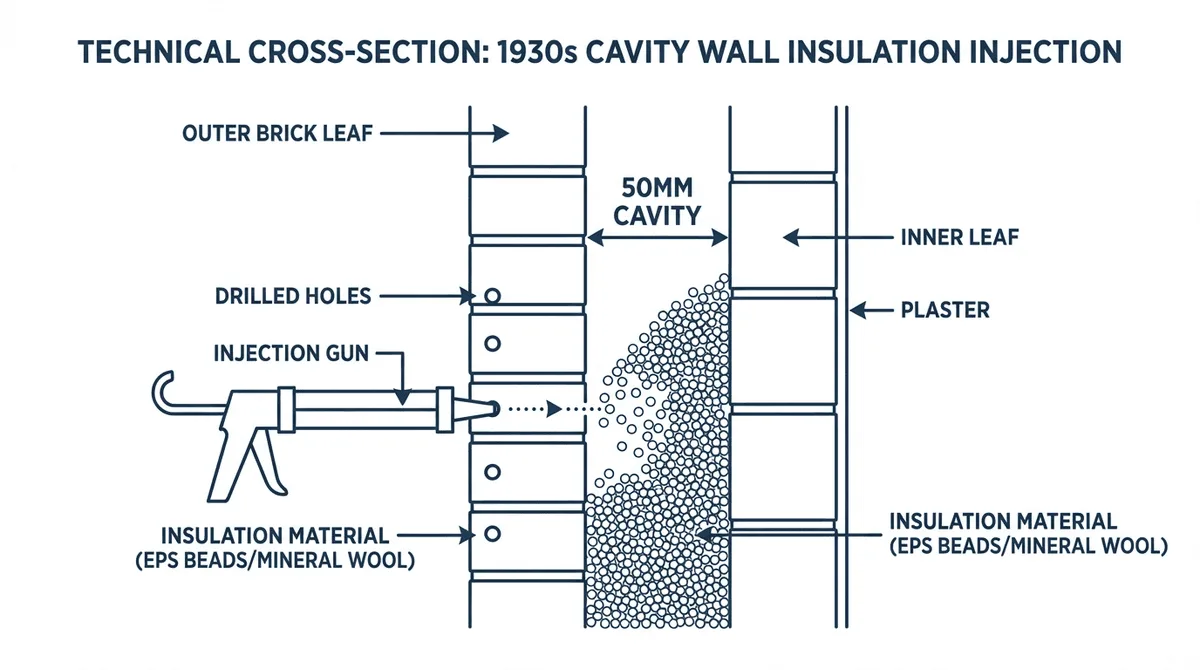
The most significant issue with 1930s semis is that cavity walls were left unfilled when built. The 50mm air gap provides some insulation, but filling the cavity with modern insulation material dramatically improves thermal performance. This is the single most cost-effective improvement available.
2. Original Single-Glazed Windows
Many 1930s semis still have original metal-framed Crittall windows or wooden sash/casement windows with single glazing. These are highly inefficient and draughty. Replacement with modern double glazing offers significant EPC improvement and tenant comfort benefits.
3. Draughty Bay Windows
The characteristic bay windows of 1930s semis are particularly prone to draughts due to their complex construction with multiple joints. The bay floor often has gaps where cold air can enter. Thorough draught-proofing of bays is essential for comfort and EPC improvement.
4. Poorly Insulated Loft
While lofts in 1930s semis are usually accessible, many have insufficient insulation, and even properties that have been upgraded may only have 100mm rather than the recommended 270mm depth.
5. Ageing Boiler and Controls
Many rental properties still have boilers that are 15-20 years old and well below current efficiency standards. Replacing an old G-rated boiler with a modern A-rated condensing boiler can gain 5-10 EPC points alone.
Recommended Upgrades
The good news for 1930s semi owners is that the improvements with the best EPC impact are also among the most cost-effective. Here are the recommended upgrades in priority order:
Priority Order for Maximum Impact
1930s Semi Upgrade Costs and EPC Impact
| Improvement | Low Estimate | High Estimate |
|---|---|---|
| Cavity Wall InsulationHighest priority. 8-12 EPC points. Quick installation. | £800 | £1,500 |
| Loft Insulation Top-up (to 270mm)Essential if below 270mm. 4-8 EPC points. | £400 | £600 |
| Condensing Boiler UpgradeIf boiler is 15+ years old. 5-10 EPC points. | £2,500 | £4,000 |
| Double GlazingWhole house replacement. 5-10 EPC points. | £4,000 | £8,000 |
| Smart Heating ControlsSmart thermostat + TRVs. 2-3 EPC points. | £200 | £400 |
| Draught ProofingWindows, doors, floors. 2-3 EPC points. | £150 | £300 |
| LED LightingReplace all bulbs. 1-2 EPC points. | £100 | £200 |
| Estimated Total | £8,150 | £15,000 |
Costs are indicative and vary by region, property size, and specification. Cavity wall insulation is typically the best value improvement. The total adds every measure; most 1930s semis need only some of them.
If your boiler is over 15 years old and you are considering a heat pump instead, the Boiler Upgrade Scheme can cover up to £7,500 toward heat pump installation.
Where those three improvements still leave you short of 69 points, the roof is the next thing worth pricing. A 1930s semi usually has an unbroken rear pitch, and we have looked at how much a solar array actually adds to a semi's score before you spend anything on it.
Should You Get Cavity Wall Insulation for a 1930s Semi?
Cavity wall insulation is typically the most cost-effective single improvement for a 1930s semi. The process involves drilling small holes in the outer wall and injecting insulation material to fill the cavity. The whole process usually takes less than a day for a typical semi.
Cavity Wall Insulation Materials Compared
| Feature | Mineral Wool | EPS BeadsRecommended | Foam (PU) |
|---|---|---|---|
| Typical Cost | 500 - 800 | 600 - 1000 | 800 - 1500 |
| Resulting U-Value | 0.35-0.45 W/m2K | 0.35-0.40 W/m2K | 0.30-0.35 W/m2K |
| Expected Lifespan | 25+ years | 25+ years | 25+ years |
| Drying Risk | Low (if dry) | Very Low | Very Low |
| Suitable for Exposed Walls | |||
| Typical Guarantee | 25 years | 25 years | 25 years |
EPS beads are the most common choice, offering good performance and moisture resistance. Foam provides the best insulation but at higher cost.
How Much Does It Cost to Upgrade a 1930s Semi EPC?
Most 1930s semis reach EPC C for £2,000 to £8,000 on indicative quotes. Part of that range sits above the £3,500 cost cap in force, and all of it sits below the £10,000 cap that has been proposed. As an indicative range, a D-rated semi at 55 points tends to need £2,000 to £5,000 of work (cavity wall plus loft top-up plus draught-proofing) to clear 69 points, and a starting E rating £5,000 to £10,000. A full retrofit including new windows and a heat pump runs £15,000 to £25,000. Get quotes before you rely on any of these figures. For detailed cost breakdowns and regional variations, see our complete cost guide.
Starting at D (55 points)
£2,000 - £5,000
Cavity wall insulation + loft top-up + minor improvements. Often sufficient to reach C without glazing or boiler upgrade.
Starting at Low D/E
£5,000 - £10,000
Likely needs boiler upgrade in addition to insulation measures. Still well within typical budgets.
Full Upgrade Package
£8,000 - £15,000
Comprehensive improvement including new windows, boiler, and all insulation measures. May achieve rating B.
How Do You Improve EPC on 1930s Bay Windows?
The bay windows that give 1930s semis their distinctive character are often the weakest point for heat loss. These areas require special attention during any upgrade programme.
Bay Window Issues
- !Multiple window units with many joints
- !Bay floor often uninsulated and draughty
- !Flat or sloped bay roof can leak heat
- !Difficult to draught-proof effectively
Recommended Fixes
- Replace with high-quality double glazing
- Insulate bay floor from below if accessible
- Insulate bay roof (internal or external)
- Thorough draught-proofing of all joints
Example Upgrade Pathway
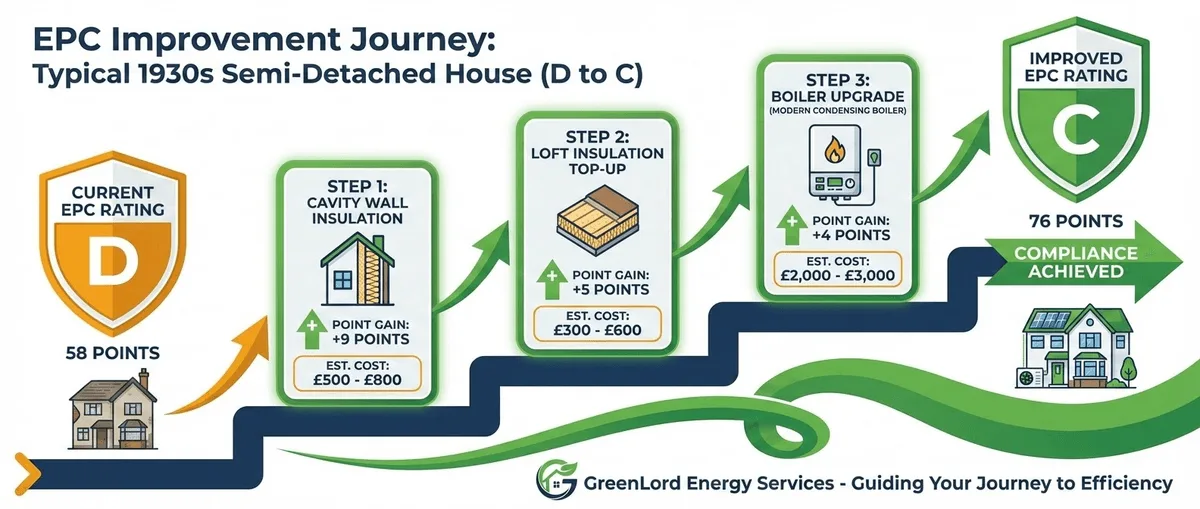
Here is a realistic example of how a typical 3-bedroom 1930s semi might progress from EPC rating D to C:
Case Study: 3-Bed 1930s Semi, Birmingham
Starting
D58 points
Target
C69 points
Note: This property did not require a boiler upgrade as the existing boiler was only 8 years old. Properties with older boilers may need to budget an additional £2,500-£4,000.
What Common Mistakes Should You Avoid?
How Do Costs and Grants Vary by Region?
1930s semi-detached properties fill suburbs across England and Wales, and installer prices and local grant support vary by region. Knowing your local market can shave hundreds of pounds off an upgrade.
Leeds & Yorkshire
Extensive 1930s suburban housing stock with competitive prices for cavity wall insulation. Good ECO4 participation and lower regional costs.
Leeds GuideBirmingham & West Midlands
Large stock of 1930s-60s properties with strong local authority support and competitive installer network for suburban properties.
Birmingham GuideNewcastle & North East
Lower regional costs and active council energy schemes make 1930s semi upgrades particularly cost-effective in the North East.
Newcastle GuideFrequently Asked Questions
Do all 1930s semis have cavity walls?
Most 1930s semi-detached houses built between 1930 and 1939 have a 50mm unfilled cavity wall. A small minority (roughly 5 to 10%, mostly early-1930s or regional builds) use solid 9-inch brickwork. A CIGA-registered installer can confirm with a borescope inspection in under 30 minutes before any work is committed.
How many EPC points does cavity wall insulation add to a 1930s semi?
Cavity wall insulation typically adds 8 to 12 SAP points on a 1930s semi with previously unfilled cavities. That is often enough on its own to lift a property from low D into C, particularly when combined with a loft top-up to 270mm. For 1930s stock, cavity wall insulation is typically the single highest-ROI improvement available.
Are 1930s semis eligible for ECO4 or the Warm Homes Plan?
Not usually. ECO4 closes on 31 December 2026, and privately rented homes qualify only if rated E, F or G with an eligible tenant and a package that includes solid wall insulation, first-time central heating, district heating or renewable heating, so cavity wall and loft insulation alone are not covered. Government has decided not to continue the Energy Company Obligation after it ends. Landlords with low-income tenants may be able to use Warm Homes: Local Grant in England for properties rated D to G. Check the grant checker to see which schemes apply to a specific property.
What is the minimum I need to spend to get a 1930s semi from D to C?
For a 1930s semi sitting at 55 to 62 SAP points (low to mid D), expect £2,000 to £5,000 on indicative quotes to reach EPC C. The lowest-cost pathway is cavity wall insulation (£800 to £1,500), loft top-up to 270mm (£300 to £600), draught-proofing (£200 to £400), and LED lighting (£100 to £200). A heating control upgrade often adds another 1 to 2 points for £150 to £300.
Will replacing the bay window improve the EPC rating?
Replacing single glazing or early double glazing on a bay window with modern A-rated units typically adds 2 to 4 SAP points. The cost is high (£3,000 to £6,000 for a typical bay), so windows usually come after cavity wall, loft, and draught-proofing on the priority list. Draught-proofing alone resolves much of the bay's heat loss for under £400.
Can a 1930s semi qualify for a cost cap exemption?
It is unlikely. A 1930s semi rated D or better already meets band E, which is the standard in force, so it needs no exemption today. Most reach EPC C for £2,000 to £8,000 on indicative quotes. Part of that range sits above the £3,500 cap in force and all of it sits below the £10,000 cap that has been proposed. Today the high-cost exemption applies where three quotes from qualified installers show that even the cheapest recommended measure would cost more than £3,500 including VAT. If you have made every improvement possible within the cap and the property is still below band E, you can register an 'all improvements made' exemption instead. Under the proposed rules that cap would become £10,000, or 10% of property value where the property is worth under £100,000, measured against band C. See the exemption checker for a property-specific assessment.
Next Steps
1. Check Your Current EPC
Find your existing EPC and note the current rating, score, and recommended improvements. This is your baseline for planning.
Find your EPC on GOV.UK2. Get a Cavity Wall Survey
Arrange a free survey from a registered installer to confirm your property is suitable for cavity wall insulation and get an exact quote.
Find CIGA-registered installers3. Calculate Your Costs
Use our calculator to get a personalised estimate based on your specific property details and current EPC rating.
Use the Cost Calculator4. Check for Grants
ECO4 closes on 31 December 2026 and privately rented homes qualify only in limited cases. Check Warm Homes: Local Grant through your council and the Boiler Upgrade Scheme for heat pumps before paying full price.
Learn about ECO4 funding