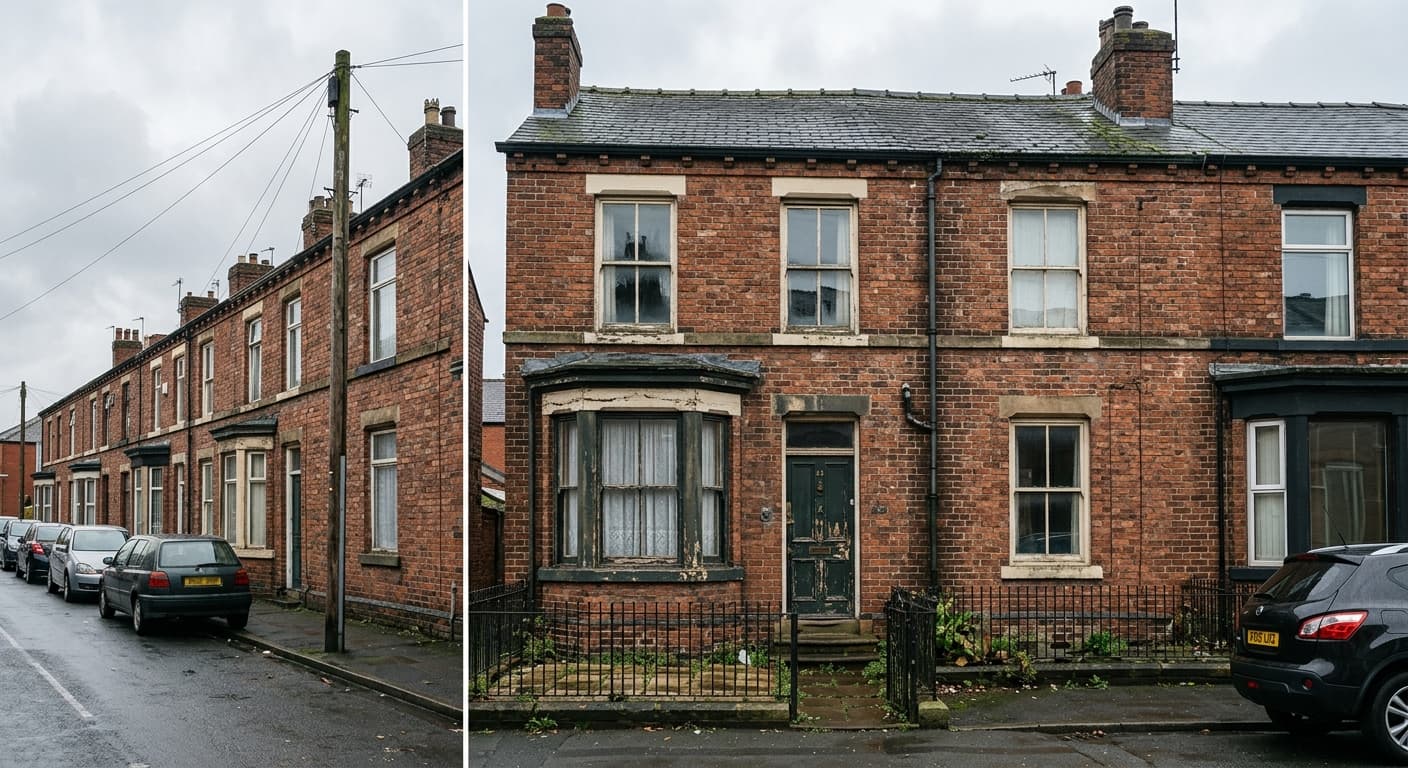
If your rental property has an EPC G rating, you cannot legally let it in England and Wales. G-rated properties have been banned from the private rented sector since 1 April 2020. Councils can fine you up to £5,000 per property, and a proposed rise to £30,000 is linked to the 2030 band C requirement. This guide sets out your legal position, what it costs to get compliant, and every grant currently available.
What Is an EPC G Rating?
An EPC G rating means the property scores between 1 and 20 on the Standard Assessment Procedure (SAP) scale. SAP runs from 1 to 100, and G is the lowest band. Properties in this range are the least energy-efficient homes in England and Wales.
| EPC Band | SAP Score | Legal Status for Landlords |
|---|---|---|
| A | 92–100 | Compliant |
| B | 81–91 | Compliant |
| C | 69–80 | Compliant (proposed 2030 target) |
| D | 55–68 | Compliant until 2030 |
| E | 39–54 | Current minimum, compliant |
| F | 21–38 | Illegal to let without a registered exemption |
| G | 1–20 | Illegal to let without a registered exemption |
SAP band definitions: Standard Assessment Procedure (SAP 10.2), DESNZ, 2012.
A G-rated property typically has one or more of: no loft insulation, solid uninsulated walls, single glazing throughout, and an old inefficient boiler or no central heating at all. Getting from a SAP score of 1–20 to band E (SAP 39) requires a larger uplift than an F-rated property. That is the key practical difference: G properties almost always need multiple measures, not a single fix.
EPCGuide's analysis of 27.6 million EPC records shows that 49.6% of homes in England and Wales are currently below EPC C. G-rated properties are the most extreme subset of that figure. They are not merely behind the 2030 target: they are already in breach of the law in force today.
Can You Rent Out a G-Rated Property?
No. The Minimum Energy Efficiency Standards (MEES) require all private rented properties in England and Wales to hold at least band E. This has applied to all tenancies, new and existing, since 1 April 2020. Letting a G-rated property without a valid registered exemption is a civil offence.
Renting without an exemption exposes you to:
- A civil penalty of up to £5,000 per property (current MEES regulations)
- A public record on the PRS Exemptions Register, visible to tenants and mortgage lenders for 18 months
- A compliance notice from your local council requiring evidence of EPC status
The only lawful route to continue renting a G-rated property is a valid exemption on the government's PRS Exemptions Register. Four grounds exist under current MEES regulations:
- High-cost exemption: The cheapest qualifying improvement costs more than £3,500 including VAT. Valid for five years.
- Third-party consent: A freeholder, lender, or tenant refused written consent for the works. Valid for five years.
- Devaluation: A chartered surveyor certifies the works would reduce the property's market value by 5% or more.
- Listed building: Works would unacceptably alter the building's character or appearance.
An exemption is a temporary deferral, not a solution. It does not make the property compliant, and you must still improve or sell before it expires. See the full EPC exemption guide and how to apply for an exemption.
What Are the Penalties for Renting a G-Rated Property?
Current MEES regulations allow councils to issue a civil penalty of up to £5,000 per property. The structure under MEES SI 2015/962, regulation 40 is:
| Breach Duration | Maximum Penalty |
|---|---|
| 3 months or less | £2,000 |
| Between 3 and 12 months | £4,000 |
| 12 months or more | £5,000 |
The government has proposed raising the maximum penalty to £30,000 from 1 October 2030, tied to the new band C requirement. This is not yet law. Primary legislation and a Statutory Instrument must be laid before it takes effect. See proposed EPC fines for landlords for the parliamentary status.
How to Get from G to E: The Minimum Legal Fix
The fastest route to compliance is to reach band E (SAP 39). For a G-rated property at the low end of the band (SAP 1–10), you need at least 29–38 points of uplift. For a property near the top of the G band (SAP 15–20), you need 19–24 points.
This almost always requires more than one measure. The most common combination for G-rated properties:
| Improvement | Typical Cost | Typical SAP Uplift |
|---|---|---|
| Loft insulation (if absent or under 100mm) | £300–700 | +5–10 points |
| Cavity wall insulation (if property has cavity walls) | £600–1,500 | +5–15 points |
| Solid wall insulation (external, if solid walls) | £4,000 to £14,000 | +10 to +20 points |
| High-efficiency condensing boiler with controls | £2,000–4,000 | +8–15 points |
| Air source heat pump | £12,908 median installed, before the grant (BUS, Apr to Jun 2026) | Varies by property |
| LED lighting throughout | £100–300 | +2–3 points |
Cost and SAP uplift estimates: Energy Saving Trust (EST), Checkatrade, and BEIS domestic energy fact sheets, 2026, except wall insulation, where the cost is the figure in the sample EPC in GOV.UK's landlord guidance for internal or external wall insulation (indicative). Actual uplift depends on the property's current SAP baseline and construction type.
A G-rated property with solid walls faces a harder path than one with cavity walls. Cavity wall insulation at £600 to £1,500 is far cheaper than solid wall insulation, which the sample EPC in GOV.UK's landlord guidance lists at £4,000 to £14,000 (indicative). Before commissioning any work, confirm your wall construction type with an EPC assessor: solid wall properties have different options and usually qualify for more substantial ECO4 funding.
The cheapest EPC improvements ranked by cost-per-SAP-point covers the full priority order for landlords.
How to Get from G to C: The 2030 Route
The government has proposed that all private rented properties must reach band C from 1 October 2030 (this is not yet law). For a G-rated property, reaching C means a SAP score of 69, an uplift of 49 to 68 points from the G band.
No single measure achieves this. The realistic route is:
- Reach band E now to stop the legal breach.
- Claim ECO4 or BUS funding while it is open.
- Upgrade the heating system (heat pump or high-efficiency boiler) as the next highest-impact measure.
- Add remaining insulation to reach C: loft, floor, and wall.
The full E-to-C upgrade guide for landlords covers stage two in detail once you have reached E.
Grants and Funding for G-Rated Properties
G-rated properties are the most likely to qualify for government funding: they represent the worst-performing stock and are a priority for every active scheme.
ECO4 (Energy Company Obligation, scheme 4)
ECO4 funds insulation, heating upgrades, and other efficiency measures. There is no set amount per property: the energy supplier decides how much to fund. Eligibility is tenant-gated: your tenant must receive qualifying benefits (Universal Credit, Housing Benefit, Pension Credit, and others) or be declared eligible by the local council under LA Flex. The scheme runs until 31 December 2026. If your tenant qualifies, this is the most urgent action available. See the full ECO4 grants guide and what happens when ECO4 ends.
Boiler Upgrade Scheme (BUS)
The BUS pays £7,500 toward an air source or ground source heat pump installation. Landlords are eligible and the scheme is not means-tested: you do not need a low-income tenant to qualify. A heat pump adds enough SAP points in most G-rated properties to carry you past band E and contribute significantly toward C. Apply through an MCS-certified installer. Full guide: BUS application for landlords.
Warm Homes Local Grant
The government announced the Warm Homes Local Grant scheme for 2025–26. It funds insulation and low-carbon heating in lower-income households via local authorities. Contact your local council directly: eligibility varies by area and scheme design is set locally. This is the main scheme available to G-rated landlords with qualifying tenants where ECO4 funding has been exhausted.
High-cost exemption as a bridge
If none of the above apply and the cheapest qualifying improvement costs more than £3,500, you can register a high-cost exemption for five years while you plan the upgrade. This is a holding position only, not a substitute for compliance.
Should You Sell or Upgrade?
For a G-rated property, the decision depends on wall construction type and proximity to the 2030 proposed deadline.
Cavity wall properties are usually worth upgrading: the route to E is achievable for under £3,500, ECO4 or BUS funding is often available, and the asset retains value after upgrade. Solid wall properties face higher costs and a longer timeline, but solid wall insulation also adds value and ECO4 frequently covers the bulk of it.
The sell-or-upgrade calculation changes if the property is in poor structural condition, if you hold it on short tenure, or if the tenant does not qualify for ECO4. See the full landlord sell-or-upgrade decision guide.
Frequently Asked Questions
Can I let a property with an EPC G rating if I have just bought it?
No. The legal minimum applies from the start of any new tenancy. If you have recently purchased a G-rated property, you cannot let it without either raising the rating to at least E or registering a valid exemption on the PRS Exemptions Register before the tenancy begins.
What is the cheapest way to move a G-rated property to band E?
It depends on wall construction. For a cavity wall property, loft insulation plus cavity wall insulation typically costs £900–2,000 and commonly delivers the 19–38 SAP points needed to reach E. For solid wall properties with no loft access, an efficient boiler upgrade (£2,000–4,000) combined with heating controls often achieves band E at least cost. An EPC assessor's pre-improvement projection will confirm the cheapest specific route for your property.
Does ECO4 cover G-rated properties?
Yes. Privately rented homes rated E, F or G can receive ECO4 measures, so a G-rated home meets the band rule and the key gate is your tenant: qualifying benefits, or a local council declaration under LA Flex. If your tenant qualifies, ECO4 can fund insulation, heating, and other measures. There is no set amount per property: the energy supplier decides how much to fund. The scheme closes 31 December 2026, so speak to an ECO4 installer well before that date.
Will the Boiler Upgrade Scheme bring my G-rated property to band E?
In most cases, yes: if the property has a functioning heating system. A heat pump adds 12–25 SAP points depending on the property. A G-rated property at SAP 15–20 often reaches band E from a heat pump installation alone. The BUS pays £7,500 toward the installation cost and is open to landlords without a means test. Apply through an MCS-certified installer.
What happens if my G-rated property's EPC exemption expires?
Once a high-cost or third-party-consent exemption expires, the legal requirement to reach band E reinstates immediately. You must either have improved the property to E before that date or register a new exemption with fresh grounds. Councils can begin enforcement proceedings as soon as the exemption lapses.
How long does it take to improve a G-rated property to band C?
The timeline depends on which measures are needed and how quickly funding is secured. Loft and cavity wall insulation can be completed within weeks. A heat pump installation typically takes 4–8 weeks from order to completion once funding is arranged. Solid wall insulation is a larger project: 6–12 weeks on site. A realistic timeline for a G-rated property reaching C is 6–18 months from the point of commissioning work, depending on property type and grant availability.