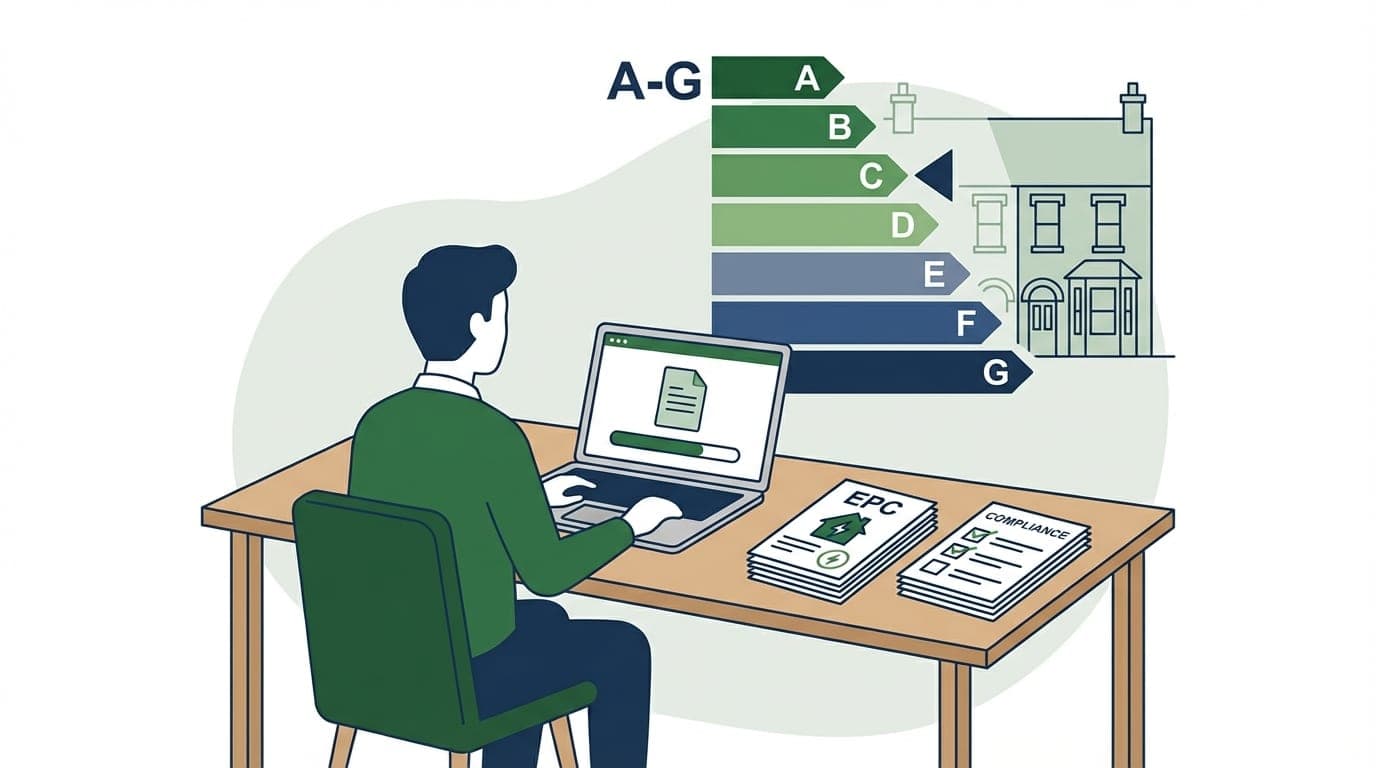
How to Register an EPC Exemption on the PRS Exemptions Register (Step-by-Step Guide for Landlords)
Landlords in England and Wales who cannot bring a rental property up to the minimum EPC standard must register an exemption on the government's PRS Exemptions Register at gov.uk/register-prs-energy-standard-exemption. There are six exemption types: High Cost, All Improvements Made, Third-Party Consent, Devaluation, Wall Insulation, and New Landlord. Registration is free, instant, and self-certified, but an unregistered exemption is no legal defence against a civil penalty of up to £5,000 in total per property.
The standard you must meet today is band E, and has been since 1 April 2020. Band D is legal to let. Government has proposed raising it to band C from 1 October 2030 with a £30,000 maximum penalty, but that is a policy intention and no legislation has been made.
If your rental property genuinely cannot reach EPC E, you need more than a reason. You need a registered exemption. Telling a council officer your freeholder refused permission, or that the works would cost too much, is not a legal defence. Only a formal entry on the PRS Exemptions Register protects you. Here is exactly how to register one correctly.
What Is the PRS Exemptions Register, and Why You Must Use It
The PRS Exemptions Register is the government's official database for landlords who cannot bring a rental property up to the minimum energy efficiency standard. It is administered by DESNZ and publicly accessible, and councils use it to verify compliance. If your property is below standard and you are not on the register with a valid exemption, you are in breach of the MEES regulations, regardless of the reason.
Registration is free, instant, and self-certified. But self-certification does not mean informal. The evidence requirements are prescribed in law, and enforcement authorities can challenge a registration if the documents are inadequate or the wrong exemption type was used. Getting it wrong leaves you exposed to a civil penalty of up to £5,000 in total per property.
Who needs to register an exemption?
Any landlord letting a domestic property in England or Wales that does not meet the minimum EPC standard, currently band E, must either bring the property up to standard or hold a valid registered exemption. There is no middle ground. If the proposed band C standard becomes law, EPCGuide's analysis of the full EPC register for England and Wales indicates that a significant share of rental properties would be unable to reach C within the cost cap, so exemptions would matter to far more landlords than they do now.
Can my letting agent register the exemption for me?
Yes. Letting agents can register exemptions on behalf of landlords via the same portal. The registration must record the landlord as the property owner. If your agent manages a portfolio of properties, this is worth delegating, but the landlord remains responsible for ensuring the evidence is correct and the exemption type is valid.
How Many Properties Are in Scope?
EPCGuide's analysis of 29.2 million EPC certificates for England and Wales shows that 55.4% of all certificated homes currently fall below band C. The properties directly affected by today's MEES minimum -- those rated F or G -- are a smaller subset, concentrated in pre-1919 solid-walled stock where insulation options are limited and improvement costs frequently exceed the £3,500 cap. Properties of this age and construction type are the most common candidates for the High Cost and All Improvements Made exemptions.
The 6 EPC Exemption Types for Landlords (Domestic Properties)
There are six exemption categories available to domestic landlords. Each has its own qualification criteria, evidence requirements, and duration rules. Choosing the wrong type, even if your underlying situation is valid, can result in a registration that fails enforcement scrutiny.
1. High Cost Exemption (Cost Cap Exemption)
Who qualifies: This exemption applies when there is no single recommended improvement that can be installed for less than the cost cap. The cap in force for EPC E compliance is £3,500 including VAT. Government has proposed a £10,000 cap alongside a band C standard, but that is not law and the figure you work to today is £3,500. If every improvement recommended on the EPC costs more than the cap, the High Cost Exemption applies.
Note that under the rules in force grant funding does not use up your £3,500 cap, so work paid for by ECO4 or another scheme does not bring you closer to a high-cost exemption. Under the proposed £10,000 cap, Boiler Upgrade Scheme money would not count, but other third-party funding, such as ECO4 or local grants, could.
Important distinction: If any improvement exists within cap cost, it must be installed first. If the property still fails to reach the standard after that installation, the correct exemption is "All Improvements Made" (see below), not High Cost. Selecting High Cost when cheaper improvements exist and haven't been installed is one of the most common registration errors.
Documents required:
- Three written quotes from different, qualified installers, each confirming the cheapest recommended improvement exceeds the cost cap (inc. VAT)
- Landlord's written confirmation they are satisfied the costs exceed the cap
- Valid EPC for the property
- Full property address
For a full breakdown of what works count toward the cap before you hit the limit, see our guide on which EPC improvements count toward the cost cap.
Duration: 5 years. At expiry, the landlord must re-attempt improvements. If costs still exceed the cap, a further exemption can be registered.
2. All Improvements Made Exemption
Who qualifies: This applies where all "relevant energy efficiency improvements", defined as measures recommended on the EPC that can be purchased and installed within the cost cap, have been installed, and the property still falls below the minimum standard. It also applies where no such measures exist at all (for example, a solid-walled property with no affordable insulation option).
Documents required:
- Valid EPC for the property (primary evidence, shows which improvements were recommended and the rating that remains after work)
- Contractor invoices and installation certificates if improvements have been carried out
- Any surveyor report listing measures attempted, if applicable
Duration: 5 years.
3. Third-Party Consent Refused
Who qualifies: Where energy efficiency improvements legally require the consent of a third party, that consent was formally sought, and was refused, or granted only on conditions the landlord cannot reasonably comply with. Third parties who commonly need to consent include:
- Freeholder or superior landlord, for leasehold flats requiring external wall insulation, heat pumps, or solar panels
- Local planning authority, for listed buildings or properties in conservation areas
- Mortgage lender, where the lease requires lender consent for structural modifications
- Current tenant, where works require access and agreement during an active tenancy
Leasehold flat landlords are the primary users of this exemption. Upgrading a flat in a converted Victorian property to EPC C often requires the freeholder's consent for external cladding or communal area modifications. If that consent is refused, this exemption applies. See our full guide on EPC for leasehold flats and our flat landlord EPC compliance guide.
Documents required:
- Correspondence or documentation showing that consent was required for the improvement
- Evidence of refusal, freeholder's written refusal letter, planning authority decision notice, or equivalent
- Valid EPC
- Full property address
Duration: 5 years, unless the third party refusing consent is your current tenant.
⚠️ Tenant consent exception: If the consent exemption is based on your current tenant refusing the works, the exemption expires when that tenant leaves, not after 5 years. You must carry out the improvement before starting the next tenancy. This is the most commonly misunderstood rule in the entire exemptions framework. Do not treat a tenant-based consent exemption as a standard 5-year protection.
4. Devaluation Exemption
Who qualifies: Where an independent surveyor advises that installing the recommended improvement(s) would reduce the market value of the property by more than 5%. This typically applies where adding external cladding to a period property, or structural modifications to a listed building, would materially reduce its market value.
Documents required:
- Report from an independent RICS-registered surveyor specifically quantifying that the recommended improvement(s) would devalue the property by more than 5%
- Valid EPC
- Full property address
The surveyor must be genuinely independent, not an advisor working in the landlord's interest on the same renovation project. The 5% threshold must be explicitly stated in the report; a general concern about value impact does not qualify.
Duration: 5 years.
5. Wall Insulation Exemption
Who qualifies: Where cavity wall insulation, external wall insulation, or internal wall insulation is recommended on the EPC, but a qualified expert confirms the installation would damage the fabric or structure of the property. This is most relevant for solid-walled period properties where external cladding or internal insulation would cause moisture or structural problems.
This exemption is commonly relevant to landlords owning listed buildings. See our guide on listed building EPC heritage exemption for the broader context.
Documents required:
- Written expert opinion from one of the following specifically accredited experts only:
- Architect on the AABC (Architect Accredited in Building Conservation) register
- Chartered building surveyor on the RICS Building Conservation Accreditation register
- Chartered engineer on the ICE/IStructE CARE (Conservation Accreditation Register for Engineers)
- Chartered architectural technologist on CIAT's Directory of Accredited Conservationists
- Alternatively: an independent installer of the wall insulation system under Schedule 3, Building Regulations 2010 (if no accredited expert is available)
- Valid EPC
- Full property address
⚠️ Accreditation matters: A general structural engineer's report does not qualify, however detailed or authoritative it reads. The regulations name specific accreditation registers. If your expert is not on one of those four registers, their report cannot support a Wall Insulation exemption. Verify accreditation before commissioning the report.
Duration: 5 years.
6. New Landlord Exemption
Who qualifies: A landlord who has recently acquired a property that does not meet the minimum energy efficiency standard. This exemption gives new landlords a 6-month grace period to assess the property and plan any necessary works, without being in immediate breach of MEES from the first day of letting.
You must register this exemption within 3 months of becoming the landlord of the property. If you acquired the property and began letting it without registering, you are not protected.
This exemption is separate from all the others, it is not an extension of the High Cost or All Improvements Made exemption. It exists specifically for the transition period when you take on a property and have not yet had the opportunity to assess what improvements are needed or engage with the registration process.
Documents required:
- Tenancy agreement showing the new letting date, or completion documents confirming the date the landlord acquired the property
- Valid EPC for the property (or confirmation that one has been commissioned)
Duration: 6 months only. At the end of the 6-month period, you must either bring the property up to the minimum standard or register a separate, substantive exemption (High Cost, All Improvements Made, Third-Party Consent, Devaluation, or Wall Insulation) with full supporting evidence. The New Landlord exemption cannot be renewed.
⚠️ Register within 3 months: The New Landlord exemption must be registered within 3 months of acquiring the property. If you miss this window, you cannot retrospectively claim the grace period. A new landlord who lets a below-standard property for more than 3 months without registering is in breach, not protected.
See our EPC exemptions complete guide for detail on how the New Landlord exemption interacts with the other five types.
How to Apply, 6 Steps to Register on the PRS Exemptions Register
The portal is free to use. Registration is instant. But you cannot save progress mid-application, have all documents ready before you start.
Before You Start, Documents to Prepare
Gather the following before opening the portal:
- EPC for the property, EPC certificate number or PDF
- Full property address
- Exemption-specific evidence, see the relevant exemption type above
- Installer quotes (PDFs), for High Cost exemption
- Expert reports (PDFs), for Devaluation or Wall Insulation exemptions
- Correspondence with third parties (PDFs), for Third-Party Consent exemption
- Invoices and installation certificates, for All Improvements Made exemption
Step 1: Go to https://www.gov.uk/register-prs-energy-standard-exemption and sign in or create a GOV.UK One Login account (updated May 2026, the previous prsregister.beis.gov.uk URL now redirects here). If you need assistance, the supported digital helpline is 0800 098 7950 (Mon-Fri 8am-6pm, Sat 9am-12pm).
Step 2: Enter the full property address so the system can link to existing EPC records for the property.
Step 3: Select the exemption type that matches your situation, do not select the nearest match; choose the correct type or the registration may fail enforcement scrutiny.
Step 4: Upload all required evidence documents for the exemption type you selected; the portal accepts PDFs and all documents must be uploaded in this session.
Step 5: Self-certify by confirming that the information provided is accurate and that you are satisfied the exemption applies.
Step 6: Submit, the exemption is registered immediately and appears on the publicly accessible register; there is no waiting period and the exemption applies from the moment of submission.
How Long Does an EPC Exemption Last?
| Exemption Type | Duration | Key Exception |
|---|---|---|
| High Cost (Cost Cap) | 5 years | Must re-attempt on expiry |
| All Improvements Made | 5 years | Must re-attempt on expiry |
| Third-Party Consent (general) | 5 years | Must re-attempt on expiry |
| Third-Party Consent (tenant only) | Until tenant leaves | Must improve before re-letting |
| Devaluation | 5 years | Must re-attempt on expiry |
| Wall Insulation | 5 years | Must re-attempt on expiry |
| New Landlord | 6 months | Must register within 3 months of acquisition; cannot be renewed |
On expiry: The exemption simply ends. There is no automatic renewal and the portal does not send reminders or alerts. The landlord must track their own expiry date. A landlord whose exemption quietly expires is immediately in breach, with no exemption in place, and exposed to fines for every day the property continues to be let below standard.
If the situation has not changed at expiry (the structural limitation still exists, the freeholder is still refusing consent), a new exemption can be registered immediately. There is no limit on the number of consecutive exemptions, provided the evidence still applies.
⚠️ Exemptions do not transfer on sale: If a property with a registered exemption is sold, the exemption ceases on completion of the transfer. The new owner must either bring the property to the minimum standard or register their own exemption. Buyers of non-compliant properties who assume they inherit the seller's registered status are in immediate breach from the date of purchase.
8 Common Mistakes That Invalidate Your EPC Exemption
-
Registering before gathering evidence. The exemption applies from the date of registration, but enforcement authorities can challenge it retroactively if documents are found to be inadequate. Gather full evidence before submitting, not after.
-
Selecting the wrong exemption type. Using High Cost when All Improvements Made should have been used, because some cheaper improvements exist but haven't been installed, applies the wrong threshold test. Enforcement authorities audit exemption types against the evidence uploaded.
-
Getting quotes from non-independent installers. The High Cost exemption requires three quotes from different qualified installers. Quotes from the same company trading under different names, or exclusively from the landlord's regular contractor, can be challenged.
-
Using a non-accredited expert for the Wall Insulation exemption. The specific accreditation registers (AABC, RICS Conservation, CARE, CIAT) are prescribed by regulation. A general structural engineer's report, however authoritative, does not satisfy the requirement.
-
Treating a tenant consent exemption as a 5-year exemption. If the Third-Party Consent exemption was registered because the tenant refused to allow the works, it expires when that tenant leaves, not after five years. Re-letting without carrying out the improvement is a breach.
-
Not registering at all, assuming a verbal reason is a legal defence. The most common and most costly mistake. "My freeholder won't allow it" is not a defence. The exemption must be on the register before the property is let or continues to be let below standard.
-
Assuming the exemption transfers to a new buyer. Buyers of non-compliant properties must register their own exemption. The previous owner's entry on the register does not carry over.
-
Letting the exemption expire without tracking the date. No reminders are sent. Set a calendar reminder five years from registration date and reassess the property's compliance position before the exemption lapses.
EPC Exemptions Under the Proposed 2030 Band C Rules
The exemption framework described on this page applies to the standard in force: EPC E. Government has proposed raising the minimum to EPC C from 1 October 2030, applying to all tenancies, new and existing. That is confirmed policy from the January 2026 government response, but it is not yet law: it requires primary legislation and a statutory instrument amending the Energy Efficiency (Private Rented Property) (England and Wales) Regulations 2015, neither of which has been made.
If the legislation passes as described, the pool of landlords needing exemptions would increase substantially. Under the proposed rules, the key changes to the exemption framework are:
| Rule | In Force Today | Proposed from 1 October 2030 |
|---|---|---|
| Minimum standard | EPC E | EPC C |
| Cost cap | £3,500 inc VAT | £10,000 inc VAT |
| Qualifying spend start date | N/A | 1 October 2025 |
| Maximum penalty for non-compliance | £5,000 total per property | £30,000 per property |
| Exemption categories | 6 (as above) | Same 6 categories |
What this means for landlords planning ahead: If you are spending on MEES-relevant improvements now, keep all invoices and installation certificates. Under the proposed rules, expenditure on qualifying improvements from 1 October 2025 would count toward the £10,000 cap, even though the new standard does not apply until 2030.
What does not change: The six exemption types, the GOV.UK registration portal, and the evidence requirements all apply under the current rules and are expected to carry over. If you register an exemption today against the E standard, it runs to its expiry date regardless of any future legislative change -- a valid registered exemption remains legally effective for its full duration.
For a full breakdown of the proposed 2030 changes, see our EPC C deadline 2030 guide for landlords.
What Are the Penalties for an Unregistered EPC Exemption?
If a local authority identifies that a property is being let below the minimum standard without a valid registered exemption, it can issue financial penalties. For full details, see our complete guide to EPC fines for landlords.
Penalties in force (EPC E standard):
| Breach | Maximum Fine |
|---|---|
| Letting below EPC E for less than 3 months | £2,000 |
| Letting below EPC E for 3 months or more | £4,000 |
| Providing false or misleading information to the register | £1,000 |
| Failing to comply with a compliance notice | £2,000 |
The single most misreported point about MEES penalties: these tiers are components of a £5,000 total per property, not additions to it. A local authority can impose more than one for the same property, but the combined maximum is £5,000 in total per property, across all breaches. There is no version of the current rules under which one property attracts more than £5,000.
Proposed: alongside the band C standard, government has proposed raising the maximum penalty to £30,000. That figure needs legislation that has not been made, so no landlord can currently be fined £30,000 under MEES. Penalties are assessed per property, so a portfolio landlord's exposure scales with the number of non-compliant properties either way.
The Publication Penalty, the Fine You Don't See Coming
Every financial penalty comes with a publication penalty: a public record of the breach on the local authority register, including the landlord's name, property address, and the nature of the breach. This record must remain visible for at least 12 months. It is visible to prospective tenants, mortgage lenders, and managing agents. For portfolio landlords, it can affect financing and tenant attraction across multiple properties.
Are Councils Actually Enforcing MEES?
Yes. Councils do not wait for complaints: they conduct proactive audits of EPC-registered properties and issue compliance notices directly, using the register to identify properties let below band E. Enforcement is likely to intensify if the proposed band C standard becomes law, because the pool of non-compliant properties would grow sharply.
Frequently Asked Questions
Do I need to register an EPC exemption for every property?
Yes, separately, for each individual property. An exemption registered for one property does not apply to any other, even if they have identical structural characteristics. Each property address requires its own registration and its own supporting evidence.
Can my letting agent register the exemption on my behalf?
Yes. Letting agents can use the PRS Exemptions Register portal to register on a landlord's behalf. The registration must record the landlord as the property owner. The landlord remains legally responsible for ensuring the exemption type is correct and the evidence is adequate, delegation to an agent does not transfer liability.
What happens when my EPC exemption expires?
The exemption ceases on the expiry date. The portal sends no reminders. You must re-assess the property: if the situation has changed (for example, a new product is now available within the cost cap, or the freeholder has changed their position), you may now be able to bring the property to the minimum standard. If the situation is unchanged, you can re-register the same exemption with updated evidence. There is no penalty for registering consecutive exemptions, provided each registration is supported by current, valid evidence.
Does an EPC exemption transfer to a new owner?
No. Exemptions are attached to the landlord, not the property. If you sell a property with a registered exemption, the exemption ceases on completion. The buyer must either bring the property to the minimum standard or register their own exemption before letting it. This is critical for buyers of non-compliant investment properties, always check the EPC rating and assess compliance obligations before exchange.
Can I register an exemption if I haven't had the EPC assessment done yet?
No. A valid EPC for the property is a required document for every exemption type. The EPC identifies the recommended improvements and the property's current rating, both of which are needed to determine which exemption applies and to provide the primary evidence for the registration. Commission an EPC assessment first, then gather the exemption-specific evidence.
Is there a fee to register on the PRS Exemptions Register?
No. Registration is completely free. The portal charges no fee for submitting an exemption or for any number of properties registered under a single account.
I just bought a rental property below EPC E. Am I automatically in breach?
Not immediately, provided you act quickly. There is a New Landlord exemption that gives you a 6-month grace period from the date you became the landlord. You must register it within 3 months of acquiring the property at gov.uk/register-prs-energy-standard-exemption. Evidence needed: a tenancy agreement or completion documents showing the date you took on the property. The grace period cannot be renewed, so use the 6 months to assess what improvements are needed and register a substantive exemption before it expires.
Is the PRS Exemptions Register Publicly Searchable?
Yes. The register is publicly accessible. Anyone, including local authority enforcement officers, tenants, and prospective buyers, can search it by property address at gov.uk/find-prs-energy-standard-exemption. A valid exemption appears on the public register immediately on submission. If you are a prospective buyer of a non-compliant property, always check the register before exchange: the exemption does not transfer on sale, and the absence of an entry means the new owner would be immediately in breach on the first day of letting.
Can a Tenant Challenge My EPC Exemption?
A tenant cannot directly dispute a registration through the portal. However, a tenant who believes a property is being let below the minimum standard without a valid exemption can complain to their local authority. The council can then investigate, including scrutinising the evidence behind a registered exemption. If the council finds the exemption was registered with inadequate documentation or the wrong exemption type, it can still issue a penalty notice even though an entry exists on the register. A registration does not protect against enforcement if the supporting evidence does not hold up.
What Happens If the Council Challenges My Exemption or Issues a Penalty Notice?
You can appeal a penalty notice to the First-tier Tribunal (Property Chamber) within 28 days of the notice date. A correctly registered exemption with complete supporting documentation is your strongest defence at tribunal. The most common reasons an exemption fails at appeal are: wrong accreditation on a wall insulation expert report, quotes from a single contractor for the High Cost exemption, or a tenant-consent exemption that was not updated when the original tenant left. If you receive a compliance notice or penalty notice, take legal advice before the 28-day deadline passes.
Register Your EPC Exemption Now
If your property cannot reach the minimum energy efficiency standard of band E, a registered exemption is your legal protection. An unregistered exemption is no protection at all. If the proposed band C standard becomes law, the same register and the same six exemption types are expected to carry the burden.
Register on the PRS Exemptions Register →
Not sure whether you need an exemption or whether improvements are still possible? Use our cost calculator to estimate upgrade costs, or read our guide to the EPC C Deadline 2030 first, then return here when you're ready to register.