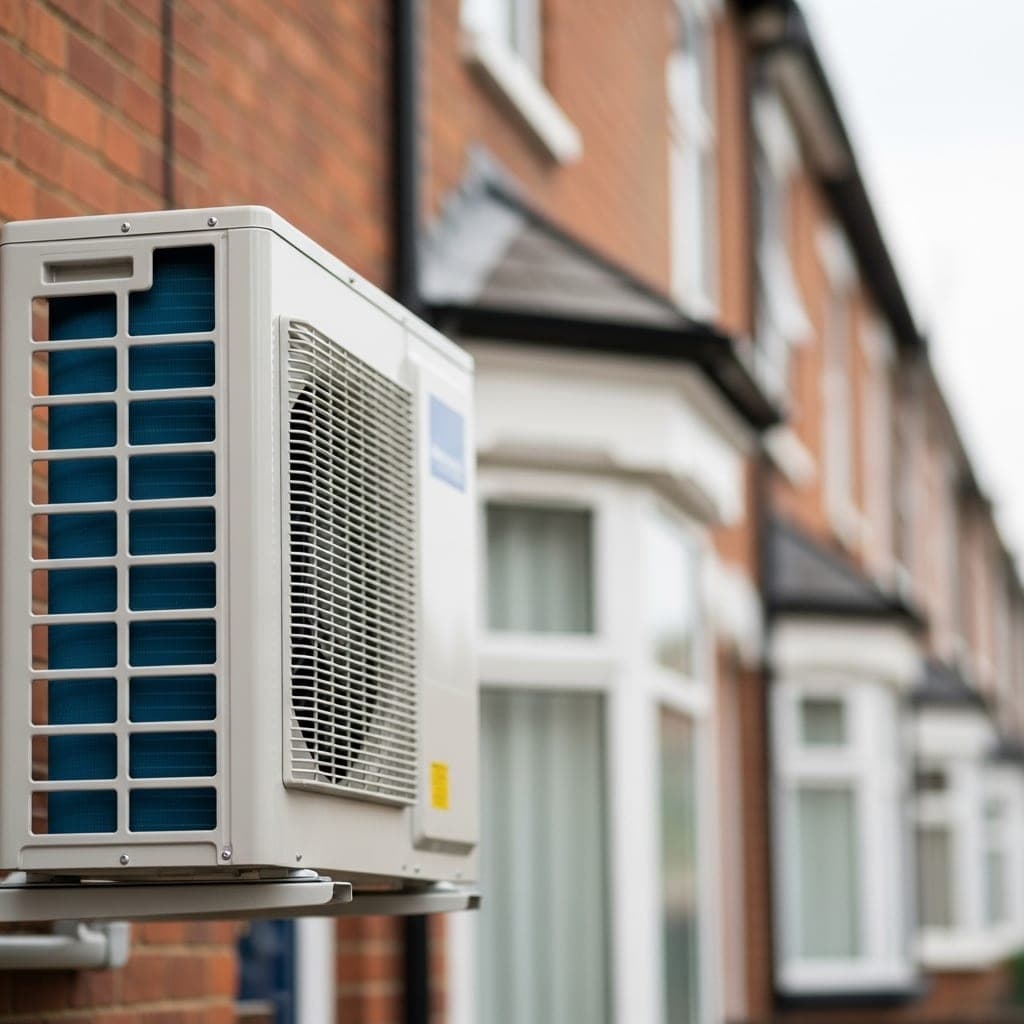
Landlords do not apply for the Boiler Upgrade Scheme directly. Your MCS-certified installer submits the application to Ofgem on your behalf, and the £7,500 grant comes off your installation invoice before you pay a penny. Your job is to choose the right installer, sign a consent email within 14 days, and hold onto the paperwork that protects you if anything goes wrong.
That sounds simple. It is not. Applications fail on avoidable errors: an unanswered consent email, wrong installer certification scope, or a product that sits on the Product Eligibility List but fails a secondary BUS check. This guide walks through the process as it stands in August 2026, after the Boiler Upgrade Scheme (England and Wales) (Amendment) Regulations 2026 came into force on 28 April, removing the EPC requirement and extending the scheme to 2030.
Key Facts
- Grant value: £7,500 for air source or ground source heat pumps, £5,000 for biomass boilers (England and Wales only).
- Who applies: Your MCS-certified installer. Property owners cannot apply directly.
- EPC requirement: Removed from 28 April 2026. A valid EPC is still the simplest evidence, but where none exists the installer supplies an alternative. There has been no minimum band requirement since May 2024.
- Loft and cavity insulation pre-requirement: Removed. Your installer assesses insulation adequacy at survey instead.
- Consent window: You must respond to Ofgem's consent email within 14 days or the application is rejected.
- Installation window: 3 months for air source heat pumps, 6 months for ground source heat pumps.
- Post-installation deadline: Installer must submit the application within 120 days of commissioning.
- Scheme end date: 2030, extended from 2028 by the 2026 Amendment Regulations.
- Per-property cap: One grant per property, no portfolio cap, so a five-property landlord can claim up to £37,500.
What Is the Boiler Upgrade Scheme Application Process?
The Boiler Upgrade Scheme (BUS) is an installer-led grant. According to Ofgem's Property Owner Guidance V5 (March 2026), the installer is responsible for checking eligibility, submitting the voucher application, and redeeming it after installation. The landlord sits in the middle: you confirm consent, sign off the quote, and give installation access.
This is different from grants like ECO4 or the upcoming Warm Homes Plan, where funding flows through an obligated energy supplier. BUS funding flows through the installer directly from Ofgem. That means the installer carries the risk if the application is rejected, and it means your installer choice is the single most important decision in the process.
How Does a Landlord Apply for the Boiler Upgrade Scheme Step by Step?
The full journey from first quote to post-installation grant redemption takes roughly 8 to 14 weeks in 2026. The steps:
- Check your EPC. Since 28 April 2026 an EPC is no longer a condition of eligibility, but a current one is still the cleanest evidence and saves your installer assembling alternatives. A new assessment costs £60 to £120.
- Shortlist MCS-certified installers. Use the MCS-certified installer finder to filter by heat pump type and postcode. Get three quotes minimum.
- Check certification scope. An installer's MCS certification must cover the specific technology they are installing (air source, ground source, or biomass). Certification for solar PV alone is not enough.
- Ask about BUS experience. Ask each installer how many BUS applications they have submitted in the last 12 months and what their rejection rate is. Installers under 10 submissions are higher risk.
- Sign the quote and consent form. The installer begins the Ofgem application. You will receive a consent email from Ofgem asking you to confirm the installer is acting on your behalf.
- Respond to the consent email within 14 days. This is the single most common rejection cause. The email lands in junk folders regularly. Whitelist Ofgem or check daily for two weeks after signing the quote.
- Wait for the voucher. Ofgem issues the voucher to the installer once consent is confirmed. The voucher locks in your grant amount and sets the installation deadline clock.
- Complete installation within the voucher window. Air source heat pumps must be commissioned within 3 months of voucher issue, ground source within 6 months. Biomass within 3 months.
- Notify your tenant before access. Give written notice well ahead of the installation days. The statutory 24-hour notice attached to Section 11 repair access does not cover voluntary upgrades, so you are relying on the tenant's agreement and should ask early rather than assume a right of entry.
- Installer redeems the voucher. Within 120 days of commissioning, your installer submits the final redemption claim with the MCS certificate. Ofgem pays the installer, who applies the discount to your invoice.
What Documents Do I Need for a BUS Application?
The landlord does not submit documents directly, but your installer will request the following before starting the application:
- Current EPC if you have one, or the alternative evidence your installer asks for (typically a recent fuel bill plus photographs of the existing heating system).
- Proof of ownership, usually an HM Land Registry title extract or recent council tax bill.
- Evidence you are the landlord if applicable: a recent tenancy agreement or gas safety certificate in your name.
- Existing heating system details: fuel type, boiler age, and flue location for fossil-fuel replacement checks.
- Property access arrangements: tenanted properties need a clear handover plan for installation days.
For portfolio landlords applying across multiple properties, Ofgem allows separate applications per property but flags linked submissions where the same landlord name appears. Each property is assessed independently. There is no portfolio review or volume scrutiny beyond standard checks.
Why Are BUS Applications Rejected?
Ofgem's installer guidance and the scheme rules point to six common failure points:
- Missed consent email. The Ofgem consent email is rejected if you do not respond within 14 days. It ends up in spam more often than not.
- Non-MCS installer. Installers must hold MCS certification covering the technology being installed. Installers lapse. Ask for a current certificate number.
- Product on PEL but BUS-ineligible. A heat pump can be on the Product Eligibility List (PEL) yet fail BUS for a secondary reason, usually MCS standards compliance at the model level. Ask the installer to confirm BUS eligibility, not just PEL listing.
- Retained fossil fuel system. You cannot keep the old gas boiler as a backup alongside a BUS-funded heat pump. The old system must be removed or permanently decommissioned.
- Post-commission application beyond 120 days. Once the heat pump is commissioned, the installer has 120 days to submit the redemption claim. Miss this and the grant is forfeit.
- Location outside England or Wales. Scotland uses Home Energy Scotland grants, not BUS. Northern Ireland has no BUS equivalent. See the Scottish landlord EPC rules for the Scotland route.
Two previously common rejection causes have gone: the missing or expired EPC, and outstanding loft or cavity wall insulation recommendations on the EPC. Landlords whose properties failed either check before 28 April 2026 can now reapply.
How Does BUS Interact With Other Landlord Grants?
Landlords can combine BUS with complementary schemes but not with overlapping heat pump grants:
- BUS + ECO4: Allowed until ECO4 closes in December 2026. ECO4 typically funds insulation and low-income heating, BUS funds the heat pump. See the ECO4 closure guide for timing.
- BUS + Warm Homes Local Grant: Allowed where scope does not overlap. Local grant typically covers insulation, BUS covers the heat pump. Read the Warm Homes local grant guide for eligible local authorities.
- BUS + the MEES cost cap: the cap in force is £3,500 including VAT, not the £10,000 figure government has proposed. Under the rules in force, grant money sits outside it. GOV.UK says that where third-party funding covers the full cost of the improvements, "the cost cap does not apply", and where it covers part, a landlord "may need to top up with your own funds to the value of the cost cap". Under the proposed £10,000 cap, Boiler Upgrade Scheme money would not count, but other third-party funding, such as ECO4 or local grants, could. Keep the invoice showing both gross cost and grant discount so your own spend is evidenced. See how the cost cap works.
- BUS + Air to Air Heat Pump Grant: Separate scheme. You cannot claim both for the same property, but you can use air to air for one property and BUS for another. See the air-to-air grant guide.
How long does BUS last?
To 2030. The 2026 Amendment Regulations pushed the end date out from 2028, so the old scarcity argument for rushing an application has gone. What has not gone is the risk to the grant value: £7,500 is set by regulation and a later statutory instrument could change it. The government has signalled through the Warm Homes Plan that future funding leans towards whole-property decarbonisation rather than single-measure grants.
Worth separating from the timing question: the proposed band C requirement for 2030 is not law. Government said in January 2026 that it intends to raise the private rented minimum to C from 1 October 2030, but that needs an Act of Parliament and then a statutory instrument amending the 2015 Regulations, and no such instrument has been laid. The minimum in force is band E. A heat pump is worth doing on running costs, tenant appeal and asset value; treat the band C date as a planning assumption rather than a deadline you are already late for.
Frequently Asked Questions
Can a landlord apply directly to Ofgem for BUS? No. The Boiler Upgrade Scheme is installer-led. Only an MCS-certified installer can submit a BUS application. The landlord's role is to sign the consent email from Ofgem within 14 days of application submission.
Does BUS count toward the MEES cost cap? No, and the cap is not £10,000. The cap in force is £3,500 including VAT; £10,000 is proposed and not yet law. Under the rules in force, grant money does not count against the £3,500 cap: GOV.UK guidance says that where funding covers the full cost of the improvements "the cost cap does not apply", and where it covers part, a landlord "may need to top up with your own funds to the value of the cost cap". Under the proposed £10,000 cap, Boiler Upgrade Scheme money would not count, but other third-party funding, such as ECO4 or local grants, could. Your own out-of-pocket spend is what counts either way, so keep invoices showing gross cost and grant discount separately.
How long does the full BUS application take? From signing the quote to grant paid, typically 8 to 14 weeks. Voucher issue takes 2 to 4 weeks after consent, installation takes 4 to 8 weeks, and redemption takes 2 weeks after commissioning.
Do tenants need to consent to the installation? Tenants do not need to consent to the grant application itself, but you must give 24 hours written notice before installation access and provide reasonable accommodation during the works. If a tenant refuses access unreasonably, seek legal advice before escalating, as the tenant refuses EPC works guidance applies.
Can I apply for BUS on a property I have just bought? Yes, as soon as you complete the purchase and are listed as the legal owner. An MCS installer will request proof of ownership, so wait until the Land Registry shows you as the current proprietor. This usually takes 2 to 6 weeks post-completion.
What if my installer goes bust mid-application? The voucher is tied to the installer. If they cease trading before commissioning, the voucher is cancelled. You must find a new MCS installer and start a new application, subject to the usual eligibility checks. Insurance-backed MCS schemes can sometimes transfer the contract, so check with MCS directly.
Is there a BUS grant for HMOs? Yes. An HMO with a single heating system being replaced is eligible for one grant. Separately-metered units that are treated as individual dwellings can each claim one. See the HMO EPC requirements guide for how this interacts with MEES.
Can I combine BUS with solar panels? Yes. Solar panels are not covered by BUS but are allowed alongside a BUS-funded heat pump. Solar can significantly reduce heat pump running costs for tenants, which is increasingly valuable for rental retention. See the solar panels EPC guide for EPC impact.