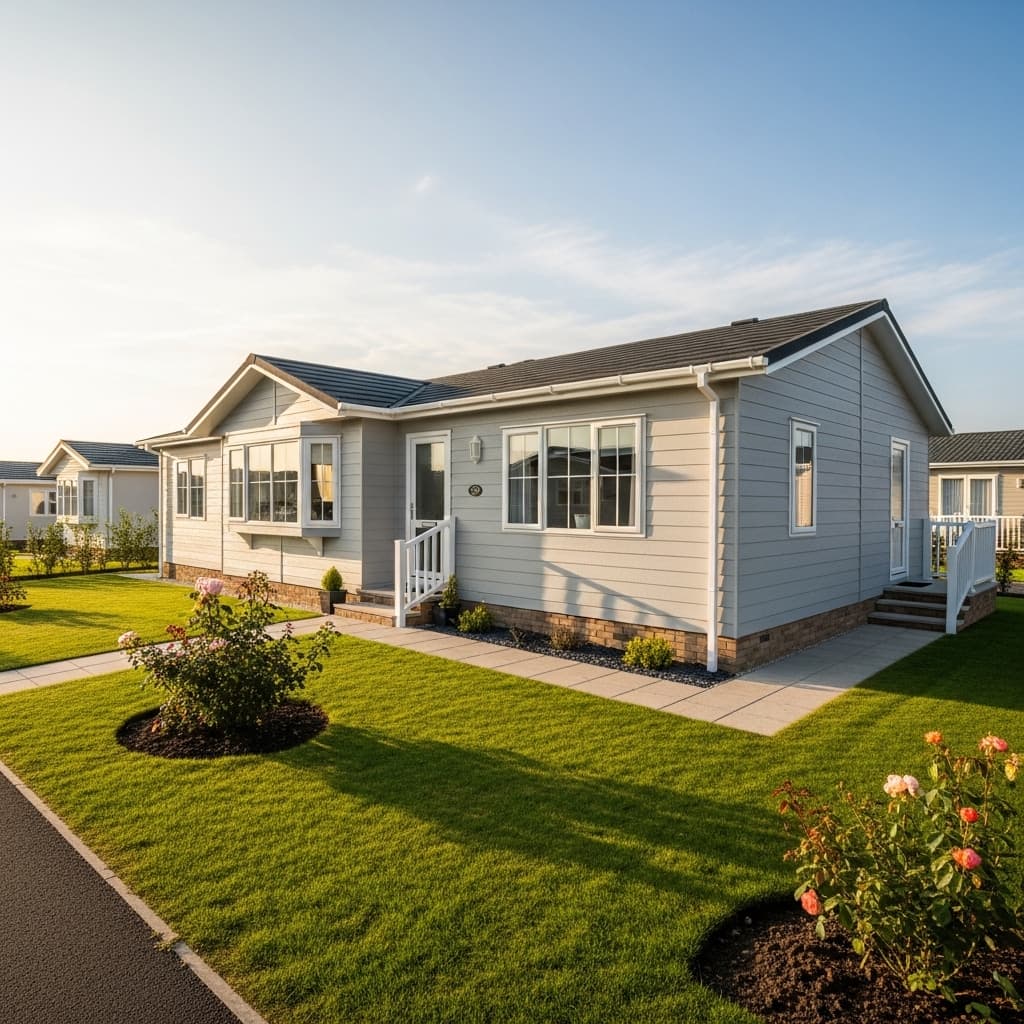
Park homes do not need an Energy Performance Certificate (EPC) in England and Wales. They are classified as a type of caravan under the Caravan Sites and Control of Development Act 1960, which places them outside the property types covered by the Energy Performance of Buildings regime. Because MEES regulations only apply to properties legally required to hold an EPC, park homes are also outside the scope of MEES compliance, and outside the band C standard government has proposed for 2030.
What Is a Park Home?
A park home is a prefabricated residential dwelling permanently sited on a licensed residential park. In law it is defined as a caravan under Part 1 of the Caravan Sites and Control of Development Act 1960. That definition distinguishes park homes from conventional buildings: park homes are not land-registered in the same way as houses and flats, and the standard rules designed for conventional property tenure generally do not apply to them.
Park homes used as permanent residences are regulated under the Mobile Homes Act 1983 and its amendments. The site owner holds the land; the park home resident holds a pitch agreement. This arrangement sits entirely outside the EPC framework.
Do Park Homes Need an EPC Certificate?
No. Park homes are exempt from the requirement to obtain or display an Energy Performance Certificate. The Energy Performance of Buildings (England and Wales) Regulations 2012 require an EPC when a building is constructed, sold, or let. Park homes, classified as caravans rather than buildings, do not fall within those triggers.
This means:
- You do not need an EPC to let a park home to a resident
- You do not need one to sell a park home
- You are not required to obtain one when a park home pitch changes occupant
Some estate agents handling park home sales have asked sellers to provide an EPC. This is incorrect practice. Park homes are exempt, and any such request can be challenged directly.
Why Are Park Homes Exempt from EPC Rules?
The EPC regime was built around conventional buildings with fixed foundations and land registry entries. Park homes have neither. They are manufactured structures, typically steel-framed, placed on a pitch rather than embedded in the ground in the conventional sense.
The Energy Performance of Buildings Regulations apply to "buildings". Because park homes are legally caravans under the 1960 Act, they do not meet that definition. There is also no technical pathway within the RdSAP or SAP assessment methodology to generate a valid EPC for a mobile home structure in the way that applies to a house or flat.
Do Park Home Landlords Need to Meet MEES?
No. The Minimum Energy Efficiency Standards (MEES) regulations only apply to privately rented properties that are legally required to hold an EPC. Since park homes are exempt from the EPC requirement, they sit entirely outside MEES.
This means:
- The EPC band E minimum that has applied to lettings in England and Wales since 1 April 2020 does not apply to park homes
- The band C standard government has proposed for 1 October 2030, which is announced policy and not yet law, would not apply to park homes either
Park home landlords are also not required to register on the PRS Exemptions Register. That register exists for properties that fall within MEES but cannot reach the required standard. Park homes do not fall within MEES at all.
For context on the scale of the EPC compliance challenge facing standard landlords: EPCGuide's analysis of 27.6 million EPC certificates covering 19.7 million homes shows that 49.6% of all residential properties in England and Wales currently sit below EPC C. That compliance gap is what drives the MEES regime. It does not affect park homes.
When Does a Park Home Need an EPC? The Holiday Let Exception
There is one scenario where a park home requires an EPC: if it is let as holiday accommodation for more than four months in any 12-month period.
This applies where the letting is on a commercial holiday basis rather than as a permanent residence:
- Permanent residential letting under a pitch agreement: no EPC needed
- Short-term holiday letting for under four months a year: no EPC needed
- Holiday accommodation let for more than four months a year: an EPC is required
If your park home falls into the third category, the standard domestic EPC process applies. You would need to arrange an assessment with a qualified domestic energy assessor.
Park Homes and Energy Efficiency Grants
Being outside the EPC regime does not mean park homes are cut off from energy support. ECO4 (closes 31 December 2026) and the Warm Homes Local Grant both include provisions for park homes, though the assessment route differs.
Because park homes have no standard EPC, grant assessors use an equivalency process instead. The home is assessed to determine whether its energy performance is equivalent to EPC band D, E, F, or G. If it qualifies, the occupant may be eligible for funded improvements: insulation, heating upgrades, or draught-proofing.
Key points for park home landlords considering grants:
- ECO4 eligibility is gated on the occupant's income or benefit status, not the landlord's
- An energy assessor with experience in park homes carries out the equivalency assessment
- The Warm Homes Local Grant runs through local councils and availability varies by area
- ECO4 closes 31 December 2026; the Warm Homes Plan succeeds it from 2027
For more detail on what replaces ECO4 and how grant eligibility will work from 2027, see our Warm Homes Plan guide for landlords.
What This Means for Park Home Landlords
If you let a park home as a permanent residence, you have no EPC obligation now, and none under the band C standard proposed for 2030 if that proposal is legislated. You do not need to register any exemption and you are free to let regardless of the home's energy performance, subject to normal tenancy rules under the Mobile Homes Act.
One area worth clarifying: if you own a timber lodge, log cabin, or similar structure, the exemption may not apply automatically. If the structure sits on a fixed foundation, carries a land registry entry, and does not meet the legal definition of a caravan under the 1960 Act, it may be treated as a conventional building and subject to standard EPC rules. A domestic energy assessor can confirm which regime applies.
For a broader look at which properties sit outside the EPC requirement, our complete guide to EPC exemptions for landlords covers listed buildings, temporary structures, and holiday lets in full. If your situation involves a property within MEES that genuinely cannot reach the required standard, see our guide on how to apply to the EPC exemption register. For comparison with another property type with its own specific compliance requirements, the listed building EPC exemption sets out how heritage properties are handled.
Frequently Asked Questions
Do park homes count as residential property for MEES purposes? No. MEES regulations apply to privately rented properties legally required to have an EPC. Park homes are exempt from EPC requirements under the Energy Performance of Buildings (England and Wales) Regulations 2012, so they fall outside MEES entirely. The band C standard proposed for 2030 would not apply to them either.
Can I let a park home without an EPC? Yes. Park homes are exempt from the requirement to hold an Energy Performance Certificate. You do not need an EPC to let a park home as a permanent residence in England and Wales.
What is the legal basis for the park home EPC exemption? Park homes are classified as caravans under Part 1 of the Caravan Sites and Control of Development Act 1960. The Energy Performance of Buildings (England and Wales) Regulations 2012 require EPCs for buildings. Park homes fall outside that definition, so the requirement does not apply.
Do park homes qualify for energy efficiency grants? Yes, in some cases. ECO4 (closes 31 December 2026) and the Warm Homes Local Grant both include park homes. Because they have no standard EPC, an equivalency assessment is used to establish eligibility based on energy performance band.
Do I need to register a MEES exemption for my park home? No. The PRS Exemptions Register is for properties that fall within MEES but cannot meet the required standard. Park homes fall outside MEES entirely, so no registration is needed.
Are timber lodges and log cabins treated the same as park homes? Not necessarily. If a timber lodge sits on a fixed foundation and carries a land registry entry, it may not meet the definition of a caravan under the Caravan Sites and Control of Development Act 1960. In that case, standard EPC rules could apply. Confirm with a domestic energy assessor if you are unsure.