Victorian Terrace Loft Conversion: How It Affects Your EPC Rating
Loft insulation, conversion types, party wall rules, and the EPC implications of each for pre-1919 terraced properties
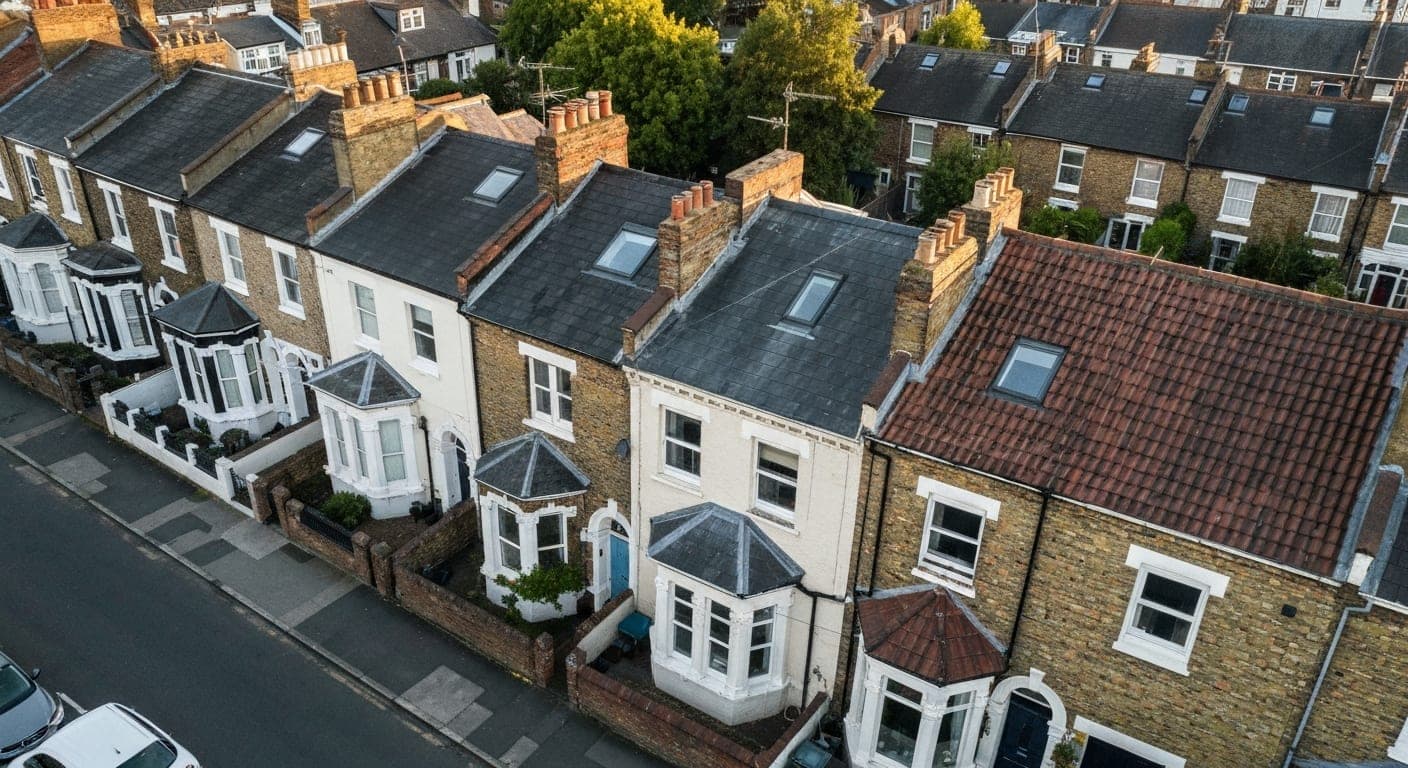
The loft of a Victorian terrace sits at the junction of two very different goals: improving EPC ratings and adding living space. These goals often pull in opposite directions. Adding 200mm of mineral wool between ceiling joists is the cheapest, highest-impact EPC upgrade available. Converting that loft into a bedroom, by contrast, can reduce the EPC score if not done carefully.
This article explains both scenarios: the simple case of adding or topping up loft insulation (where every pound spent yields one of the best EPC returns available) and the more complex case of a loft conversion (where the EPC impact depends entirely on the insulation specification chosen).
Loft Insulation: The Cheapest Win
If your Victorian terrace has an unconverted loft with an accessible ceiling joist level, loft insulation is almost certainly the most cost-effective EPC improvement available. Heat rises, and without insulation at ceiling level, the warm air generated by your tenants' heating simply escapes through the roof. Loft heat loss accounts for approximately 25 per cent of total heat loss in a typical Victorian terrace.
The recommended depth under current Building Regulations is 270mm (around 10.5 inches). Many older Victorian terraces have insulation installed during previous improvement programmes from the 1980s or 1990s, but this is typically only 50 to 100mm deep and should be topped up. If you have no insulation at all, starting from scratch is straightforward and inexpensive.
Insulation Types and Costs
| Improvement | Low Estimate | High Estimate |
|---|---|---|
| Top up from 100mm to 270mm (mineral wool)Suitable for accessible, uncomplicated lofts | £300 | £500 |
| Install from scratch (no existing insulation)Including access clearing and installation | £500 | £1,200 |
| Loose fill blown insulationFaster installation; good for irregular joist layouts | £400 | £800 |
| Rigid board insulation (where mineral wool not possible)Used where cold water tanks or access requirements prevent mineral wool | £800 | £1,800 |
Mineral wool roll is the standard choice: inexpensive, easy to install, and with excellent fire resistance. The two-layer method (100mm between joists, 170mm perpendicular on top) achieves the target 270mm depth and is the approach used by most cavity and loft insulation installers.
The Great British Insulation Scheme, which previously funded free loft insulation for properties rated EPC D to G in council tax bands A to D, closed on 31 March 2026. Free loft insulation is still available through ECO4 for tenants on qualifying benefits. Contact your energy supplier or an ECO4 broker to check eligibility.
EPC Impact of Loft Insulation
How a Loft Conversion Affects Your EPC
Converting a loft changes the thermal envelope of the property. Before conversion, the insulation layer sits at ceiling joist level (the floor of the loft), keeping the loft cold. After conversion, the loft becomes a heated room, and the insulation must move to the roof slope and party gable walls.
If the new roof slope insulation meets or exceeds the thermal performance of the old ceiling insulation, the EPC score is broadly preserved or slightly improved (because the heated volume becomes slightly more compact in proportion to the building envelope). If the conversion is done with minimal or substandard insulation, the EPC score falls, because the assessor records the new roof construction with its actual U-value rather than the excellent U-value of 270mm of mineral wool between ceiling joists.
Dormer vs Roof Light Conversions
The two main conversion types for a Victorian terrace are dormer conversions (adding an extension to the rear roof slope) and roof light conversions (inserting Velux-style windows into the existing roof without altering the roof line). From an EPC perspective:
- Roof light conversions preserve the original roof structure and are easier to insulate well. The existing rafters are supplemented with rigid insulation boards above or below to achieve a U-value of 0.18 W/m2K or better.
- Dormer conversions add new wall and roof area, which creates more potential thermal weakness. The dormer cheeks (side walls) and dormer roof must all be insulated to the same standard as the main roof. Properly done, a dormer conversion has minimal negative EPC impact.
Insulating a Converted Loft to Protect Your EPC
Building Regulations for loft conversions require roof slope insulation to achieve a U-value of 0.18 W/m2K (Part L of the Building Regulations). This is best achieved with:
- Rigid PIR insulation boards above and below the rafter (warm roof / hybrid approach) -- achieves 0.16 to 0.18 W/m2K within normal rafter depths.
- A full warm roof system with insulation above the existing rafter plane -- the most thermally efficient approach but requires re-roofing and adds cost.
Avoid the "cold rafter" approach of fitting insulation only between rafters with no top layer. This is Building Regulations compliant only if the rafters are sufficiently deep, and it rarely achieves the 0.18 W/m2K target in Victorian roof structures. Always confirm the target U-value in writing with your conversion contractor before works begin.
Party Wall Considerations
Victorian terraces share party walls with neighbouring properties. The Party Wall etc. Act 1996 requires you to notify your neighbours if any conversion work involves:
- Cutting into the party wall -- for example, to insert a beam bearing or to create access between the party wall and the conversion.
- Building on the boundary line -- a rear dormer that runs to the full width of the rear elevation may approach or touch the party wall plane.
- Raising the party wall -- some dormer conversions require raising the shared party wall to meet the new roofline.
A Party Wall Notice must be served at least two months before work begins (or one month for some works). If a neighbour dissents, a surveyor must be appointed. From an EPC perspective, party wall insulation is a useful bonus: the exposed gable end wall of a terrace is an external wall and benefits from insulation, but this is separate from the conversion process itself.
Cost Comparison
| Improvement | Low Estimate | High Estimate |
|---|---|---|
| Loft insulation top-up to 270mm (mineral wool)Best EPC return per pound on any Victorian terrace | £300 | £600 |
| Loft insulation from scratch (mineral wool)Including access clearing | £500 | £1,200 |
| Roof light loft conversionIncludes insulation to Building Regs standard | £15,000 | £25,000 |
| Dormer loft conversionFull dormer with en-suite; higher in London | £25,000 | £45,000 |
| Additional insulation upgrade (warm roof)Premium over standard spec for better EPC performance | £3,000 | £6,000 |
| Party wall surveyor feesPer neighbouring property; required if they dissent | £800 | £2,000 |
Planning and Building Regulations
Most loft conversions on Victorian terraces qualify as permitted development and do not require a full planning application, provided:
- The additional roof space does not exceed 40 cubic metres (for a terraced house).
- The dormer does not extend beyond the highest point of the roof.
- The extension does not overhang the original footprint of the building.
- The property is not in a conservation area or listed (in these cases, permitted development rights may be restricted).
Building Regulations approval is always required for a loft conversion, regardless of planning status. The Building Control officer will inspect the structural, fire safety, and thermal insulation elements of the conversion. For EPC purposes, the Building Regulations Part L insulation requirement (U-value 0.18 W/m2K for roof slopes) should be treated as a minimum, not a target.
For a full picture of all improvements available to a Victorian terrace, from the cheapest quick wins to larger structural changes, see the main Victorian terrace EPC guide. You may also find it helpful to combine a loft conversion programme with solid wall insulation to maximise the EPC improvement from a single period of disruption.
Frequently Asked Questions
Does a loft conversion improve the EPC rating?
+
Not automatically. A loft conversion can improve, maintain, or reduce the EPC score depending on the insulation specification. A well-insulated conversion (roof slope U-value 0.18 W/m2K or better) is broadly EPC neutral or slightly positive. A conversion with minimal insulation can reduce the EPC score by 3 to 6 points because the heated roof slope replaces the excellent U-value of ceiling-level mineral wool.
How much does loft insulation improve the EPC in a Victorian terrace?
+
Installing or topping up loft insulation to 270mm typically adds 4 to 8 EPC points to a Victorian terrace. Installing from scratch (no existing insulation) adds 6 to 10 points. Topping up from 100mm to 270mm adds 2 to 4 points. This makes loft insulation the best-value EPC measure available for most Victorian terraces with unconverted lofts.
Do I need a party wall agreement for a loft conversion?
+
You need to serve a Party Wall Notice if the conversion involves cutting into the party wall, building on the boundary, or raising the party wall. Many roof light conversions (Velux windows only) do not trigger party wall requirements. Dormer conversions on a Victorian terrace usually do, particularly at the rear. Always check with a structural engineer or architect before starting.
Can I get free loft insulation for my Victorian terrace?
+
Potentially yes. The Great British Insulation Scheme (GBIS), which previously funded free loft insulation for properties rated D to G in council tax bands A to D regardless of tenant income, closed on 31 March 2026. ECO4 still provides free installation for landlords whose tenants are on qualifying benefits. Contact your energy supplier or an ECO4 broker to check eligibility. Availability varies by region.
What insulation should I use in a Victorian loft conversion?
+
For the roof slope of a converted loft, use a combination of rigid PIR insulation boards between and below (or above) the rafters to achieve a U-value of 0.18 W/m2K or better. A warm roof approach (insulation above the rafter plane) achieves the best thermal performance but is more expensive. Avoid fitting insulation only between rafters without a secondary layer, as this rarely achieves the target U-value with Victorian rafter depths.
Related Articles
Victorian Solid Wall Insulation
Internal vs external insulation options, costs from £5k, and EPC improvements.
Victorian Sash Window EPC Upgrades
Secondary glazing, draught proofing, and conservation area rules.
Victorian Bay Window Draught Proofing
The cheapest EPC quick win for Victorian terraces -- costs and point gains.
Victorian Terrace EPC Guide
Complete landlord guide to improving EPC ratings in pre-1919 terraced properties.