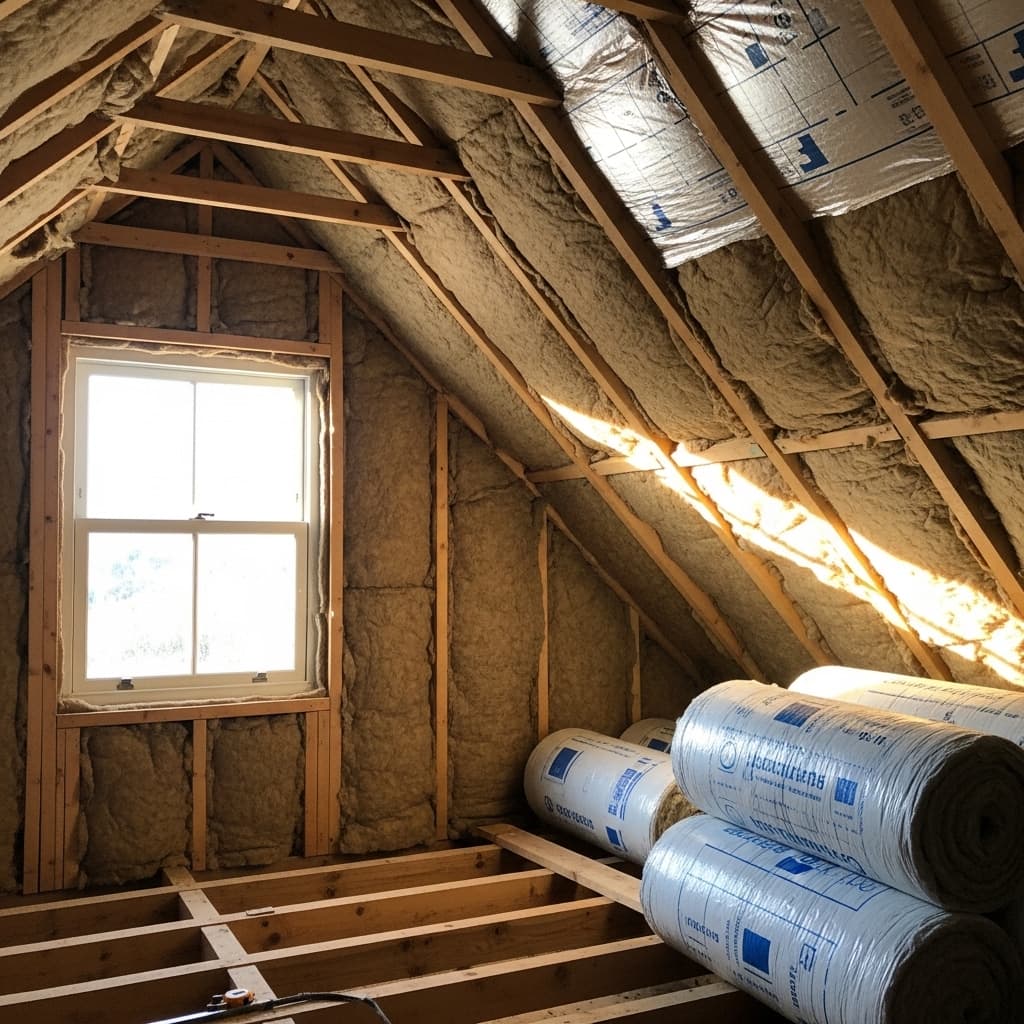
Room-in-roof insulation covers a habitable room built within the pitch of a roof. It typically costs £1,500 to £5,000, adds 4 to 8 SAP points to an EPC, and qualifies for ECO4 funding if your tenant meets the eligibility criteria. ECO4 closes on 31 December 2026, so the window to claim is shorter than many landlords realise.
What Is Room-in-Roof Insulation?
Room-in-roof insulation is the thermal treatment of a room where the ceiling follows the slope of the rafters rather than sitting flat above the room. The government's Retrofit Room in Roof Insulation Best Practice Guide (BEIS, January 2022, gov.uk) defines it as "any pre-existing room in which all or part of the ceilings follow the rafter line of the roof."
This distinguishes it from standard loft insulation in an important way. In a standard loft, insulation sits on the loft floor and the void above stays cold. In a room in the roof, you need to insulate the sloped ceiling sections, the eaves spaces, the gable walls, and any flat ceiling sections, which means more surfaces, more specialist labour, and a higher cost.
Common property types with rooms in the roof include Victorian terraces with loft conversions, 1930s semi-detached houses with attic bedrooms, and any property where a bedroom or study sits within the roof pitch.
How Much Does Room-in-Roof Insulation Cost?
Typical costs range from £1,500 to £5,000 for a standard installation (Cucumber Eco, 2026). Where a quote lands within that range depends on:
- The number of surfaces to treat: sloped ceiling, eaves, flat ceiling sections, and gable walls
- Whether the eaves spaces are accessible without structural work
- The presence of Velux windows or dormers, which require additional detailing
- Whether the existing structure meets ventilation requirements
| Factor | Lower end (around £1,500) | Upper end (around £5,000) |
|---|---|---|
| Surfaces | Single sloped ceiling, simple eaves | Multiple surfaces, complex eaves, dormers |
| Access | Easy loft access | Difficult or no existing access |
| Room size | Small single bedroom | Large double room with Velux windows |
| Preparation work | Minimal | Ventilation upgrade or structural work needed |
Get a survey before accepting any quote. Photos are not enough: a surveyor needs to assess moisture condition, existing insulation depth, roof ventilation, and electrical penetrations. Most reputable installers will visit before quoting.
How Much Does Room-in-Roof Insulation Improve Your EPC?
Room-in-roof insulation typically adds 4 to 8 SAP points to an EPC rating (Cucumber Eco, 2026). A property sitting at 62 (band D) could move to 66 to 70. For many properties, that is the difference between band D and band C.
The actual uplift depends on how poorly insulated the roof room is, what the baseline heating system is, and what other improvements are in place.
The documentation trap landlords need to know about
This is where many landlords get caught out. If a room in the roof was added or converted without documented evidence that it met Building Regulations at the time, an EPC assessor has no choice but to assess the insulation based on the original property dateband rather than the conversion date.
According to EPC Works, if a conversion was carried out since 2012 but without building regulation certificates, the assessor treats the roof room insulation as if it was built to the standard of the original property. This can result in an 11-point reduction in the EPC score compared to a correctly evidenced assessment.
The practical implication for landlords: before spending money on new insulation, locate your completion certificates. If they exist and the work was done to regulation, your assessor may already be scoring the roof room incorrectly. Getting the assessment corrected costs nothing but a call to your assessor, and is faster than any physical upgrade.
Grants Available for Room-in-Roof Insulation
Two main grant routes cover room-in-roof insulation for private landlords in England in 2026.
ECO4 (closes 31 December 2026)
ECO4 is the primary route for landlords whose tenants meet the eligibility criteria. It funds a package of energy efficiency measures, of which room-in-roof insulation can form a part. There is no set amount per property: the energy supplier decides how much to fund. Eligibility is tenant-gated: the occupier must be on a qualifying benefit such as Universal Credit or Pension Credit, or be declared eligible by the local authority.
ECO4 closes on 31 December 2026. The successor scheme, Warm Homes Plan, is expected from 2027 but has not yet opened. If your tenant qualifies now, it is worth checking first, and the time to move is short.
For eligibility criteria and how to apply, see our full ECO4 grants guide for landlords.
Warm Homes: Local Grant
The Warm Homes Local Grant funds energy efficiency improvements in privately rented homes rated EPC D to G, delivered through local authorities that have signed up to the scheme. The household income threshold is typically £36,000 per year. Landlords may need to contribute around 50% of the installation cost.
The maximum available is up to £15,000 per property for a full package of measures. Room-in-roof insulation can be included as part of that package. Availability varies by local authority area.
See our guide to the Warm Homes Local Grant for landlords for area eligibility and how to apply.
| Grant | Max amount | Who qualifies | Closes |
|---|---|---|---|
| ECO4 | No set amount (supplier decides) | Tenant on qualifying benefit or declared eligible by the council | 31 December 2026 |
| Warm Homes Local Grant | £15,000 | EPC D-G, household income under £36,000 | Ongoing (by LA) |
Does Room-in-Roof Insulation Get You to EPC C?
For most properties, room-in-roof insulation alone will not achieve EPC C. But it can be a meaningful part of a combined upgrade plan, particularly for older terraces and semis where the roof room is a significant source of heat loss.
The minimum EPC band you need to let a property is E, and has been since 1 April 2020. Band D is legal to let. Government has said it intends to raise that to band C in the private rented sector from 1 October 2030, covering every tenancy, new and existing, with a single date. That is a proposal: it needs an Act of Parliament and then a statutory instrument amending the 2015 Regulations, and neither has happened. An earlier 2028 milestone for new tenancies was floated at consultation and dropped in the government's January 2026 response.
The MEES cost cap in force today is £3,500 including VAT per property. Work you cannot complete within that cap can support a high-cost exemption on the PRS exemptions register. The proposed cap of £10,000 would come in with the band C standard, if it is legislated. Room-in-roof insulation at £1,500 to £5,000 can absorb most or all of the current cap on its own, so sequence it carefully against other measures.
For a property currently at EPC D or E, the most effective approach is usually to stack several lower-cost measures rather than one expensive one. Room-in-roof insulation combined with cavity wall insulation, draught-proofing, and LED lighting can collectively shift a property by 15 to 20 SAP points, which is often enough to cross from D into C.
EPCGuide's analysis of 27.6 million EPC certificates covering 19.7 million homes shows that 49.6% of homes in England and Wales are currently below EPC C, across 318 local authorities. For landlords with older roof-room properties, finding the right combination of measures is the practical task, whether or not the proposed 2030 standard is legislated.
Our cost to improve EPC rating guide for landlords covers how to build a cost-effective upgrade plan across all major property types.
What Landlords Often Get Wrong
Skipping the survey. Getting quotes from photos leads to wide cost estimates and missed complications such as damp or poor ventilation. A proper survey takes around an hour and usually saves more than it costs.
Not checking EPC assumptions first. Your current EPC may already be scoring the roof room poorly because of assumed data. Before spending on insulation, ask your assessor what data they used for the roof room. If you have building regs evidence of a compliant conversion, a corrected EPC may improve your score without any physical work.
Installing insulation before other measures. Our guide to cheapest EPC improvements ranked by cost and impact starts with draught-proofing and LED lighting, which cost under £500 combined and add 2 to 5 SAP points. Tackling these first means you may need fewer expensive measures to reach C.
Missing the ECO4 deadline. If your tenant qualifies for ECO4 and you have not applied, the scheme closes on 31 December 2026. The replacement scheme is not expected until 2027. Act now if your tenant is eligible.
Frequently Asked Questions
Is room-in-roof insulation the same as loft insulation? No. Standard loft insulation sits on the loft floor and keeps the cold roof void separate from the living space. Room-in-roof insulation treats a habitable room within the roof pitch, insulating the sloped ceilings, eaves, and gable walls. It covers more surfaces, requires specialist installation, and costs more.
Does room-in-roof insulation require planning permission? Typically not, as it is internal work. If the property is listed or in a conservation area, check with the local authority before proceeding. Building Regulations approval is generally required for thermal upgrades to habitable roof spaces, and keeping your completion certificates is important for future EPC assessments.
Can tenants stay in the property during installation? In most cases yes, though access to the roof room will be restricted during the work. Most installations complete in one to two days. Discuss access requirements and any disruption with your tenant before scheduling.
How long does room-in-roof insulation last? Well-installed roof room insulation should last 25 to 40 years. Lifespan depends on material quality, whether ventilation is adequate, and whether any moisture issues are addressed at installation. Inadequate ventilation is the most common cause of early deterioration.
Is room-in-roof insulation covered by ECO4? Yes. Room-in-roof insulation is an eligible measure under ECO4 as part of a package of improvements. It must be installed by an ECO4-approved contractor. Eligibility depends on tenant benefit or income status, not the landlord. ECO4 closes on 31 December 2026.
What if my EPC already flags limited roof room insulation? This notation means the assessor recorded the insulation as limited, unknown, or assumed. It does not automatically mean the room is uninsulated. Commission a survey to confirm the actual condition. If insulation is adequate and you have building regs documentation, your assessor can correct the score without any physical work.