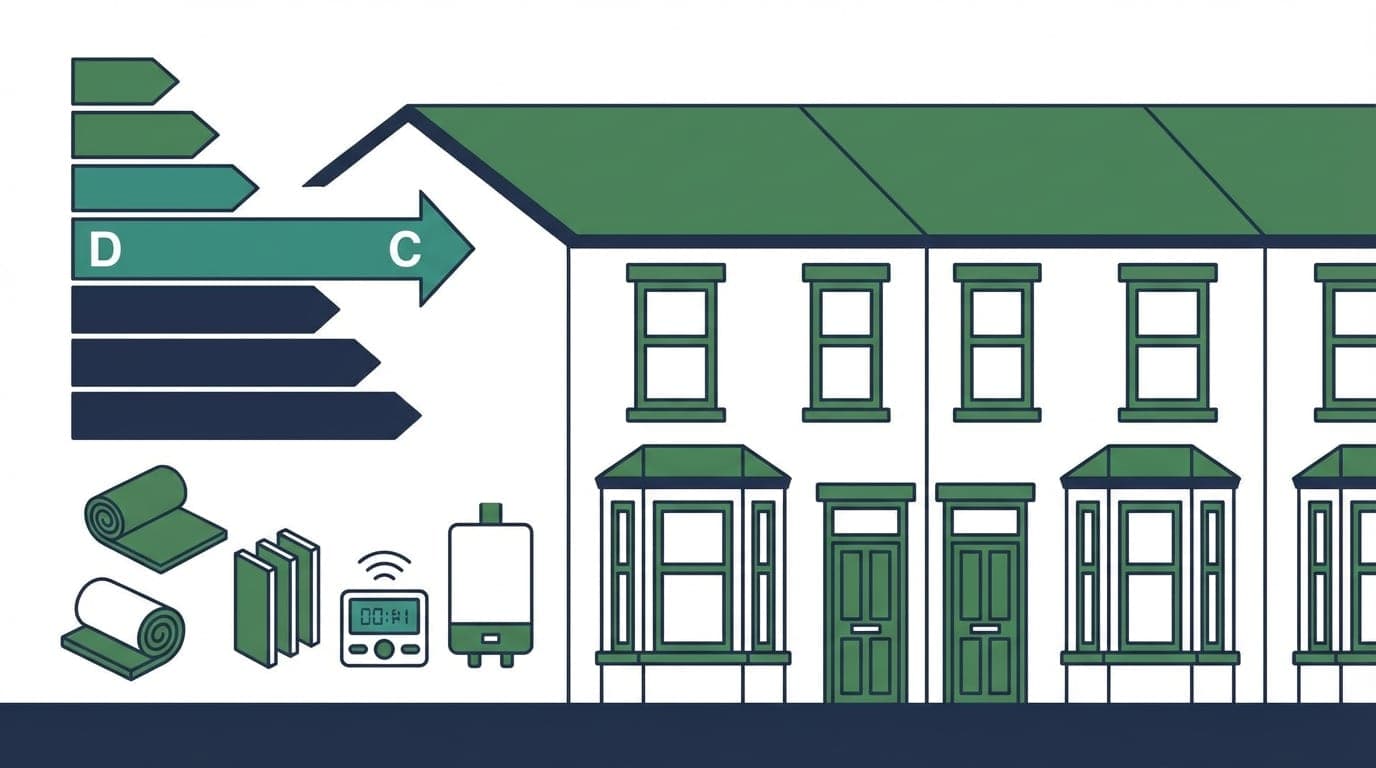
If your rental property is EPC band D, you are closer to band C than you think. Band D runs from 55 to 68 and band C starts at 69, so the gap is somewhere between one and fourteen SAP points depending on where you sit. At the top of the band that usually doesn't require expensive work.
Two things worth being straight about before you spend anything. A band D property is legal to let today: the minimum standard in England and Wales is band E, and has been since 1 April 2020. And the EPC C standard for 2030 is a government proposal, not law. It needs an Act of Parliament and then a statutory instrument amending the 2015 Regulations, and neither has happened. Planning for it is sensible. Being told you are already in breach is not true.
This guide shows the cheapest path from D to C, in the right order, with realistic 2026 costs.
How far is D from C?
Reading your EPC score
Your EPC certificate shows two numbers: your current SAP score and your potential SAP score (if all recommended measures were completed). Open your EPC report before reading further, the gap between those two numbers tells you how much headroom you have.
| EPC Band | SAP Score Range |
|---|---|
| A | 92–100 |
| B | 81–91 |
| C | 69–80 |
| D | 55–68 |
| E | 39–54 |
How many points do you actually need?
If you score D 60, you need 9 SAP points to reach C. If you score D 55, you need 14. Most of the improvements below add 3–15 points each, which means many D-rated properties reach C after just two or three targeted upgrades.
Check your current EPC rating using the EPCGuide EPC checker before you plan any work.
Cheapest improvements first, the right order matters
Start with the lowest-cost, highest-impact measures. Don't jump straight to a new boiler if loft insulation and controls can get you over the line for a fraction of the cost.
1. LED lighting (£50–£200 | +1–3 SAP points)
Replace all remaining halogen or CFL bulbs with LEDs. The SAP calculation rewards properties where 75%+ of fixed lighting is low-energy. This is the cheapest improvement you can make, and worth doing regardless of your current band.
Do this first. It costs almost nothing and forms the baseline for everything else.
2. Draught proofing (£100–£300 | +1–3 SAP points)
Seal gaps around doors, windows, letterboxes, and pipework. Professional draught proofing for a full house typically runs £100–£300. The SAP gain is modest, but it stacks well with bigger measures and makes heating systems more effective.
3. Loft insulation top-up (£300–£600 | +5–10 SAP points)
If your loft has less than 270mm of insulation, topping it up is often the single biggest lever for a D-rated property. It's affordable, quick to install, and delivers significant SAP gains plus around £150–£250 in annual bill savings.
For many D-rated homes, loft insulation plus one of the measures below is enough to cross into C. Check your EPC report, if it lists loft insulation as a recommended measure, do this before anything else.
Cost breakdown:
- Top-up existing insulation to 270mm: £300–£600
- New installation (no existing insulation): £400–£1,200
4. Heating controls upgrade (£200–£500 | +3–8 SAP points)
If your EPC lists missing or basic heating controls as a recommendation, fixing this can add meaningful SAP points at low cost:
- Room thermostat + programmer, if you don't already have them
- Thermostatic radiator valves (TRVs) on all radiators
- Smart thermostat (optional, improves control precision)
This is a good pairing with the loft insulation top-up. Together, these two measures often add 8–18 SAP points, enough to push many D-rated properties into C.
Get a reassessment here before spending more. You may already be at C.
5. Cavity wall insulation (£1,000–£2,500 | +5–15 SAP points)
If your property has unfilled cavity walls (most UK properties built between 1920 and 1990 do), cavity wall insulation is one of the highest-impact improvements available. It's significantly cheaper than solid wall insulation and delivers strong SAP gains.
Before booking: confirm your walls are suitable. A surveyor or installer will check for wall type, cavity condition, and exposure to driving rain. Some cavity walls are not suitable for insulation, don't proceed without a check.
Average costs: £1,200–£2,100 for a typical 3-bedroom semi.
6. New condensing boiler (£2,000–£4,000 | +5–15 SAP points)
Only consider this if your boiler is old (pre-2005), non-condensing, or flagged on your EPC as a key recommendation. A modern A-rated condensing boiler can add significant SAP points, but at a higher cost. Check grants first (see below).
If your boiler is already efficient, skipping this and reaching C via insulation + controls is almost always cheaper.
Cost summary table
| Improvement | Typical Cost | SAP Points Gained | Best for D-rated? |
|---|---|---|---|
| LED lighting | £50–£200 | +1–3 | ✓ Always |
| Draught proofing | £100–£300 | +1–3 | ✓ Good stack |
| Loft insulation top-up | £300–£600 | +5–10 | ✓ High priority |
| Heating controls | £200–£500 | +3–8 | ✓ High priority |
| Cavity wall insulation | £1,000–£2,500 | +5–15 | ✓ If applicable |
| New condensing boiler | £2,000–£4,000 | +5–15 | Only if old/inefficient |
Typical total cost D→C (cavity-wall home): £500–£3,500. Solid-wall or period properties can run £5,000–£12,000+ if wall insulation is required.
Can I get a grant?
ECO4, free upgrades if your tenant qualifies
The Energy Company Obligation (ECO4) scheme can fund insulation and heating upgrades at no cost to the landlord, but eligibility is based on your tenant's circumstances, not yours. If your tenant receives qualifying benefits (Universal Credit, Pension Credit, certain tax credits), they may be eligible.
This is a commonly misunderstood rule. Landlords who assume they won't qualify because they're financially comfortable are often surprised to find their tenant qualifies. Ask your tenant to check ECO4 eligibility via Ofgem, the potential saving is significant.
Note: ECO4 was extended and now runs until 31 December 2026, with measures needing to be installed by then and no new applications after that date. Apply well before the deadline. A successor Warm Homes Plan scheme may follow.
Boiler Upgrade Scheme, £7,500 toward a heat pump
If your property's heating upgrade route involves a heat pump (air source or ground source), the Boiler Upgrade Scheme offers up to £7,500 off installation costs. This isn't relevant for most D-rated landlords focused on a cost-efficient D→C upgrade, but worth knowing if a boiler replacement is on your roadmap.
Warm Homes Local Grant
Your local council may offer additional funding. Check the GOV.UK Warm Homes Plan guidance and search your council's housing pages for active schemes.
What if it costs more than the cost cap?
MEES has never required a landlord to spend without limit. Where the cost of all recommended improvements exceeds the cap, you can register a high-cost exemption on the PRS Exemptions Register instead of doing the works.
The cap in force today is £3,500 including VAT per property, and a registered exemption lasts five years. Government has proposed replacing it with £10,000, or 10% of property value where the value is under £100,000, with 10-year exemptions, at the same time as the band C standard. That is a proposal and not yet law, so plan against £3,500 and watch the £10,000 figure.
Grant money does not count towards the cap. Only what you pay yourself does, which is why exhausting grant routes first is worth the effort.
The exemption route matters most for solid-wall period properties where the cheapest path to C involves expensive wall insulation. If you're in this situation, seek quotes from three installers, document them, and register the exemption rather than assuming it applies.
For more on what non-compliance costs, see our guide to EPC fines and enforcement for landlords.
When to reassess your EPC
After completing steps 3–4 (loft insulation + heating controls), commission a new EPC assessment before spending more. For many D-rated properties, especially those scoring D 62–68, those two measures are enough to reach C. Spending on cavity wall insulation or a boiler unnecessarily adds cost without compliance benefit.
An EPC assessment costs £60–£120. It's cheap insurance before a larger spend.
Frequently asked questions
How much does it cost to upgrade from EPC D to C on average?
For a typical cavity-wall property, £500–£3,500 covering loft insulation, heating controls, and possibly cavity wall insulation. Solid-wall properties can cost significantly more (£5,000–£12,000+) if wall insulation is required.
Can my tenant help fund EPC improvements through ECO4?
Yes, if your tenant is on qualifying benefits, ECO4 can fund insulation and heating upgrades at no direct cost to you. Eligibility is based on the tenant's circumstances. Check with your tenant before assuming it doesn't apply.
Do I have to reach EPC C before 2030?
Not under current law. The requirement in England and Wales today is band E, so a band D property is compliant. Government has said it intends to raise the minimum to band C from 1 October 2030 for all tenancies, but that needs primary legislation followed by a statutory instrument and neither has been passed. A near-identical proposal was scrapped in September 2023. Plan for it, but do not let anyone tell you it is already the law.
What if I can't afford the upgrade?
Document quotes showing the cost of the recommended measures exceeds the cap, and register a high-cost exemption on the PRS Exemptions Register. The cap is £3,500 including VAT today, with £10,000 proposed. This is a legal route, but only if you register it formally. Letting a property below the minimum band without a registered exemption risks a civil penalty of up to £5,000 in total per property, plus publication of the breach on the register.
What's the cheapest single improvement I can make for EPC D?
Loft insulation top-up (£300–£600) delivers the best SAP return per pound spent for most D-rated properties. If your loft is already well-insulated, heating controls are the next-best value option.
EPC ratings and SAP scores quoted in this article are based on current government methodology. The Home Energy Model (new EPC methodology) is expected to replace SAP assessments, see our guide to what the HEM delay means for landlords. Cost figures are indicative 2026 UK prices and may vary by region, property type, and installer.