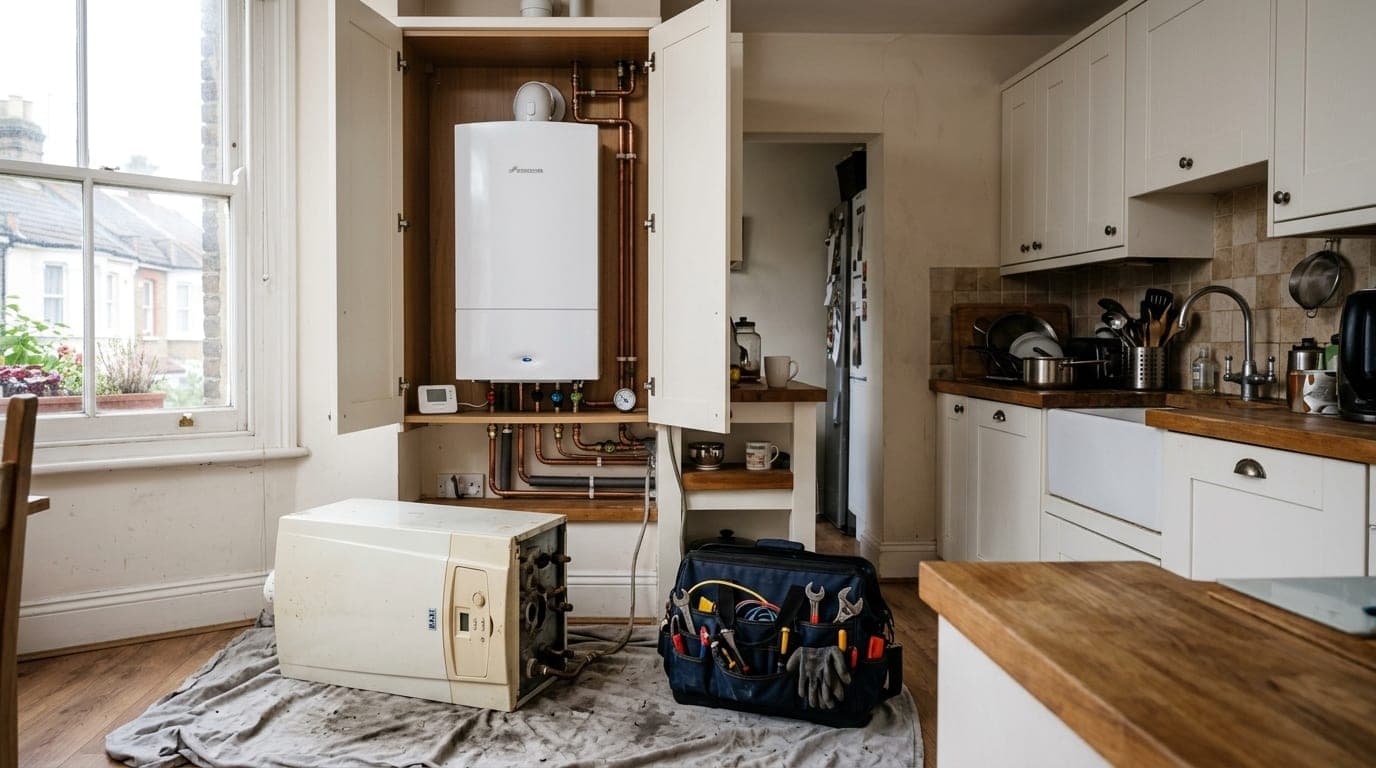
Yes, a new boiler improves an EPC rating when it replaces an old non-condensing unit: a modern A-rated condensing boiler in place of a pre-2005 boiler typically adds 5 to 15 SAP points, enough to lift many properties a full band. Swap one condensing boiler for another and the certificate barely moves, because the assessor's software scores efficiency.
That distinction decides whether a boiler is the best £3,000 a landlord spends on an EPC or the worst.
How does an EPC assessor score your boiler?
An EPC for an existing home is produced with RdSAP, the reduced-data version of the Standard Assessment Procedure. RdSAP models the cost of heating and hot water for a standard occupancy, so the boiler's seasonal efficiency is one of the biggest inputs. Higher efficiency means less modelled fuel, a lower modelled cost and a higher score.
The assessor gets that efficiency figure one of two ways. If the make and model are identifiable, the boiler is looked up in the Product Characteristics Database, the government database of validated boiler and heat pump performance data used in SAP and RdSAP. If the data plate is missing or unreadable, the software falls back to a default by boiler type and age: a non-condensing boiler installed before 2000 is assumed to run at around 70% efficiency. That default is why two identical houses can sit several points apart. One assessor found the data plate, the other did not.
Two regulatory dates tell you what sits in an older rental. Condensing boilers became mandatory for new installations on 1 April 2005, with a SEDBUK rating of A or B, according to a CREDS briefing note for BEIS on the condensing boiler transition. Since April 2018 the Boiler Plus standard has required a minimum 92% ErP efficiency for new gas boilers in England, with a timer and room thermostat as an explicit requirement. A boiler fitted before 2005 is almost certainly non-condensing and scoring badly. One fitted after 2005 is already scoring well.
How many EPC points does a new boiler add?
It depends on what you replace. The ranges below are the ones EPCGuide uses across its upgrade guides, drawn from BRE's SAP documentation.
| What you are replacing | Assumed efficiency in RdSAP | Typical SAP gain from a new A-rated condensing boiler | Worth doing for the EPC? |
|---|---|---|---|
| Pre-2000 non-condensing, floor-standing or open-flued | Around 70% by default | 5 to 15 points | Yes, often a full band |
| 2000 to 2005 non-condensing wall-hung | Above the pre-2000 default, below condensing | Low end of the range | Sometimes, if the property sits near a band boundary |
| Post-2005 condensing boiler | 86% minimum, 92% since 2018 | 0 to 2 points | No, replace it when it fails |
| Electric storage or panel heaters | Not a boiler | 10 to 25 points if switched to a heat pump | Yes, the heat pump route carries a grant |
Three things sharpen those numbers. SAP bands are wide: band E runs from 39 to 54, band D from 55 to 68 and band C from 69 to 80, so a 10-point gain takes a property at 60 across the C line while the same 10 points at 45 leaves it in band E. The gain scales with heat demand, so a large, poorly insulated house scores more from the same boiler than a small, well-insulated flat. Nothing changes until a new certificate is lodged, so keep the installer's Benchmark commissioning checklist with the boiler for the assessor to look the model up.
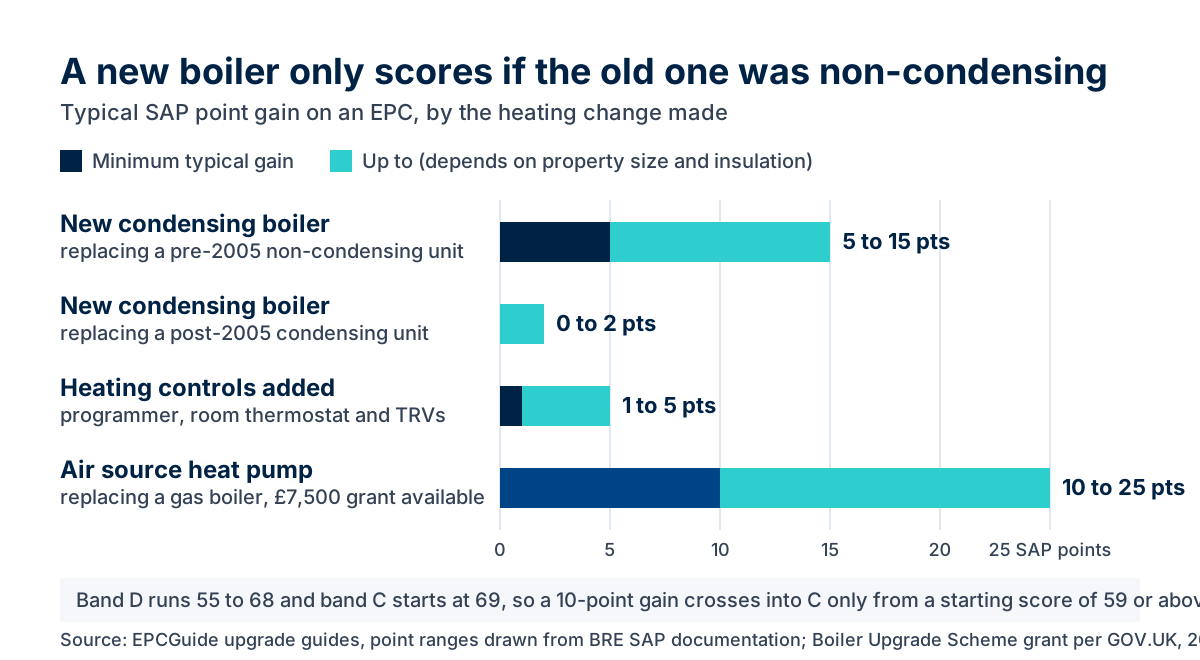 The age of the boiler you remove decides the gain. Replacing a condensing boiler with another condensing boiler buys almost nothing on the certificate.
Does a combi boiler score better than a system boiler?
Not by itself. RdSAP scores the efficiency figure, so an A-rated combi and an A-rated system boiler with the same seasonal efficiency score the same on heating. The difference is hot water. A combi has no cylinder to lose heat. A system boiler feeds a cylinder. An old cylinder with a thin jacket loses heat all day in the model, which is why a British Standard 80mm jacket at £15 to £25 is worth up to 3 SAP points and tops our cost-per-point ranking. A well-lagged cylinder with a thermostat scores close to a combi and keeps the option of a heat pump later. Choose on hot water demand: a one-bathroom flat suits a combi, a three-bathroom HMO wants stored hot water.
Do heating controls add EPC points?
Yes. They are the cheapest add-on to a boiler job. RdSAP scores the control set as well as the boiler: a programmer, a room thermostat and thermostatic radiator valves (TRVs) together count as full control. A new boiler with no room thermostat is penalised as an inefficient system whatever its efficiency rating.
Upgrading from a basic timer to a full set of programmer, room thermostat and TRVs typically adds 1 to 5 SAP points at £200 to £500 installed. A property with almost no controls reaches the top of that range. Boiler Plus means a compliant installer should already be fitting a timer and room thermostat with every new gas boiler in England, so ask for TRVs on every radiator that lacks them. A smart thermostat also counts toward the separate Smart Readiness score under the proposed 2027 metrics, covered below.
For an older rental with a pre-2005 boiler and basic controls, a boiler plus controls package of £2,200 to £4,500 commonly delivers 6 to 20 points. That is the single largest gas-heated gain in our band E to C upgrade guide.
What does a new boiler cost per EPC point?
Total price is the wrong yardstick. Cost per SAP point tells you whether the boiler comes before or after the loft. The table takes the installed cost ranges EPCGuide publishes for a typical three-bedroom terrace and divides them by the point gain.
| Measure | Installed cost | Typical SAP gain | Cost per point |
|---|---|---|---|
| Loft insulation, 0mm to 270mm | £300 to £600 | 5 to 12 points | £25 to £120 |
| Heating controls, programmer, room stat and TRVs | £200 to £500 | 1 to 5 points | £40 to £500 |
| Cavity wall insulation | £500 to £1,500 | 5 to 10 points | £50 to £300 |
| New condensing boiler, replacing pre-2005 unit | £2,000 to £4,000 | 5 to 15 points | £130 to £800 |
| Air source heat pump, net of £7,500 grant | £2,500 to £6,500 | 10 to 25 points | £100 to £650 |
| New condensing boiler, replacing post-2005 unit | £2,000 to £4,000 | 0 to 2 points | £1,000 or more |
Read the table from the top. An uninsulated loft or an unfilled cavity beats a boiler on cost per point every time, which is why the boiler is step three in a sensible sequence, after fabric and controls. If the boiler is already condensing, it drops to the bottom of the table.
The heat pump line deserves a second look. After the £7,500 Boiler Upgrade Scheme grant, the net cost lands in the same range as a gas boiler while delivering roughly twice the points. Our heat pump versus boiler comparison works through when each wins. Run your own property through the EPC predictor before committing, so you learn whether a boiler alone reaches C.
Why might a new gas boiler score worse than a heat pump from 2027?
Everything above describes the EPC as assessed today. The method is due to change.
The government's reforms to the Energy Performance of Buildings regime introduce four headline metrics on new-style domestic EPCs in place of the single A to G score: Fabric Performance, Heating System, Smart Readiness and Energy Cost. The calculation moves from RdSAP to the Home Energy Model. On 9 March 2026 the government moved the launch of those reforms to the second half of 2027.
The Heating System metric scores efficiency and carbon intensity together. A condensing gas boiler is efficient by combustion standards but burns a high-carbon fuel, so specialist analysis of the proposed methodology places a new condensing gas boiler at band D to E on that metric. An air source heat pump sits at A to B. That is the reversal: the boiler you fit in 2026 to gain 10 SAP points could, on a 2028 certificate, be the reason the heating metric reads D.
Under the government's proposed 2030 standard for the private rented sector, which is not law, compliance would be judged on Fabric Performance at C plus a second metric of the landlord's choice, either Heating System or Smart Readiness. A gas boiler cannot reach C on Heating System, so a gas-heated property would need to pass on Smart Readiness instead: smart heating controls, a smart meter and, where possible, battery storage. Our guide to the 2027 multi-metric EPC sets out both routes.
A boiler fitted today still counts. Government has said a property holding a valid EPC C under the current rating on 1 October 2029 would be treated as compliant until that certificate expires, so a boiler that gets the property to C on a 2026 or 2027 certificate buys up to ten years. That remains stated policy intention until legislation passes. Specify a system boiler with a cylinder, larger radiators and smart controls, so the switch to a heat pump in the 2030s costs less.
Is there a grant for a new gas boiler?
For most private landlords, no. The Boiler Upgrade Scheme funds low-carbon heating only. According to GOV.UK's Boiler Upgrade Scheme page, the scheme pays £7,500 toward an air source or ground source heat pump, £5,000 toward a biomass boiler and £2,500 toward an air-to-air heat pump. Until March 2027 an extra £1,500 applies to a heat pump replacing oil or LPG heating in a property with no mains gas, taking that grant to £9,000. Landlords are explicitly eligible for a property rented out to tenants. Hybrid systems that keep a gas boiler alongside a heat pump are excluded.
ECO4 can fund a boiler replacement where the tenant receives a qualifying benefit and the property is rated D to G. The scheme closes on 31 December 2026. Our boiler grants guide for landlords and ECO4 guide cover the eligibility tests. If the property runs on oil, LPG or electric heaters, the heat pump route carries £7,500 to £9,000 and scores 10 to 25 SAP points today. Our Boiler Upgrade Scheme guide for landlords walks through the application.
Should a landlord replace the boiler now for the EPC?
Start with the law as it stands. The minimum EPC band to let a property in England and Wales is E, with a landlord cost cap of £3,500 including VAT and a maximum civil penalty of £5,000 per property, as set out in GOV.UK's MEES landlord guidance, last updated 5 May 2026. Band C from 1 October 2030, a £10,000 cost cap and a £30,000 penalty were proposed in the government response of 21 January 2026. None of that is law. No statutory instrument has been laid.
The decision then comes down to three cases.
The boiler is non-condensing and the property is below C
Replace it, after loft and cavity insulation. It is the largest gas-heated gain available. Every pound you spend counts as qualifying spend against the current £3,500 cap. Under the proposals, spend from 1 October 2025 would count toward the higher £10,000 cap too.
The boiler is non-condensing and the property is already at C
Leave it until it fails. The certificate does not need the points. When it does fail, price a heat pump under the Boiler Upgrade Scheme before defaulting to a like-for-like gas swap.
The boiler is condensing
Do not replace it for the EPC. Spend the money on the measures that score: controls, insulation, LED lighting, a cylinder jacket. If the property is still short of C after those, the remaining options are a heat pump or solar PV. Our heating requirements to 2030 guide covers where the rules are heading.
Whatever you do, book a new EPC afterwards, at £60 to £120. Improvements only count once an assessor records them.
Frequently Asked Questions
How many EPC points does a new boiler add? Typically 5 to 15 SAP points when a modern A-rated condensing boiler replaces a pre-2005 non-condensing unit, with the largest gains in bigger, poorly insulated houses. Replacing a boiler that is already condensing adds 0 to 2 points. The gain comes from the efficiency difference between old and new.
Will a new combi boiler get my rental property to EPC C? Only if the property is within roughly 10 to 15 points of the band C threshold of 69 and the old boiler is non-condensing. A property at 60 with a 1990s boiler often crosses with a boiler and controls alone. One at 45 will not.
Does a new boiler on its own move the property up a band? Sometimes. Bands are 14 to 16 points wide, so a 10-point gain moves the property a band only if it started in the upper half of its current band. Add heating controls and, where the loft is uninsulated, loft insulation to make a band jump likely.
Do I need a new EPC after fitting a new boiler? Yes, if you want the improvement to count. The register keeps the old certificate until a new one is lodged. Give the assessor the boiler's make and model, ideally the Benchmark commissioning checklist, so the efficiency is looked up in the Product Characteristics Database.
Does a new boiler count toward the MEES cost cap? Yes. Your own spend on a boiler replacement counts as qualifying spend toward the £3,500 cap in force today. Grant money does not count against that cap. Keep the invoice, because the cap is your route to a high-cost exemption if the property still cannot reach the required band.
Is there a grant for a new gas boiler for landlords? Not from the Boiler Upgrade Scheme, which funds heat pumps and biomass only. ECO4 can fund a gas boiler replacement where the tenant receives a qualifying benefit, until it closes on 31 December 2026. For everyone else a gas boiler is an unfunded cost, while a heat pump attracts £7,500, or £9,000 for off-gas oil and LPG properties until March 2027.
Do I need to change the radiators when I replace a boiler? Not for a like-for-like gas boiler. The EPC does not score radiator size. Larger radiators help a condensing boiler run at the lower return temperatures where it is most efficient. If a heat pump is likely later, fitting them now avoids paying twice.
Should I choose a boiler or a heat pump for a better EPC? A heat pump scores more under today's RdSAP, roughly 10 to 25 points against 5 to 15. It is also the only heating type expected to reach band C on the proposed Heating System metric from 2027. Choose a gas boiler where the property is already close to C, a heat pump is impractical, or the fabric is too poor to support one yet.