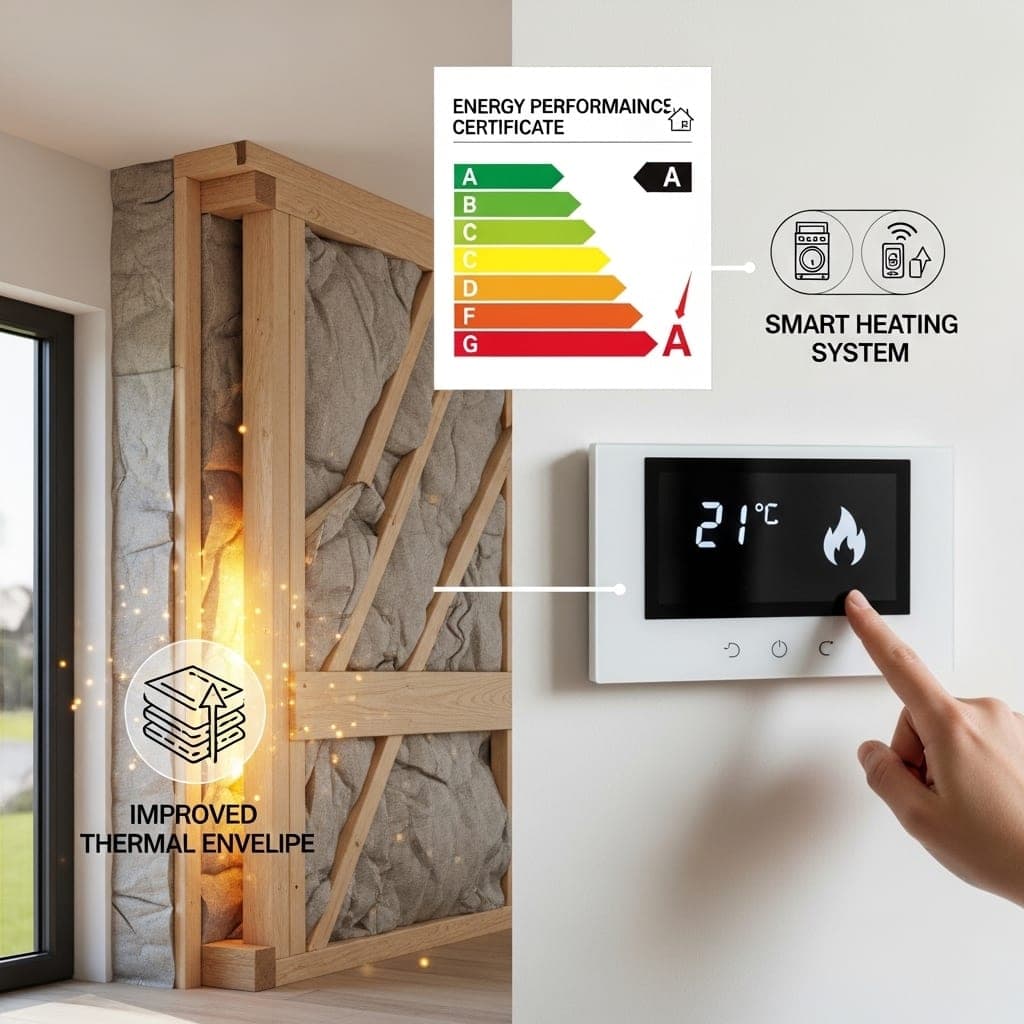
From H2 2027, every EPC certificate in England and Wales is due to show four separate ratings instead of the single A–G score landlords are used to. This is the Home Energy Model (HEM), and it changes how MEES compliance would be measured under the government's proposed 2030 band C standard.
The key question is: which of the four ratings would determine whether you comply with the minimum energy efficiency standard?
The short answer: two metrics, Fabric Performance plus your choice of either Heating System or Smart Readiness. The fourth metric, Energy Cost, appears on the certificate but carries no compliance weight.
Before going further, be clear on status. The minimum standard you must let at in England and Wales today is band E, unchanged since 1 April 2020. The band C standard for 1 October 2030, and the metric structure described below, come from the government's January 2026 response and the Warm Homes Plan. Both need primary legislation and then a statutory instrument amending the 2015 Regulations, and neither has happened. The detail can still move. This guide sets out the proposed shape so you can plan, not a set of rules you are already bound by.
Here is what each metric measures, which ones you need to achieve, and what that means for your upgrade strategy.
From One Rating to Four, What Is Changing
Currently, your EPC shows a single Energy Efficiency Rating (EER) on an A–G scale, calculated using the Standard Assessment Procedure (SAP/RdSAP) based on modelled running costs. There is also an Environmental Impact Rating (EIR) showing estimated CO₂ emissions, but MEES compliance is assessed against the EER only.
The Home Energy Model replaces both with four distinct metrics:
| Metric | Scale | What It Measures | Role in MEES Compliance |
|---|---|---|---|
| Fabric Performance | A–G | Insulation, glazing, airtightness, thermal bridging | PRIMARY, proposed at C or above |
| Heating System | A–G | Heating efficiency + carbon intensity | SECONDARY, your choice: this OR Smart Readiness |
| Smart Readiness | A–G | Smart controls, battery storage, flexibility | SECONDARY, your choice: this OR Heating System |
| Energy Cost | £/year | Estimated annual energy running cost | Display only, no compliance role |
HEM was originally due to launch in October 2026. Following engagement with industry on delivery timescales, the government moved the launch to H2 2027. Existing EPCs remain valid until they expire.
The Two-Step MEES Compliance Test
If the proposals are enacted as drafted, once HEM EPCs are in use and the 2030 standard applies, landlords in England and Wales would have to pass both steps:
Step 1 (Primary): Fabric Performance at EPC C or Above
The Fabric Performance metric measures how well your building's physical structure retains heat, entirely independent of the heating system. It assesses:
- Wall insulation: cavity fill, external or internal insulation, U-value and continuity
- Roof and loft insulation: depth and material
- Floor insulation: especially suspended timber floors
- Windows and doors: glazing type (single, double, triple), frame material
- Airtightness: uncontrolled air leakage through gaps and junctions
- Thermal bridging: heat loss at structural junctions (wall corners, window reveals)
The critical point: whether you have a gas boiler or a heat pump makes no difference to your Fabric Performance score. This metric is about the building shell. Insulating your walls and upgrading your windows will improve it regardless of your heating technology.
Step 2 (Your Choice): Heating System OR Smart Readiness at EPC C or Above
Once Step 1 is met, you must also reach C on one of two secondary metrics. You choose which one, the government confirmed this explicitly in its January 2026 policy response, and the Country Land & Business Association confirmed: "They will never be forced to make upgrades to the heating system if smart technology upgrades are not possible."
⚠️ Important: You are not required to choose the Heating System route. If Smart Readiness is more practical for your property type, for example a leasehold flat where installing a heat pump is not possible, the Smart Readiness metric offers an alternative pathway.
The Heating System Metric, Why Gas Boilers Won't Reach C
The Heating System metric scores your property's heating based on both efficiency and carbon intensity. A heating system that uses a lot of carbon-intensive fuel scores poorly even if it is technically efficient by combustion standards.
| Heating Type | Expected Rating | Why |
|---|---|---|
| Air source heat pump (ASHP) | A–B | High efficiency (COP 2.5–4) + low-carbon electricity |
| Ground source heat pump (GSHP) | A–B | Higher efficiency than ASHP + low-carbon electricity |
| Low-carbon heat network | A–C | Depends on heat source and distribution losses |
| New condensing gas boiler | D–E | High combustion efficiency but high-carbon fuel |
| Old non-condensing gas boiler | E–F | Lower efficiency + high-carbon fuel |
| Oil boiler | E–G | Lower efficiency + highest carbon fuel |
| Direct electric heating | C–E | Low-carbon grid but poor efficiency (COP 1.0) |
Expected ratings based on specialist analysis of the proposed HEM methodology (home-energy-model.co.uk, February 2026). Final band boundaries will be confirmed once the HEM consultation outcome is published.
⚠️ Key fact: Even the newest, A-rated condensing gas boiler cannot achieve band C on the Heating System metric. If you choose the Heating System route for Step 2, you need a heat pump. For landlords on this pathway, the Boiler Upgrade Scheme offers £7,500 per property for an air source heat pump, and the air-to-air heat pump grant offers £2,500.
This metric directly addresses a well-known flaw in the current system: under RdSAP, installing a heat pump can paradoxically lower an EPC rating because it switches the property from cheap gas to more expensive electricity. The Heating System metric corrects this, the efficiency and carbon advantage of a heat pump is properly rewarded.
The Smart Readiness Metric, The Alternative Route
Smart Readiness is an entirely new concept for UK EPCs. It measures a property's capacity to interact with smart energy systems and the electricity grid.
What contributes to a Smart Readiness score:
- Smart heating controls: internet-connected thermostats, zoned heating, weather compensation
- Smart meter: real-time monitoring and access to time-of-use tariffs
- Battery storage: storing solar PV generation or cheap off-peak electricity
- EV charging: smart charger capable of managed or vehicle-to-grid charging
- Solar PV: on-site generation combined with smart export and self-consumption management
- Demand-side response: ability to shift energy use in response to grid signals
Why this matters for landlords who can't install a heat pump:
If you own a leasehold flat, a listed building, an HMO where tenants occupy individual rooms, or any property where a heat pump is impractical, the Smart Readiness route may be your viable path to meeting Step 2. A property with a smart thermostat, a smart meter, and battery storage can achieve C on Smart Readiness without any changes to the heating system.
Smart Readiness upgrades are typically far cheaper than heat pump installations, and many of them, smart meters in particular, are supplied free of charge by energy suppliers.
The Energy Cost Metric, Information for Tenants, Not Landlords
The Energy Cost metric shows the estimated annual energy running cost in pounds sterling. Unlike the other three metrics, it is not banded A–G, it displays as a number (for example, £1,200/year).
It uses standardised fuel prices rather than current market rates, so it reflects the property's intrinsic performance rather than energy price fluctuations. This makes it directly comparable between properties.
What it is NOT: a MEES compliance metric. The government confirmed that Energy Cost will appear on certificates to help tenants and buyers compare running costs between properties, similar to the way appliance energy labels show running cost estimates. It plays no role in determining whether a landlord has met the minimum energy efficiency standard.
The current Energy Efficiency Rating (the single A–G score you see today) will also remain on new-format EPC certificates during the transition period, to support the grandfathering arrangements described below.
The Grandfathering Rule, Your Current EPC C May Buy You Time
Government has said that a property achieving EPC C under the current Energy Efficiency Rating before 1 October 2029 would be grandparented under the new system, deemed compliant until that certificate expires.
That matters if the proposals are enacted. A new EPC C obtained in 2027 under current RdSAP rules would be valid until 2037. During that validity period, even once HEM is live and the proposed 2030 date has passed, the property would be treated as compliant.
The implication: acting under the current system and securing an EPC C before October 2029 is a legitimate compliance strategy that avoids immediate HEM assessment.
⚠️ But note: Grandfathering buys time, it does not guarantee permanent compliance. When your current EPC expires, the new HEM assessment will apply. Properties currently at C under RdSAP may score differently under the four new metrics, because the methodology is fundamentally different. This is explored in detail in our article on what happens to your EPC after the Home Energy Model launches.
What This Means for Your Upgrade Strategy
You own a terraced or semi-detached house with a gas boiler: Your priority is Step 1, bring Fabric Performance to C through insulation and glazing. For Step 2, your options are a heat pump (BUS grant available) or battery storage and smart controls. Consider which is more practical given your property's hot water system, planning position, and budget.
You own a leasehold flat: Fabric performance is your likely bottleneck, no loft, limited wall options, freeholder consent required for external works. For Step 2, the Smart Readiness route is typically more achievable than a heat pump installation in a flat. Smart thermostat controls, a smart meter, and battery storage are all possible in a flat context. See our leasehold flat EPC compliance guide.
You manage a portfolio across multiple property types: Categorise your properties by how they align with each step. Fabric performance is universal, every property needs it. For Step 2, assess property by property: houses may suit the heat pump route; flats the smart readiness route. A mixed strategy within a portfolio is entirely permitted.
You already have (or can get) an EPC C under the current system: Consider acting before October 2029 under current RdSAP rules to grandparent your properties into the new system and buy time to plan your HEM compliance approach. See our full guide to the January 2026 EPC consultation response for the broader reform context.
Frequently Asked Questions
Which EPC metric counts for MEES landlord compliance in 2030? Under the government's proposals, two metrics would count. Fabric Performance would have to reach band C. You would also need band C on either the Heating System metric or the Smart Readiness metric, your choice. The Energy Cost metric is display-only and plays no compliance role. None of this is law yet: the minimum standard in force in England and Wales is band E.
Can I pass the new EPC compliance test without a heat pump? Yes. If you choose the Smart Readiness route for the secondary metric, no heat pump is required. Smart heating controls, a smart meter, and battery storage can achieve band C on Smart Readiness without any changes to your heating system.
Does the Energy Cost metric determine whether I comply with MEES? No. Energy Cost is shown on the certificate for tenant and buyer information only. It has no role in determining MEES compliance.
I already have an EPC C. Do I need to get reassessed under the new system? Not immediately. Government has said a property holding a valid EPC C under the current Energy Efficiency Rating on 1 October 2029 would be grandparented, deemed compliant until that certificate expires. When it expires, the new HEM assessment applies and your rating under the new metrics may differ. This is stated policy intention, not enacted law.