No. A smart meter does not improve an EPC rating, not by a single SAP point. The assessor writes down whether one is fitted, then the calculation ignores the answer: the RdSAP 10 specification lists "presence of smart meter" as a yes or no data item and states in the same line that it "does not affect the calculation; used for statistical reasons only".
That is the whole answer. The rest of this guide covers why the myth persists, which "smart" things do count, the rules when a tenant asks for one, and where a limited budget should go instead.
Why does a smart meter not count towards an EPC rating?
An EPC does not measure how much energy a home uses. It models how much energy a home would need under standard assumptions about occupancy, heating hours and temperatures, using the building's fabric and fixed systems as inputs. The GOV.UK guidance on the Standard Assessment Procedure describes SAP as the methodology "used by the government to estimate the energy performance of homes", with RdSAP as the reduced-data version for existing dwellings. Estimate is the operative word. The model runs on what the property is, not on what the current tenant does in it.
A smart meter measures consumption. It records what went through the pipe and the wire, then sends the readings to the supplier. It changes nothing about the walls, the roof, the glazing, the boiler, the controls, the hot water cylinder or the lighting, which are the categories an assessor collects data on.
The RdSAP 10 specification, published by BRE and listed by GOV.UK as the current methodology for existing homes, makes the position explicit. Two data items in the dwelling-level survey cover metering:
| RdSAP 10 data item | What the assessor records | Effect on the score |
|---|---|---|
| 1-17 Presence of smart meter | Yes or No | "Does not affect the calculation; used for statistical reasons only" |
| 1-18 Presence of smart meter for gas | Yes or No | "Does not affect the calculation; used for statistical reasons only" |
The assessor ticks a box, the data feeds government rollout statistics, and the SAP score is computed as if the box did not exist.
One metering input does move the score, which causes some of the confusion. RdSAP records the electricity tariff as single rate or dual rate (Economy 7 and similar off-peak arrangements), because that changes the modelled cost of running electric heating and hot water. A smart meter can be switched to an off-peak tariff, but the model sees only the tariff type and the heating type. A conventional dual-rate meter scores the same.
What do people confuse a smart meter with?
Three things, usually.
Smart heating controls. A smart thermostat (Hive, Nest, Tado and similar) is a heating control. Heating controls are a scored input. A smart meter is not a control: it cannot switch the boiler on or off. The two products arrived in homes at roughly the same time, both have a screen, both get sold under the word "smart". That is where the myth comes from.
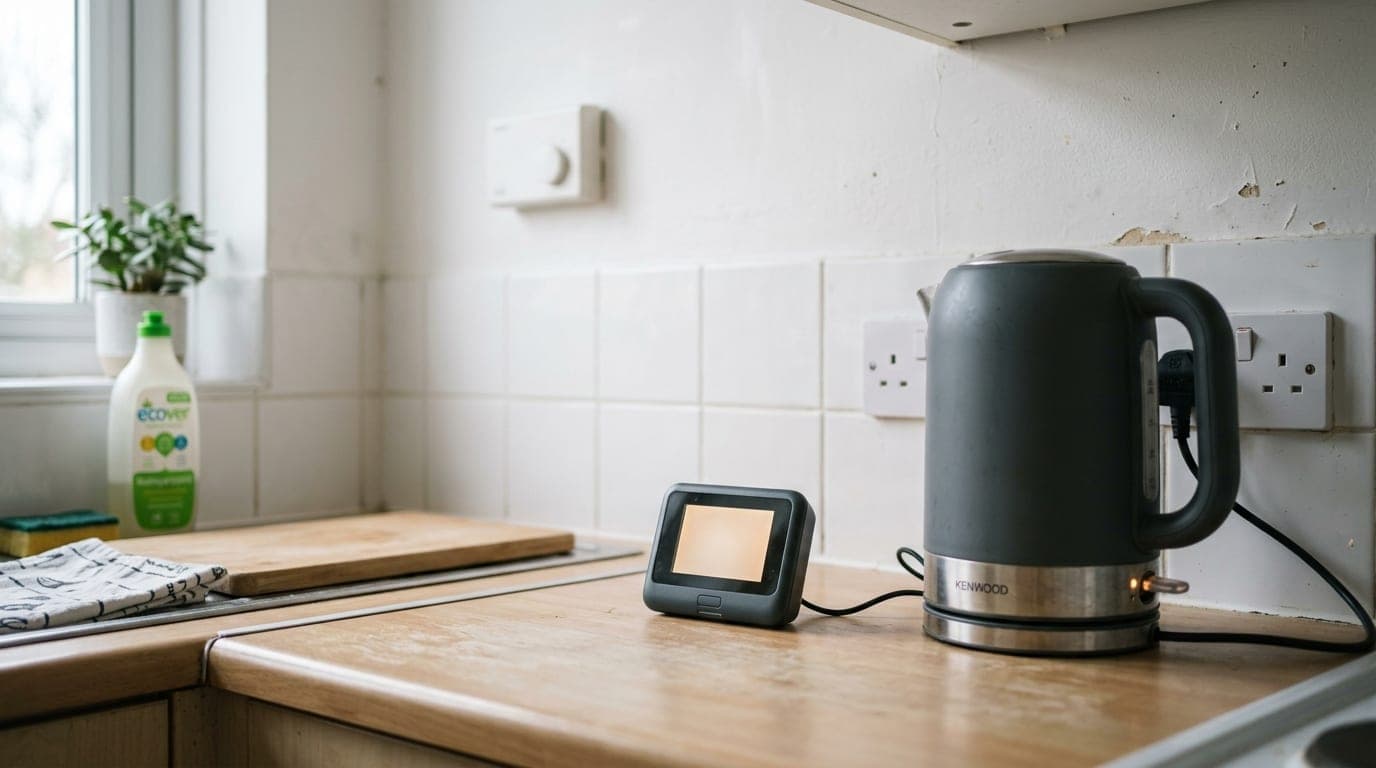
The in-home display. The small screen the installer leaves on the kitchen worktop shows spend in pounds and pence, updating in near real time for electricity and every 30 minutes for gas. It is a readout. It does not control anything.
Smart tariffs. Time-of-use tariffs need a smart meter to work, so some marketing implies the meter "improves efficiency". The EPC models a standard tariff type, not the deal the tenant signed up for.
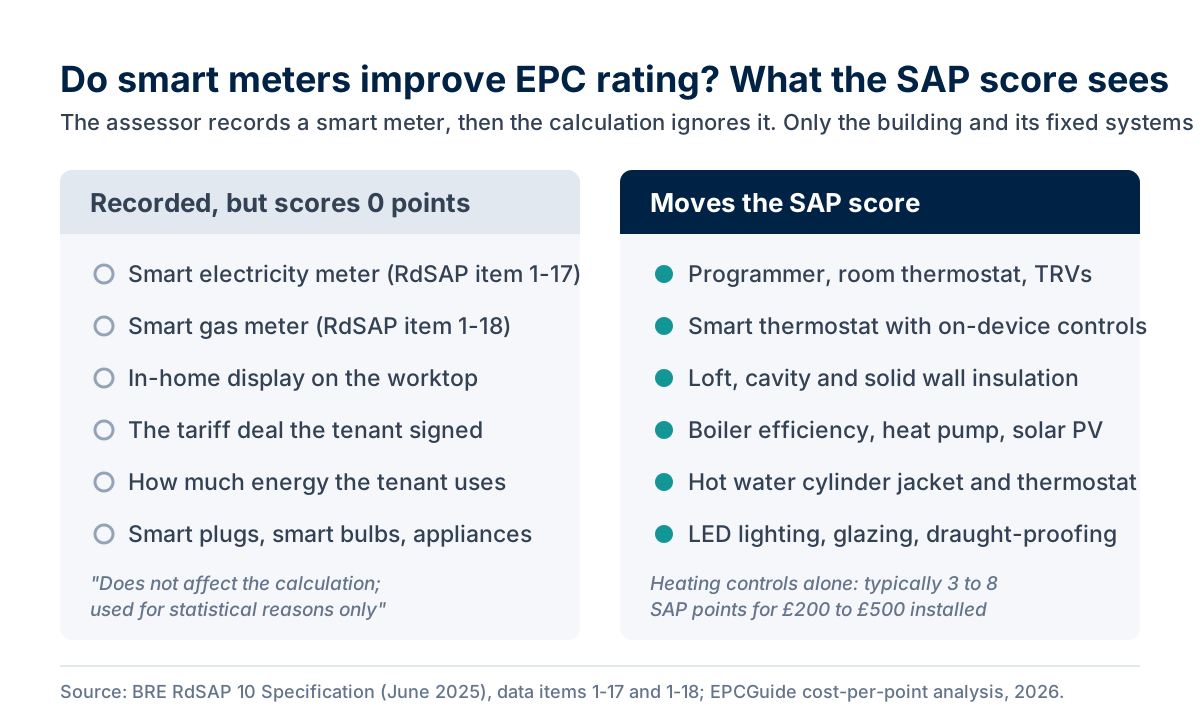 The survey form records a smart meter, then the calculation drops it. Heating controls, insulation, glazing, the boiler, the hot water cylinder and fixed lighting all feed the score.
Which heating controls do count on an EPC?
This is the part worth spending money on, because the point gains are real and the outlay is small. For a boiler with radiators, RdSAP 10 grades the controls on a ladder. Its improvement table uses these categories for wet central heating:
| RdSAP 10 controls category | What is fitted | Assessor's recommended upgrade |
|---|---|---|
| G-1 | No controls | Room thermostat, programmer and TRVs |
| G-2 | Programmer only | Room thermostat, programmer and TRVs |
| G-3 | Room thermostat only | Room thermostat, programmer and TRVs |
| G-4 | Room thermostat and TRVs, no programmer | Room thermostat, programmer and TRVs |
| G-5 | Programmer and a single room thermostat, no TRVs | Room thermostat, programmer and TRVs |
| G-6 | TRVs with or without programmer, no room thermostat | Room thermostat, programmer and TRVs |
| G1-1 | Programmer and at least two room thermostats | Time and temperature zone control |
The target state for a radiator system is a programmer, a room thermostat and thermostatic radiator valves. For a gas combi boiler, the specification also lists the four Building Regulations options from Approved Document L 2021 paragraph 6.2, one of which should be present: flue gas heat recovery, weather compensation, load compensation, or a "smart thermostat with automatization and optimisation".
Where does a Hive or Nest sit? Accreditation scheme conventions treat a smart thermostat with on-device controls (you can change the temperature and the schedule on the unit itself, without a phone) as a programmer and room thermostat. An app-only device with no physical interface is a grey area, so if you are buying one for EPC purposes, choose a model with a screen and buttons on the wall.
A full set of controls on a property with poor or no controls gains 3 to 8 SAP points for £200 to £500 installed, one of the best cost-per-point figures on the whole ranked list of EPC improvements. On a property that already has a programmer, thermostat and TRVs, swapping to a smart thermostat gains close to zero.
Myth-busting: what does not count, and what does
| Does not move the SAP score | Moves the SAP score |
|---|---|
| Smart electricity meter | Room thermostat, programmer, TRVs |
| Smart gas meter | Smart thermostat with on-device controls (scored as programmer and room thermostat) |
| In-home display | Time and temperature zone control |
| A cheaper or greener tariff | Off-peak (dual rate) electricity tariff type, where heating is electric |
| Energy usage habits of the tenant | Loft, cavity and solid wall insulation |
| Plug-in lamps, smart bulbs, portable heaters | Fixed low-energy lighting |
| Appliances (fridge, washing machine) | Boiler efficiency and age, heat pump |
| An energy monitoring app | Solar PV, solar thermal, PV battery storage (added in RdSAP 10) |
| Smart plugs | Hot water cylinder insulation and thermostat |
| A supplier's "energy saving" letter | Double or triple glazing, draught-proofing |
The pattern is simple. If it changes how much heat the building loses, how efficiently heat is made, or how the heating is controlled, it scores. If it measures, displays or bills, it does not.
What are the smart meter rules for landlords and tenants?
Most landlords have had the request by now. The rules are set out by Ofgem and are short.
Whoever pays the energy bill decides. Ofgem's wording: "If you pay for the gas or electricity in your rented property, you can choose to have a smart meter." A tenant with the bills in their own name can ask their supplier for one. If the landlord pays the bills and recharges through the rent, the decision is the landlord's.
A permission clause does not give you a veto. Many tenancy agreements say the tenant needs the landlord's permission to alter the metering. Ofgem's position is that where such a clause exists, the landlord "should not unreasonably prevent it". Smart Energy GB's landlord guidance carries the same line. Reasonable grounds are narrow: an unsafe meter position, a supply shared with another dwelling, or works that would damage the fabric.
Nobody is forced to have one. Ofgem is equally clear that a customer "can choose not to accept an offer to have a smart meter fitted", with the caveat that refusing "might mean you have a limited choice of energy tariffs". There is no legal obligation on a landlord to fit smart meters in rental property. No MEES penalty attaches to their absence.
Installation is free at the point of fitting. There is no separate charge for the meter or the in-home display. The installer needs access, so the usual 24 hours' notice for entry applies if the landlord is arranging it.
The display stays with the property. The in-home display is paired to that property's meter, so a departing tenant should leave it behind for the next occupant. Note it on the inventory. The meter itself switches between prepayment and credit mode remotely, so no physical swap is needed between tenancies.
The rollout is far advanced. DESNZ's quarterly smart meter statistics to end March 2026 count over 41 million smart and advanced meters in homes and small businesses across Great Britain, 72% of all meters, with about 38.0 million domestic meters running in smart mode.
None of this touches the EPC. A smart meter request is a tenancy administration question: say yes unless you have a specific reason, then do not book an EPC reassessment on the strength of the new meter.
What actually moves the score cheaply?
If the smart meter question came up because you are a few points short of a band, work from this list. Figures are the indicative ranges published across EPCGuide's cost guides, based on 2026 installed prices for a typical three-bed mid-terrace.
| Measure | Typical cost | Typical SAP gain | Cost per point |
|---|---|---|---|
| Hot water cylinder jacket | £15 to £25 | 1 to 3 | about £8 |
| LED lighting swap (fixed fittings only) | £100 to £300 | 3 to 8 | about £30 |
| Loft insulation top-up to 270mm | £300 to £600 | 5 to 15 | about £40 |
| Draught-proofing | £100 to £400 | 2 to 5 | about £55 |
| Heating controls (programmer, thermostat, TRVs) | £200 to £500 | 3 to 8 | about £55 |
| Cavity wall insulation | £500 to £1,500 | 10 to 20 | about £65 |
Band D runs from 55 to 68 SAP points and band C starts at 69, so the median D-rated rental needs about 9 points. Controls plus an LED swap plus a loft top-up covers that gap for most cavity-wall houses. Run your own combination through the EPC predictor before you spend: it estimates the new score from the measures you pick, so you can see whether a £300 controls upgrade is enough on its own.
Improvements only count once a new assessment records them, so budget £60 to £120 for a fresh EPC after the works. Our EPC points calculator explainer shows how the inputs stack into a score. The E to C upgrade guide sequences the bigger measures for properties two bands short.
Will smart meters count under the proposed new EPC metrics?
Possibly, under a proposal that is not law. The government's consultation response on EPC reform proposes four headline metrics in place of today's single score: energy cost, fabric performance, heating system and smart readiness. Under the January 2026 response, a private landlord in England and Wales would need band C on fabric performance plus band C on either heating system or smart readiness from 1 October 2030. Smart readiness covers smart controls, battery storage and flexibility, and a smart meter is expected to contribute to it. Our multi-metric EPC explainer covers how the secondary metrics would work.
Three things to hold onto. First, none of this is in force: the legal minimum for a let property in England and Wales today is band E under the 2015 MEES Regulations, with a £3,500 cost cap and a £5,000 maximum penalty, as set out in the GOV.UK landlord guidance updated 5 May 2026. Band C from October 2030, the £10,000 cap and the £30,000 penalty are proposed. They need an Act plus a statutory instrument before they bind anyone. Second, the Home Energy Model that would produce those metrics was delayed in June 2026; SAP 10.3 is the sole approved methodology for now. Third, smart readiness is a secondary metric behind fabric. Insulation would still decide compliance. A smart meter would never rescue a poorly insulated house on its own.
For today's certificate, the answer stays no.
Frequently Asked Questions
Do smart meters improve EPC rating? No. The RdSAP 10 assessment records whether a smart meter is present as a yes or no answer and states that the item "does not affect the calculation; used for statistical reasons only". The SAP score models the building's fabric, heating, controls, hot water and lighting under standard occupancy, not how much energy the tenant uses.
Does a smart thermostat improve an EPC rating? It can. A smart thermostat with on-device controls is scored as a programmer and room thermostat. On a property with no thermostat or only a programmer, a full set of controls typically adds 3 to 8 SAP points for £200 to £500. On a property that already has a programmer, thermostat and TRVs, the gain is near zero.
Can a landlord refuse a tenant's request for a smart meter? Only with a reasonable ground. Ofgem's position is that where a tenancy agreement requires the landlord's permission to alter the metering, the landlord "should not unreasonably prevent it". If the tenant pays the energy bills, the choice is theirs. If the landlord pays the bills, the landlord decides.
Are smart meters compulsory for rental properties? No. There is no legal requirement on landlords to fit smart meters, and their absence carries no MEES penalty. Suppliers must offer them, but a customer can decline, although declining may limit the tariffs available.
Will the EPC assessor ask about my smart meter? Yes, in most cases. The RdSAP 10 survey includes two data items, presence of a smart electricity meter and presence of a smart gas meter, which the assessor records for statistical purposes. The answer has no effect on the rating.
Does the in-home display count as a heating control? No. The in-home display shows energy spend in pounds and pence; it does not switch or regulate the heating. Only devices that control the boiler, heat pump or radiators, such as a programmer, room thermostat, TRVs or a smart thermostat, are scored as heating controls.
Will a smart meter help under the proposed 2030 EPC C standard? Possibly, under a proposal that is not yet law. The proposed multi-metric EPC includes a smart readiness metric, to which a smart meter is expected to contribute, but fabric performance would remain the primary requirement. Today the legal minimum is band E. On the current certificate a smart meter scores nothing.
What is the cheapest way to raise an EPC rating if a smart meter does not count? A hot water cylinder jacket (£15 to £25, 1 to 3 points), a fixed LED lighting swap (3 to 8 points), a loft top-up to 270mm (5 to 15 points) and a full set of heating controls (3 to 8 points). Together those cover the gap for most D-rated cavity-wall houses. Check your own combination in the EPC predictor before spending.