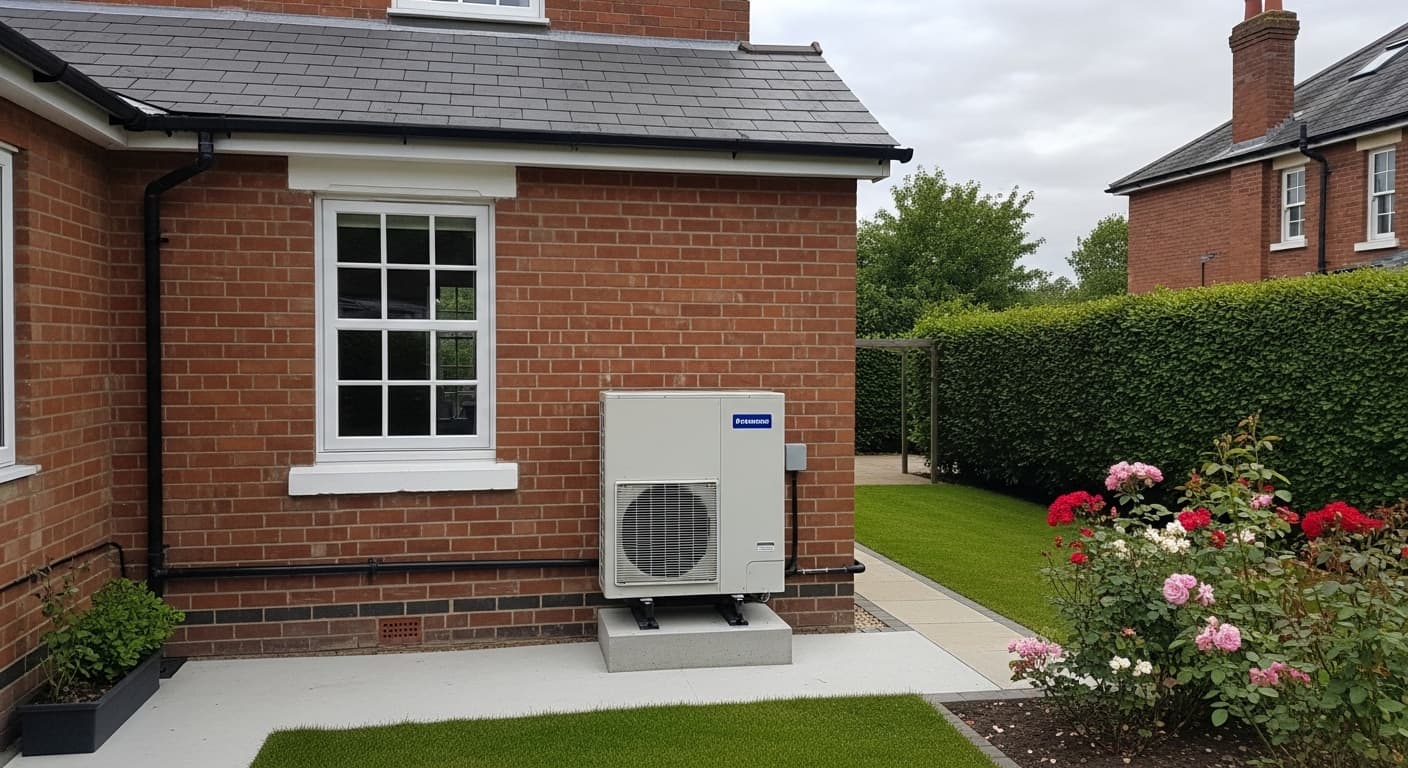
For a landlord planning against the government's proposed EPC C standard for 1 October 2030, which is not yet law, the heating system is one of the biggest single levers you can pull. It is also one of the most expensive, which makes the heat pump versus gas boiler decision worth getting right the first time. The two options are not close on EPC impact. A heat pump typically delivers a much larger rating boost because of how the SAP methodology scores efficiency, while a modern condensing gas boiler gives a smaller gain at a lower upfront cost. According to EPCGuide's analysis of the full EPC register for England and Wales, the average property scores 63 on SAP, six points below the band C threshold of 69, and heating is often what closes that gap. This guide sets out the trade-off in plain terms so you can choose based on your property, your budget, and your timeline.
Why does the heating system move the EPC so much?
The EPC rating is driven by the SAP (Standard Assessment Procedure) score, and the heating system is one of the largest single factors in that calculation. The reason is efficiency, and the way SAP measures it favours heat pumps heavily.
A modern condensing gas boiler runs at roughly 90 to 92% efficiency: it turns most of the gas it burns into useful heat, but never more than the energy it consumes. A heat pump works differently. It moves heat rather than burning fuel, so for every unit of electricity it uses, it delivers several units of heat. A heat pump with a coefficient of performance (COP) of around 3.5 is treated in SAP as roughly 350% efficient.
That gap, 90% versus 350%, is why the two systems land so far apart on the EPC. SAP rewards the heat pump for producing far more heat per unit of energy, and the rating reflects it. This is the single most important fact in the decision: the choice is not marginal.
How much EPC boost does each option give?
The honest answer is that it depends on the property's starting point and the rest of its fabric, but the direction and rough scale are consistent.
Heat pump. Replacing a fossil-fuel boiler with an air-source heat pump typically lifts the EPC by one to two bands where the fabric supports it, for example D to C or E to C/D. In SAP-point terms this is often in the region of 10 to 15 points, though the exact figure varies with insulation, property type, and the system specified.
Modern condensing gas boiler. Upgrading from an old, inefficient boiler to a new condensing model gives a smaller gain, often in the region of 5 to 10 SAP points depending on what it replaces. A gas boiler upgrade alone is frequently not enough to move a band E property to band C: you usually need insulation improvements alongside it.
The practical read: if the property is close to band C, a good gas boiler upgrade combined with insulation might be enough. If it has further to climb, the heat pump is far more likely to get it over the line, and it does so on the strength of the heating change alone. Model your own property's likely rating with the EPCGuide EPC predictor before committing.
Heat pump vs gas boiler: the landlord comparison
Here is the decision laid out across the factors that matter to a landlord.
| Factor | Air-source heat pump | Modern condensing gas boiler |
|---|---|---|
| Typical EPC boost | Larger, roughly 10-15 SAP points, often 1-2 bands | Smaller, roughly 5-10 SAP points |
| Typical installed cost | Higher, commonly £8,000-£18,000 | Lower, commonly £2,000-£4,000 |
| Grant support | £7,500 via Boiler Upgrade Scheme | None |
| Net cost after grant | Often £500-£10,500 | Full cost, unfunded |
| Running cost for tenant | Efficient, but sensitive to electricity price and system design | Predictable, gas-price dependent |
| Property suitability | Needs space for an outdoor unit and adequate insulation | Fits almost any property with a gas supply |
| Future-proofing | Aligned with decarbonisation policy | Facing long-term policy headwinds |
| Disruption to fit | Higher, may need larger radiators | Lower, usually a straight swap |
Two lines in that table decide most cases: the grant and the EPC boost. The heat pump is the more expensive system on paper, but the £7,500 BUS grant narrows the gap substantially, and it delivers the bigger rating jump. The gas boiler is cheaper and simpler, but unfunded and lower-scoring.
When does a heat pump make sense for a landlord?
A heat pump is the stronger choice when several of these hold:
- The property needs a real EPC jump. D and E are legal to let today, but if you are planning for the proposed band C standard, the heat pump is the surer route on heating alone.
- The fabric is decent, or you will improve it. Heat pumps perform best in insulated homes. If the property is poorly insulated, plan insulation first (BUS requires no outstanding insulation recommendations on the EPC anyway).
- There is space for an outdoor unit. A flat with no external wall or garden is a harder fit.
- You are holding the property long-term. The upfront cost and disruption make more sense across a longer hold, where the EPC compliance and future-proofing value accrues.
- You can use the grant. £7,500 off through BUS changes the maths materially.
For the funding detail, see our Boiler Upgrade Scheme application guide. Model the payback with the EPCGuide ROI calculator.
When does a gas boiler still make sense?
A gas boiler upgrade can still be the right call in specific cases:
- The property is already close to band C. If a boiler upgrade plus modest insulation lands you at C, you may not need the heat pump's larger gain or larger cost.
- The heat pump is impractical. No outdoor space, a flat with restrictive freeholder rules, or a property where the fabric cannot support a heat pump efficiently.
- Budget is tight and the timeline is short. A gas boiler is cheaper and quicker to install, though it attracts no grant.
- The existing boiler has failed and needs immediate replacement. Sometimes the practical need overtakes the strategic one, though it is worth pausing to check whether BUS-funded heat pump timing is feasible before defaulting to a like-for-like swap.
Bear in mind the direction of policy. There is no grant for a gas boiler, and long-term the regulatory pressure runs against fossil-fuel heating. A gas boiler bought in 2026 is a working system, but it is not a future-proof one. Our guide to landlord heating requirements to 2030 sets out where the rules are heading.
What about running costs for tenants?
EPC compliance is your obligation, but running cost affects lettability and tenant relations, so it belongs in the decision.
A well-designed heat pump in a properly insulated home can be cheaper to run than gas heating, because its efficiency more than offsets electricity being more expensive per unit than gas. But that outcome depends on good design, adequate insulation, and the electricity-to-gas price ratio, which moves. A poorly specified heat pump in a leaky property can cost a tenant more, which damages the property's appeal.
A gas boiler gives predictable, familiar running costs tied to the gas price. There is less that can go wrong on the design side, but the system is locked to a fossil fuel whose long-term policy trajectory is downward.
The safe conclusion: a heat pump is a running-cost win only when the fabric and design are right. Get the insulation sorted first. Our costs section and cost calculator help sequence and price the fabric work.
Will the Home Energy Model change this?
Worth flagging, because it affects the medium-term maths. The government is moving from RdSAP to the Home Energy Model as the basis for EPC assessments. It announced on 9 March 2026 that the launch moves to the second half of 2027. The Home Energy Model is intended to reflect real-world performance and low-carbon heating more accurately than the current methodology.
The current SAP approach already scores heat pumps favourably. The Home Energy Model could change how both heating types are rated, and the detail is not final. For a landlord deciding now, this does not change the core position, heat pumps score well and attract a grant, gas boilers do not, but it is a reason to weight future-proofing in the decision rather than optimising purely for today's SAP figure.
What EPCGuide's data says about the heating decision
EPCGuide maintains the largest independent analysis of the domestic EPC register for England and Wales: 27.6 million certificates covering 19.7 million homes.
- 49.6% of homes sit below band C, roughly 9.8 million homes, all in scope of the proposed 2030 standard.
- The average SAP score is 63, six points below the band C threshold of 69. For many properties, the heating system is the single change large enough to close that gap.
- Band D is the most common rating at 37.8%. These are the homes where the heat-pump-versus-boiler decision most often determines whether the property clears band C.
The strategic read: with the proposed EPC C standard set for 1 October 2030, and a proposed rise in the maximum civil penalty from the £5,000 in total per property in force today to £30,000, the heating decision is a compliance decision as much as a comfort one. Both changes need legislation that has not been laid. The heat pump delivers the larger EPC boost and carries a £7,500 grant, but only performs when the fabric supports it. The gas boiler is cheaper and simpler but lower-scoring and unfunded. Insulate first, then choose the heating system that clears your property's specific gap to band C. Our interactive local authority map shows where the least efficient rented stock sits.
Frequently asked questions
Does a heat pump improve an EPC rating more than a gas boiler?
Yes, generally by a wide margin. A heat pump typically lifts the EPC by one to two bands, roughly 10 to 15 SAP points, because SAP treats a heat pump with a COP of around 3.5 as roughly 350% efficient, against 90 to 92% for a gas boiler. A gas boiler upgrade gives a smaller gain, often 5 to 10 SAP points.
Can a new gas boiler get my rental property to EPC C?
Sometimes, but often not on its own. Upgrading from an old boiler to a new condensing model gives a smaller EPC gain, and a property currently at band E usually needs insulation improvements alongside the boiler to reach band C. If the property is already close to C, a boiler upgrade plus modest insulation may be enough.
Is a heat pump worth it for a landlord given the higher cost?
For many landlords planning for the proposed 2030 standard, yes. The installed cost is higher, commonly £8,000 to £18,000, but the £7,500 Boiler Upgrade Scheme grant brings the net cost down substantially, and the heat pump delivers the larger EPC boost. It makes most sense for a decently insulated property held long-term with space for an outdoor unit.
Do landlords get a grant for a gas boiler?
No. There is no grant for a gas boiler for landlords in 2026. The Boiler Upgrade Scheme funds heat pumps, not gas boilers. A gas boiler is a private, unfunded cost, whereas a heat pump attracts up to £7,500 through BUS.
Which is cheaper to run for tenants, a heat pump or a gas boiler?
It depends. A well-designed heat pump in a well-insulated home can be cheaper to run than gas, because its efficiency offsets electricity's higher unit price. A poorly specified heat pump in a leaky property can cost more. A gas boiler gives predictable running costs. Insulation quality is the deciding factor for the heat pump.
Do I need to insulate before installing a heat pump?
Usually yes. Heat pumps perform best in well-insulated homes, and the Boiler Upgrade Scheme requires the property's EPC to have no outstanding insulation recommendations. Sorting insulation first improves both the heat pump's performance and the tenant's running costs.
Will the Home Energy Model change how heating is scored?
Possibly. The government is moving from RdSAP to the Home Energy Model for EPC assessments, with the launch moved to the second half of 2027, to reflect real-world performance and low-carbon heating more accurately. It could adjust how both heating types are rated. For now, heat pumps score well and attract a grant, which is a reason to weight future-proofing in the decision.
What is the best heating upgrade for EPC before the proposed 2030 date?
For most landlords who need a real band jump, a heat pump combined with adequate insulation is the strongest route, because it gives the larger EPC boost and carries a grant. Where a property is already close to band C, or a heat pump is impractical, a gas boiler upgrade plus insulation can be sufficient. The right answer depends on the property's starting rating and fabric.
This article was last updated on 19 August 2026. EPCGuide's analysis covers the full domestic EPC register for England and Wales: 27.6 million certificates covering 19.7 million homes. For methodology and interactive data, visit the EPCGuide Research Hub.