An EPC certificate (Energy Performance Certificate) is a document that rates how energy efficient a home is on a scale from A, the best, to G, the worst, and lists the improvements that would move it up the scale. In England and Wales you must have one before you market a property to let, it lasts 10 years, and the letter on it decides whether you can legally rent the property out at all.
That last part is where most general explainers stop, because they are written for buyers and sellers. This guide covers the certificate from a landlord's side, through to how the rating connects to the band E minimum in force today and the band C standard proposed for 2030.
What does an EPC certificate actually show?
The certificate is a short report, usually four to six pages, produced after an accredited assessor inspects the property. The first page carries the part everyone recognises: a coloured chart from A to G with an arrow marking where the property sits. Behind the letter is a number from 1 to 100 called the SAP score (Standard Assessment Procedure), and the band is a bracket applied to that score.
The rest of the document is more useful to a landlord than the chart:
- Estimated energy costs for heating, hot water and lighting, with a figure for how much the recommended improvements could save.
- A breakdown by element. Walls, roof, floor, windows, main heating, heating controls, hot water and lighting each get a star rating and a one-line description such as "cavity wall, as built, no insulation (assumed)".
- Recommended improvements, in the order the assessor suggests doing them, each with an indicative cost range and the rating the property would reach after that step.
- Property facts the assessment relied on: floor area, property type, construction date band, main fuel.
The word "assumed" matters. An assessor works from what can be seen or evidenced on the day. Insulation hidden behind plasterboard or a boiler with no visible model plate gets a default value, often worse than reality. Since 15 June 2025, assessments use the RdSAP 10 methodology, which records insulation thickness and boiler efficiency more precisely when evidence is presented, so a certificate lodged before that date may understate a property that has been improved.
What are the two ratings on an EPC?
A domestic EPC carries two separate A to G ratings that measure different things. Government's statistical release on certificates describes them this way: the Energy Efficiency Rating (EER) is "based on estimated fuel costs" and the Environmental Impact Rating (EIR) is "based on CO2 emissions". Source: GOV.UK EPC statistics, January to March 2026.
The Energy Efficiency Rating is the one that matters legally. It is the big chart on page one, it is the number the MEES regulations test against, and it is what people mean when they say "the property is a D". Because it is a cost metric, a home on cheap mains gas can score better than an identical home on electric heating, even if the electric home emits less carbon.
The Environmental Impact Rating sits lower down the document and has no bearing on whether you can let the property. Our guide to the multi-metric EPC system covers how the proposed new-format certificate would split the single rating into several.
Current versus potential
Each chart also has two arrows. The current arrow is the property today. The potential arrow is where the property would land if every recommended improvement were carried out. For a landlord planning works, the gap between the two is the first free piece of advice you get, because the recommendations list is a costed route from one arrow to the other. The EPC rating chart guide walks through the SAP score behind each band.
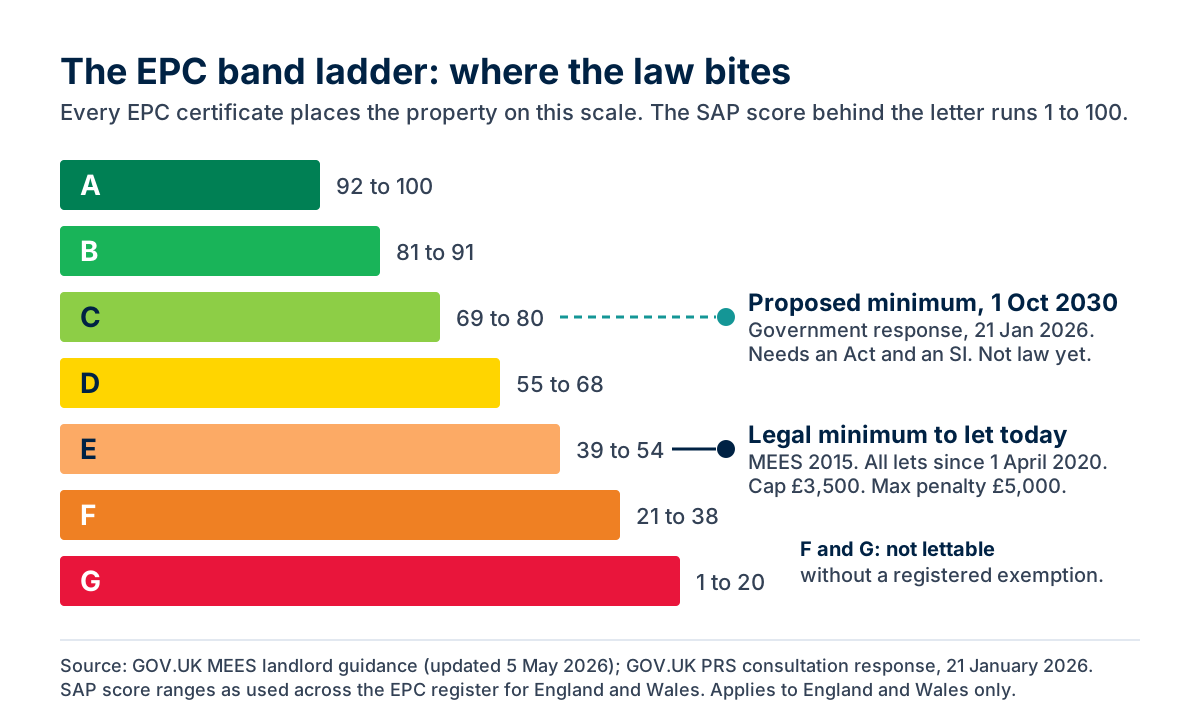 The band ladder on every EPC certificate. Band E is the legal minimum to let in England and Wales today. Band C from 1 October 2030 is still only a proposal.
Who issues an EPC certificate?
Only an accredited Domestic Energy Assessor (DEA) can produce a valid EPC for an existing home. The assessor visits the property, records its construction, insulation, glazing, heating and lighting, runs the data through the government-approved RdSAP model, and lodges the result on the national register. New-build homes are assessed by a separate class of assessor working from plans, using full SAP.
Lodging is the step that makes the certificate real. An assessment that was never lodged does not exist as far as a council or a court is concerned. You can confirm any certificate is on the register, and download it free, at GOV.UK's find an energy certificate service. That register covers England, Wales and Northern Ireland; Scotland has its own.
There is no government EPC assessor. GOV.UK's get a new energy certificate page lists accredited assessors by postcode, each a private business setting its own price. Our guide to choosing an EPC assessor covers what to ask before booking.
How much does an EPC certificate cost?
Between £60 and £120 for most rental properties in 2026, with a one or two bed flat at the bottom of that range and a four bed house or an HMO above it. London and the South East run 10% to 30% higher. There is no set fee: it is a market price. Our EPC assessment cost guide breaks it down by property type and location.
Two cost details that general guides skip:
- The certificate is free to the tenant. Regulation 6 of the Energy Performance of Buildings (England and Wales) Regulations 2012 requires you to make a valid EPC available "free of charge to any prospective buyer or tenant" and to give one to the person who becomes the tenant. You cannot pass the cost on as a fee.
- The assessment fee counts toward the MEES cost cap. If you are spending on improvements to reach the minimum standard, the fee is part of the £3,500 you must spend before a high-cost exemption is available. Keep the receipt.
When is an EPC legally required?
GOV.UK's guidance on Energy Performance Certificates sets three triggers: selling a property, renting one out, and building one. The certificate must exist before the property is marketed. Regulation 6 of the 2012 Regulations puts the timing more sharply: the EPC has to be made available "at the earliest opportunity" and in any event before written particulars go out or a viewing takes place, whichever comes first.
For a landlord that means:
| Situation | EPC needed? | Notes |
|---|---|---|
| Marketing a property to let | Yes, before the first viewing or written listing | Regulation 6, EPB Regulations 2012 |
| Signing a new tenancy | Yes, a copy must be given to the tenant | Also a precondition for serving certain possession notices |
| Renewing with the same tenant on the same terms | No new certificate needed | An expired EPC is not automatically an offence mid-tenancy |
| Tenancy converting to periodic on 1 May 2026 (Renters' Rights Act) | No | Not a new letting for EPC or MEES purposes |
| Certificate reaches 10 years old | Renew before the next marketing or new tenancy | Nothing on GOV.UK reminds you; diarise the expiry |
| Holiday let used under 4 months a year | No | One of the statutory exemptions |
The validity period is 10 years from lodgement (full detail in how long an EPC lasts). The January 2026 government response on EPC reform confirmed it intends to keep the 10-year validity for the reformed certificate, with existing certificates keeping their remaining term. The same response said government is still "working to refine the position on requiring a new EPC when an existing one expires" for private rented homes, so an expiry-triggered renewal duty is on the table but undecided. Under current law you need a valid certificate at the point of marketing and letting; there is no duty to hold one continuously. See our guide to EPC expiry mid-tenancy.
What is the penalty for not having an EPC?
This is where two separate legal regimes get muddled, and where the top-ranking explainers say nothing useful.
Failing to have or provide an EPC is a breach of the Energy Performance of Buildings Regulations 2012, enforced by trading standards. Regulation 38 sets the penalty for a dwelling at a fixed £200. Source: SI 2012/3118, regulation 38. The fine is small; the real cost is that without a certificate you cannot show the property complies with MEES, and you cannot lawfully market it.
Letting a property whose EPC is below band E is a different offence under a different set of regulations, with a much bigger penalty.
What is the minimum EPC rating to rent a property?
Band E. Under the Energy Efficiency (Private Rented Property) (England and Wales) Regulations 2015, known as MEES, a domestic property rated F or G cannot be let on a new tenancy since 1 April 2018, and cannot be let at all since 1 April 2020, unless a valid exemption is registered. This is the law in force today. GOV.UK's landlord guidance on the minimum standard was last updated on 5 May 2026 and still states band E, a £3,500 cost cap inclusive of VAT, and a maximum penalty of £5,000 per property.
The penalty structure, from the same guidance:
| Breach | Maximum penalty |
|---|---|
| Letting a non-compliant property for under 3 months | £2,000 |
| Letting a non-compliant property for 3 months or more | £4,000 |
| Providing false or misleading information to the Exemptions Register | £1,000 |
| Failing to comply with a compliance notice | £2,000 |
| Total cap per property, all breaches combined | £5,000 |
If the property cannot reach E within the £3,500 cap, or a freeholder or tenant refuses consent for the works, you register an exemption on the PRS Exemptions Register. Most exemptions last five years; the one for someone who has recently become a landlord lasts six months. The complete guide to EPC exemptions covers each ground and the evidence it needs.
If you want to know where a property sits before spending anything, the free EPC predictor estimates a likely score from its age, type and heating, and the postcode EPC lookup pulls the existing certificate from the register.
How does the EPC certificate link to the proposed band C standard for 2030?
Everything in the previous section is law. This section is a proposal, and the distinction is the most important thing to take from this article.
On 21 January 2026, government published its response to the consultation on improving the energy performance of privately rented homes. It proposes that all private rented homes in England and Wales meet a standard equivalent to band C by 1 October 2030, on a single date with no earlier phase for new tenancies. The proposed cost cap is £10,000 per property, or 10% of the property's value where that is lower. The proposed maximum penalty is £30,000 per breach. Three exemption grounds (cost cap, property value adjustment and negative impacts) would last 10 years.
None of that is in force. The response says government "will seek new powers by Act of Parliament" and then lay a statutory instrument to amend the 2015 Regulations, aiming for 2027. Until that instrument passes, the legal minimum stays at band E, the cap at £3,500 and the maximum penalty at £5,000. An almost identical band C proposal was dropped in September 2023 without any repeal, because it had never become law.
| Law today (MEES 2015) | Proposed (January 2026 response) | |
|---|---|---|
| Minimum band to let | E | C, from 1 October 2030 |
| Cost cap | £3,500 inc VAT | £10,000, or 10% of value if lower |
| Maximum penalty | £5,000 per property | £30,000 per breach |
| Exemption length | 5 years (6 months for new landlords) | 10 years on three grounds, 5 years on others |
| Legal status | In force since April 2020 | Needs an Act and a statutory instrument, targeted 2027 |
One further wrinkle. The proposed 2030 standard would be measured on the reformed EPC, which replaces the single cost rating with four headline metrics: energy cost, fabric performance, heating system and smart readiness. The proposed test is a primary standard on fabric performance plus a secondary standard on either heating system or smart readiness, so "band C" is shorthand for a test on a certificate format that does not yet exist. The launch date for that format has slipped; see our guide to the Home Energy Model delay, and the 2030 EPC C deadline guide for planning.
For a landlord reading a certificate today: a D or E is legal now and needs no action under current law. If the proposal becomes law, the recommendations list on that same certificate is the first draft of the plan, and spend from 1 October 2025 is proposed to count toward the higher cap. Either way, check the expiry date, keep the PDF with the tenancy file, and diarise the renewal a few months before the 10 years run out.
Frequently Asked Questions
What is an EPC certificate in simple terms? An EPC certificate is a report that grades a home's energy efficiency from A (best) to G (worst), estimates its running costs, and lists improvements that would raise the grade. It is produced by an accredited assessor after a site visit and lodged on a national register. In England and Wales you need one before marketing a property to sell or let.
How long does an EPC certificate last? Ten years from the date it is lodged. Government's January 2026 response on EPC reform confirmed it intends to keep the 10-year validity for the reformed certificate, and existing certificates keep their remaining term. You can check any certificate's expiry date free on GOV.UK's find an energy certificate service.
How much does an EPC certificate cost? Between £60 and £120 for most rental properties in 2026. Smaller flats sit at the lower end, larger houses and HMOs higher, and London and the South East add 10% to 30%. There is no fixed fee; assessors set their own prices.
Do I need a new EPC every time a tenant changes? No, as long as the existing certificate is still within its 10 years. You must give a copy of the valid certificate to each new tenant, and it must be available before the property is marketed. A renewal with the same tenant, or an automatic conversion to a periodic tenancy, does not require a new certificate.
What is the minimum EPC rating to rent out a property? Band E, under the Energy Efficiency (Private Rented Property) (England and Wales) Regulations 2015. Properties rated F or G cannot be let unless a valid exemption is registered on the PRS Exemptions Register. The maximum civil penalty for breaching this is £5,000 per property.
Is EPC band C already required for rented properties? No. Band C by 1 October 2030 was proposed in the government's January 2026 consultation response, alongside a proposed £10,000 cost cap and £30,000 penalty. It needs an Act of Parliament and a statutory instrument, neither of which has been passed. Band E remains the legal minimum today.
What is the difference between the two ratings on an EPC? The Energy Efficiency Rating is based on estimated fuel costs and is the rating the law tests against. The Environmental Impact Rating is based on carbon dioxide emissions and has no bearing on whether you can let the property. Both use the same A to G scale, which is why they are easy to confuse.
Can I do my own EPC assessment? No. Only an accredited Domestic Energy Assessor can produce a valid EPC, and the certificate must be lodged on the national register to count. An unlodged assessment, however accurate, has no legal standing.