
An Energy Performance Certificate lasts 10 years from the date it was entered on the national register, in England, Wales and Northern Ireland. It expires on the "valid until" date printed on the certificate, unless a newer certificate for the same property is lodged first, in which case the older one stops counting straight away.
That second part is easy to miss. This guide covers what triggers a new certificate, what you can safely ignore, and when renewing early pays off, with current law and the 2030 changes (decided policy, not yet law) kept firmly apart.
How long does an EPC last?
Ten years. Regulation 9 of the Energy Performance of Buildings (England and Wales) Regulations 2012 says a certificate is valid only if it "was entered on the register no more than 10 years before the date on which it is made available". The clock starts on the day the certificate is entered on the register.
Three details follow from that wording:
- The date that matters is the register date, not the survey date. The two are normally close together, but the regulation counts from the register entry, and the register shows the "Valid until" date you can check yourself.
- There is no partial validity. A certificate is either inside its 10 years or outside them. Nothing about the rating fades or downgrades over time.
- A newer certificate replaces an older one. Regulation 9 also requires that "no other energy performance certificate for the building has since been entered on the register". More on why that catches landlords out below.
The government asked whether validity should be shortened. Respondents who wanted a shorter period mostly preferred five years, but the majority favoured keeping 10, and a significant majority of landlords disagreed with a cut. In its partial response to the EPC reform consultation, published 21 January 2026, it said: "We intend to maintain the current ten-year validity period for reformed EPCs, whilst existing EPCs will retain their ten-year validity, in recognition of consultation responses highlighting the cost of commissioning EPCs more regularly." That is a stated intention. Reformed certificates are now expected in the second half of 2027, according to the government's 10 March 2026 update on the same consultation page.
Scotland and Northern Ireland have their own rules on some points, covered in a short section further down.
New to EPCs? Our guide to what an EPC certificate is covers the basics.
How do I check my EPC expiry date?
Use the free GOV.UK service at gov.uk/find-energy-certificate. It covers England, Wales and Northern Ireland. You can search by postcode, by street name and town, or by certificate number. Postcode results list each certificate with a "Valid until" column, and older certificates are marked "Expired". Each certificate page shows the energy rating, the "Valid until" date, the certificate number and the assessor's details.
Three things to check while you are there:
- The valid until date. Note it in your compliance calendar. If it falls inside the next 18 months, read the early-renewal section below first.
- That the address matches your unit, not the building. The government's guide to EPCs for the marketing, sale and let of dwellings says only the most recent EPC for each distinct building or building unit is valid, so a flat needs its own certificate.
- That the certificate you gave your tenant is the newest on the register. If anyone has lodged a later assessment, the copy in your tenancy pack is no longer the valid one.
If you manage several properties, our postcode EPC lookup pulls the rating and expiry for each address in one go. For a walkthrough of the register, including what to do when a property does not appear at all, see how to find an EPC certificate.
When does a landlord legally need a valid EPC?
The 2012 Regulations attach the duty to letting events. Regulation 6 requires the landlord (the "relevant person") to make a valid EPC available free of charge to prospective tenants at the earliest opportunity, and to ensure that a valid certificate has been given free of charge to the person who ultimately becomes the tenant.
Regulation 7 sets the marketing timetable where no valid certificate is available. Before marketing starts, the landlord must secure that an EPC is commissioned. They must then use all reasonable efforts to obtain a valid one within 7 days of first marketing the property, and if that fails, obtain it within a further 21 days. That is where the "28 days" figure comes from. The government has said it intends to require an EPC at the point of marketing, but that is an intention in the same partial response, not a change to the regulations. Our 28-day grace period guide tracks it.
In practice:
- Before marketing to a new tenant: if you do not already hold a valid certificate, commission one. If you do, there is nothing to commission.
- Before a new tenant moves in: they must have been given a valid certificate, free of charge.
- For MEES: DESNZ's landlord guidance says that since 1 April 2020 landlords "can no longer let or continue to let properties covered by the MEES Regulations if they have an EPC rating below E, unless they have a valid exemption in place".
The penalty for missing the regulation 6 or 7 duties on a dwelling is a fixed £200 under regulation 38, enforced by trading standards. That is separate from MEES, where the DESNZ landlord guidance says the maximum you can be fined per property is £5,000 in total. Our EPC fines guide sets out both regimes side by side.
The same partial response also says the government intends to require a valid EPC for a whole HMO when a single room is let, for short-term rental properties irrespective of who pays the energy bills, and to remove exemptions for heritage properties. None of that is law yet. See the HMO EPC guide and the listed building guide for those property types.
Does an EPC have to be renewed mid-tenancy?
Not under current law. The government's guide says existing occupiers and tenants do not require an EPC unless they sell, assign or sublet their interest in the building, and it does not treat a lease renewal or extension as a sale or let. An expiry date passing during a tenancy is therefore not a breach by itself.
Two things could change that. The government is still working out whether to require a new EPC when an existing one expires for all private rented buildings, and its final response is due in 2026. And the Renters' Rights Act, which received Royal Assent on 27 October 2025, makes all tenancies periodic, while the guide above pre-dates it and no official source we found says whether that alters the EPC position. Our full guide to EPC expiry mid-tenancy covers the edge cases.
What happens if my EPC has expired?
An expired certificate cannot be used to market or let a property. Regulation 9 counts a certificate as valid only if it was entered on the register no more than 10 years before it is made available.
Expiry does nothing on its own. The certificate stays on the register, and a tenancy that is already running is not affected. It bites at your next letting event, when you must commission a new EPC before marketing and have it within the 7 plus 21 days that regulation 7 allows. If you miss that, the fixed penalty for a dwelling is £200 under regulation 38. The government's guide says trading standards can issue it up to six months after the failure is corrected.
There is no grace period after expiry. Regulation 9 has no provision that extends a certificate beyond 10 years. The 28-day figure you may have seen relates to marketing, not to expiry. For the mid-tenancy question see the guide to EPC expiry mid-tenancy.
When should a landlord renew an EPC early?
A certificate does not have to be expired for a new one to make sense. The question is whether a fresh assessment will improve your position, because under regulation 9 it replaces whatever is on the register, better or worse.
| Situation | Renew early? | Why |
|---|---|---|
| Just completed insulation, boiler or heating works | Yes, once the works are finished | The old certificate does not credit the new measures. A new one records the higher score for the next 10 years |
| About to market or re-let with under 12 months left | Often worth it | It gives the next tenant a certificate with a longer run. It is not a legal requirement |
| Current rating is D or E and you are planning works before the 2030 standard | Only after the works | An early certificate before works records the same low band for another decade |
| Rated C and you want to extend 2030 protection | Worth considering, before 1 October 2029 | Under decided policy, a C or better on an EPC issued before 1 October 2029 counts as compliant until that EPC expires or is replaced, so a new C starts a fresh 10 years. A lower score would replace it. Decided policy, not yet law |
| Certificate expired mid-tenancy, no new letting planned | Not required | No letting event, so no breach under current law |
| Certificate valid, no works, no letting event | No | A new assessment could score lower and would replace the existing one |
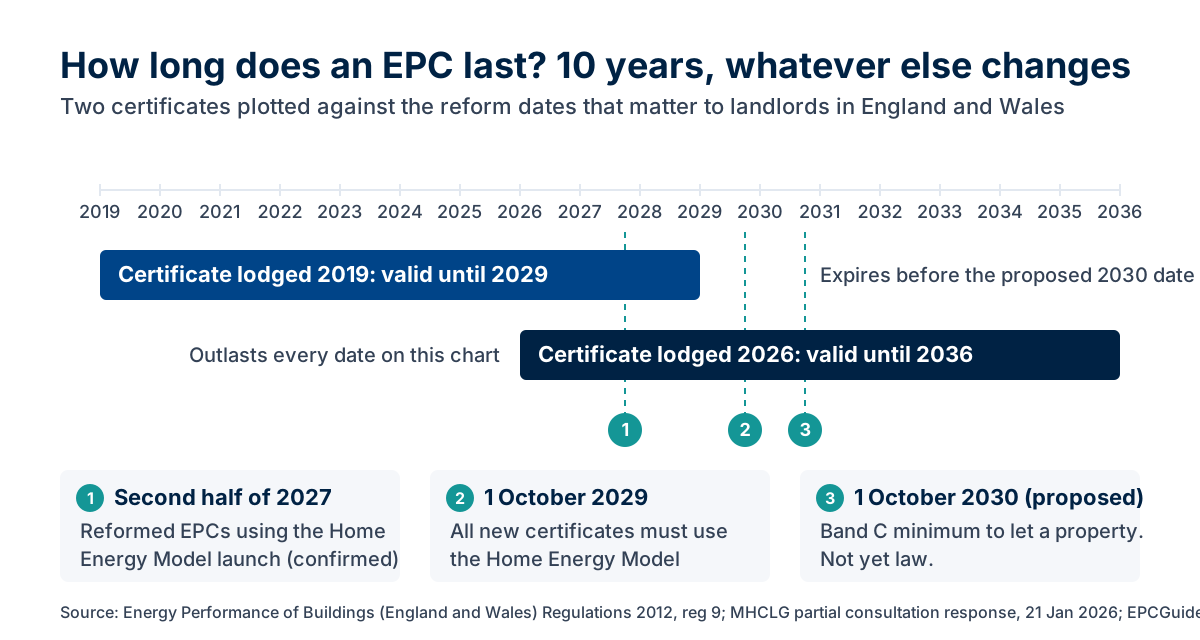 A certificate lodged today runs to 2036, past every date on this chart.
After improvement works
This is the clearest case. A certificate issued before a new boiler, loft insulation or cavity fill still shows the pre-works score. It will keep showing it for the rest of its 10 years if you do nothing. Commission a new assessment once everything is installed. Have the invoices and product specifications ready for the visit. GOV.UK certificate pages note that assumed ratings "are used for features the assessor could not inspect", so evidence of what is installed matters. What an assessment costs varies by area.
Before a new tenancy
Renewing before you grant a new tenancy is optional. It gives the new tenant a certificate that reflects the property as it is today and pushes the expiry date ten years out, which matters if government later requires a valid EPC throughout tenancies. That requirement is still undecided.
Before the 2030 standard
The government's 21 January 2026 response says all tenancies in scope must comply by 1 October 2030. It is not law yet: the government will seek new powers by Act of Parliament, then a statutory instrument, "with the aim of it coming into force in 2027". The test is also not a simple band C. It is a fabric standard plus either a smart readiness or a heating system standard, measured on new-style EPCs. Band C matters through a transitional rule: a property with an EER of C or higher on an EPC issued before 1 October 2029 "will be considered compliant with the higher standard until this EPC expires or is replaced".
If you are at D or E, an early certificate achieves nothing until the works are done. The response says landlords may include the cost of EPCs commissioned before and after improvement works within the cap under decided policy. See the E to C upgrade guide for sequencing.
Before the methodology switch
Reformed EPCs, which are based on the Home Energy Model, are now due in the second half of 2027, after the government moved the launch back in its March 2026 update. Existing certificates keep their expiry dates. Our guide to locking in EPC C before the October 2029 cut-off works through the timing.
What invalidates an EPC before the 10 years are up?
Only one thing in law: a newer certificate lodged for the same building. Regulation 9(2)(b) makes the most recent certificate the only valid one. Nothing else cancels a certificate early.
That has consequences the top-ranking guides skip:
- Works do not invalidate a certificate. Replacing a boiler, adding an extension or removing loft insulation leaves the existing certificate legally valid until its expiry date. The rating may be wrong, but it is still the certificate of record.
- A worse new certificate replaces a better old one. If a lender, buyer or agent commissions a fresh assessment and it scores lower, that lower score is now your rating. A landlord with a 2019 C who orders a 2026 reassessment "to be safe" and gets a D has replaced a C with a D on the register.
- You cannot pick which certificate to use. Once a newer one is on the register, the older PDF in your filing cabinet is worthless for compliance.
So never commission a new assessment without a reason to expect the score to hold or improve. Before booking, run the property through our EPC predictor to see whether the current rating is likely to survive. The EPC analyser shows what your existing certificate assumed about the fabric and heating.
Does EPC validity differ in Scotland and Northern Ireland?
Yes, in the detail. Scotland runs its own register and rules. The Scottish Government's EPC guide for buildings for let says EPCs "do not have to be provided where an existing tenant is renewing their lease, and a new EPC does not need to be produced when the previous certificate's 10-year validity period expires, unless the property is being sold or let to a new tenant". Scottish certificates are on the Scottish EPC Register, not the GOV.UK service. New Scottish EPC regulations are now due to come into force on 30 April 2028, once the Scottish Parliament agrees the amending regulations, with a transition period to 30 April 2029, according to the Scottish Government's reform update. See our Scottish landlord EPC guide.
In Northern Ireland, nidirect says each EPC is valid for 10 years and can be used multiple times during that period. The Department of Finance's EPC FAQ says an EPC must be obtained before a building is marketed, where England and Wales allow up to 28 days after marketing starts. A new certificate should be produced if the property is marketed after the old one expires, and the penalty for a dwelling is £200. Northern Ireland certificates sit on the same GOV.UK register as England and Wales. See our Northern Ireland landlord EPC guide.
Does an old EPC still count after the Home Energy Model launches?
Yes. The government's stated position is that existing EPCs "will retain their ten-year validity", so every certificate on the register keeps its original expiry date. The March 2026 update that moved reformed EPCs to the second half of 2027 did not change that.
For the 2030 standard, the government has said a property with an EER of C or higher on an EPC issued before 1 October 2029 would be treated as compliant until that EPC expires or is replaced. That is decided policy but not yet law, so the detail could change when the legislation is drafted. Our guide to what happens to your EPC after the Home Energy Model tracks it.
What is law today and what is only proposed?
| Rule | In force now (England and Wales) | Proposed or intended, not yet law |
|---|---|---|
| EPC validity | 10 years from register date | Stays at 10 years (stated intention, January 2026) |
| EPC needed at marketing | Commission before marketing, obtain within 7 plus 21 days | Required at the point of marketing (stated intention) |
| Valid EPC needed throughout a tenancy | No, only at marketing and letting to a new tenant | Decision deferred to a final response in 2026 |
| Minimum standard to let | Band E (since 1 April 2020) | Higher standard by 1 October 2030 (decided policy, not yet law; needs an Act and a statutory instrument) |
| Landlord cost cap | £3,500 including VAT | £10,000 |
| Maximum MEES penalty | £5,000 per property | £30,000 |
| Missing EPC on a dwelling | £200 fixed penalty | No change announced |
| Registered exemption length | 5 years | 10 years for the cost cap, property value adjustment and negative impacts exemptions |
Nothing in the right-hand column can be enforced today. The rented-sector changes need an Act of Parliament and then a statutory instrument, with the government aiming for 2027. The EPC changes need amending regulations. For the full picture see the 2030 EPC C deadline guide.
Frequently Asked Questions
How long does an EPC last in the UK? Ten years from the date it was entered on the register, in England, Wales and Northern Ireland. The government said in January 2026 that it intends to keep the 10-year period for both existing and reformed certificates. Scotland has its own register and its own regulations.
Is my EPC still valid if it was issued more than 10 years ago? No. A certificate older than 10 years is expired and cannot be used to market or let the property. Check the exact date at gov.uk/find-energy-certificate, where the "Valid until" date is shown on the certificate page.
Do I need a new EPC if my tenant stays and the old one expires? Not under current law. The government's guide says existing tenants do not require an EPC unless they sell, assign or sublet, and a lease renewal is not treated as a new let. A proposal to require a new EPC on expiry for all private rented buildings is undecided.
Does an EPC expire if I do building work? No. Works do not cancel a certificate; only a newer certificate on the register does. The existing rating may no longer reflect the property, so after energy improvements it is worth commissioning a new assessment to record the higher score.
Can I use the EPC the previous owner or landlord had? Yes, as long as it is still within its 10 years and no later certificate has been lodged. The government's guide says an EPC is valid for 10 years or until a newer one is produced "no matter how many times the property is sold or rented out during that period". You can find it free on the GOV.UK register.
What is the fine for letting without a valid EPC? A fixed penalty of £200 per dwelling under regulation 38 of the 2012 Regulations, for breaching the duties to make a certificate available or to commission and obtain one around marketing. Letting a property rated F or G without a registered exemption is a separate MEES offence with a maximum penalty of £5,000 per property.
Will my current EPC still be valid when the new Home Energy Model EPCs arrive? The government says existing EPCs will retain their ten-year validity, so yes. Reformed EPCs are now expected in the second half of 2027. You would need a new-style certificate only when your current one expires and a letting event requires one.
Should I renew my EPC now to lock in a C before 2030? Only if your property already scores C and you want that protection to last longer than the current certificate. Under decided policy (not yet law), a C or better on an EPC issued before 1 October 2029 counts as compliant until that EPC expires or is replaced, so a new C lodged before that date starts a fresh 10 years. If you are at D or E, wait until the improvement works are done, because a new certificate replaces the old one whatever it scores.
Is there a grace period after an EPC expires? No. Nothing in regulation 9 extends a certificate beyond 10 years. Expiry matters when you next market or let the property. The 28-day figure relates to marketing: you must commission an EPC before marketing, use all reasonable efforts to obtain a valid one within 7 days of first marketing, and if that fails, obtain it within a further 21 days. See our 28-day grace period guide.
Do I need a new EPC for each new tenant? No. The same certificate can go to each new tenant while it is within its 10 years and no later one has been lodged. You need a valid certificate for each letting, not a new one.
Which EPC counts if there are two on the register? The most recent one. Regulation 9(2)(b) says a certificate is valid only if no other certificate for the building has since been entered on the register, and the government's guide says only the most recent EPC for each distinct building or building unit is valid.