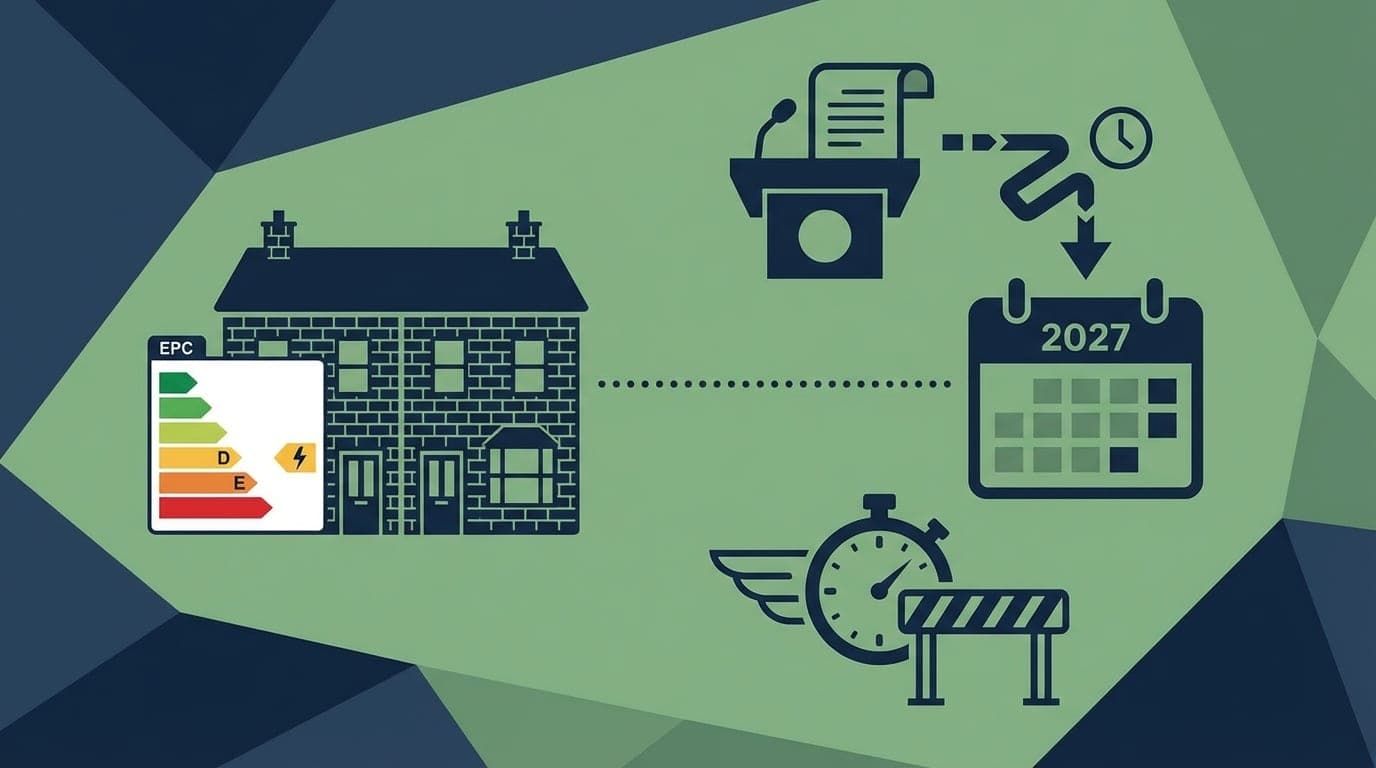
The government announced on 9 March 2026 that the Home Energy Model (HEM), the new methodology that was set to replace the current SAP-based EPC system, has been delayed until the second half of 2027.
If you heard this news and felt a wave of confusion (or panic), you're not alone. But here's the short version: your existing EPC is still valid, and the proposed 2030 EPC C date has not moved. The minimum EPC to let in England and Wales remains band E, which is what the law requires today.
Read on for the full picture.
What Is the Home Energy Model?
The Home Energy Model is the government's planned replacement for the current Standard Assessment Procedure (SAP/RdSAP) used to calculate EPC ratings. It was developed as part of a broader overhaul of the Energy Performance of Buildings (EPB) framework.
Under the current system, EPC ratings (A–G) are based on a SAP score, a calculation of the property's energy efficiency based on fuel costs, insulation, heating system, and other factors. The higher the score, the higher the rating.
The Home Energy Model was designed to change two fundamental things:
- Switch the metric, from SAP points (which use fuel cost as the primary measure) to Primary Energy (which measures the total energy used, including the energy needed to generate and deliver it).
- Improve accuracy, by using a more detailed calculation methodology (RdSAP 10) that accounts for factors the current system misses or approximates.
The practical effect: some properties that currently sit at EPC C might drop to D under HEM, and some D-rated properties might improve. The exact impact depends heavily on the heating system, heat pumps and low-carbon heating tend to perform better under a Primary Energy metric.
What Exactly Has Been Delayed?
On 9 March 2026, the government published an "outcome update" stating:
"Government continues to work at pace to deliver reformed domestic EPCs. Following engagement with industry on the delivery timeline, we have decided to move the launch of the reforms to the second half of 2027."
This means:
- The new EPC methodology (HEM / RdSAP 10) will not launch before H2 2027 at the earliest
- The new Primary Energy metric will not apply to EPC assessments until then
- The HEM consultation that closed on 18 March 2026 will feed into the revised implementation plan
The delay was originally expected after the government first published the consultation in January 2026. The industry had flagged that assessors, software providers, and landlords needed more time to prepare for the scoring change.
Does This Delay Affect My EPC Compliance? (The Key Question)
Does My Existing EPC Certificate Still Count?
Yes. An EPC issued today under the current RdSAP 9 methodology is valid for 10 years and will continue to be the legally recognised document for compliance purposes. The HEM delay does not change this.
If you have a current EPC showing an E, D, or C rating, that certificate remains valid until it expires, regardless of when HEM launches.
Does the Proposed 2030 EPC C Date Still Apply?
Yes, the proposed date has not moved. It is still a proposal.
The government's plan remains:
- All tenancies in scope: EPC C proposed from 1 October 2030
- No earlier compliance date for new tenancies. The two-stage timeline floated at consultation was removed in the January 2026 government response.
Neither point is law. Government must take powers through an Act of Parliament, then lay a statutory instrument amending the MEES regulations, targeted for 2027. No instrument has been laid, and the minimum you must meet today is band E. The MEES regulations are separate from the EPC methodology, so the HEM delay does not shift the proposed 2030 date either way.
Should Landlords Rush to Get an EPC Before HEM Launches?
This is the question most landlords are asking. Here's a clear answer.
If your property is already EPC D or E and you're planning upgrades: There is no urgency to rush an EPC assessment purely because of the HEM delay. The current methodology is still in use and will be until H2 2027 at the earliest. A D or E rated property is legal to let today. If you are planning for the proposed band C standard, the proposed 2030 date is unchanged.
If you want to lock in a C rating under the current system: Some landlords are considering getting an EPC under the current SAP methodology before HEM launches, because certain property types (particularly those with gas boilers in well-insulated homes) may score slightly lower under the new Primary Energy metric.
However, a current EPC is valid for 10 years, which would take you to 2036, well beyond the proposed 2030 date. The risk is that if HEM shows your property as a D when it launches, mortgage lenders or future compliance checks may use the newer rating.
The cautious approach: Get an EPC now to understand your property's current position, make the improvements needed to reach C, and get a new EPC post-improvement. Don't assume your current C rating is permanent if HEM might move the goalposts.
What Changes When the Home Energy Model Does Launch?
How Property Ratings May Shift
The switch from SAP to Primary Energy will affect different property types differently:
- Gas-heated properties: May see ratings affected by the shift to Primary Energy, as gas has a relatively high primary energy factor
- Heat pump properties: Likely to benefit, electric heat pumps have a lower primary energy factor than gas boilers under the new system
- Well-insulated older properties: Generally expected to perform similarly under both systems
- Properties with solid wall insulation: May see improved ratings as HEM accounts more accurately for fabric improvements
No official modelling has been published on how many properties will change band under HEM. The government has said it will publish more detail as part of the final consultation response.
The Role of Primary Energy vs SAP Points
Under the current system, a property's EPC rating is determined by its energy cost (in pence per square metre per year). This has always meant that properties with cheap fuel, gas, for instance, score better than electrically heated properties, even if they use more actual energy.
HEM shifts the measure to primary energy (in kWh per square metre per year), which measures the total energy consumed in delivering heat and power to the property, including the extraction, processing, and transmission losses upstream. This is considered a more accurate measure of a building's environmental impact.
The implication for landlords: if you've been relying on a cheap-to-run gas boiler to push your SAP score over the C threshold, you may want to investigate what your rating would look like under Primary Energy now, before 2027 makes it official.
FAQs
Will I need a new EPC when HEM launches?
Not immediately. Your existing EPC will remain valid for its 10-year term. However, when you next let a property or when your current EPC expires, the new assessment will be under the HEM methodology.
What rating system will my EPC use after 2027?
From H2 2027 (assuming no further delays), new EPCs will use the Home Energy Model / RdSAP 10 methodology with Primary Energy as the key metric. The A–G rating band will be retained, but the thresholds for each band will change.
Where can I find official government updates on the Home Energy Model?
The official source is the gov.uk consultation page for Reforms to the Energy Performance of Buildings Regime. The outcome update published 9 March 2026 is the most current statement.
Does this affect the cost cap?
No. The cost cap that limits what landlords must spend on EPC improvements is unchanged by the HEM delay. Worth being precise about which cap: the one in force under the 2015 Regulations is £3,500 per property including VAT. The £10,000 figure is a government proposal that would arrive with the band C standard, and it has not been legislated.
The Bottom Line
The Home Energy Model delay is frustrating for an industry trying to plan. But for individual landlords, the immediate practical impact is limited:
- Your EPC is valid, the proposed 2030 EPC C date is unchanged, and it is still the sensible target to plan around even though it is not yet law.
- The delay gives you more time to make informed improvement decisions before the scoring methodology changes.
- If you're planning upgrades, factor in that HEM may alter your rating when it does launch, especially if you're relying on a gas heating system to reach C.
The sensible path: know your current EPC rating, understand what improvements would bring you to C under the current system, and keep an eye on HEM developments for H2 2027.
Check your property's current EPC rating and use our grant checker tool to see what funding is available in your area. Not sure whether to act now or wait for the new metrics? Read our HEM delay decision guide for a structured framework. If a heat pump is on your agenda, and under HEM it increasingly should be, the Boiler Upgrade Scheme provides up to £7,500 off installation costs and heat pumps perform well under both current SAP and the incoming HEM Primary Energy metric. You can also estimate typical upgrade costs for your property type using our property cost estimator.