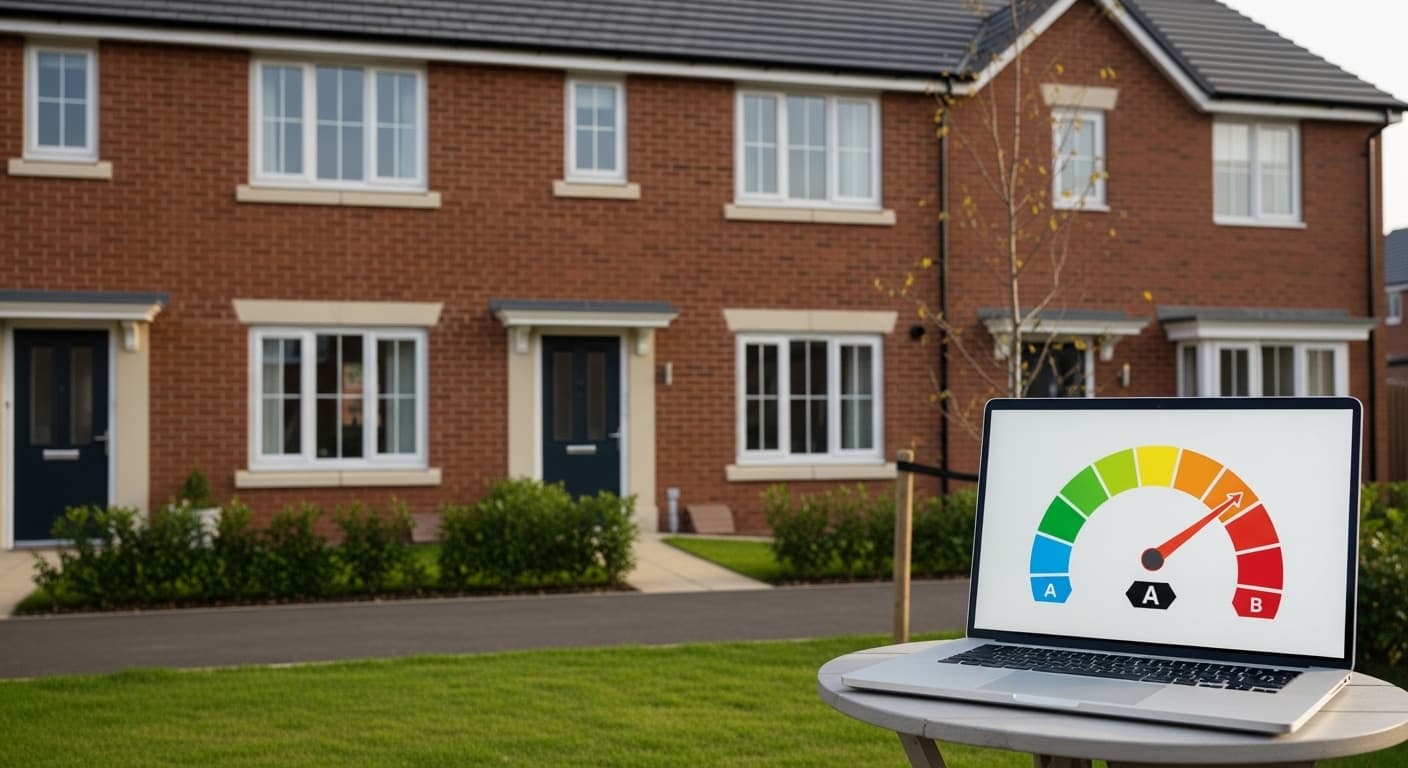
Before you spend money booking an accredited assessor, you can predict your EPC rating online in a couple of minutes. A prediction will not replace the certificate you legally need, but it tells you roughly where a property sits, whether you are close to band C, and how big a job the proposed 2030 band C standard would be. That matters, because according to EPCGuide's analysis of the full EPC register for England and Wales, 27.6 million certificates covering 19.7 million homes, 49.6% of homes currently fall below band C. For landlords planning upgrades, an early estimate is the difference between guessing and budgeting.
This guide explains how to predict your EPC rating for free, which property features drive the score, how accurate a prediction is compared with a real assessment, and when you need to book the accredited version. The fastest route is the free EPCGuide EPC predictor tool, which asks a handful of questions and returns a likely band in seconds.
Can you predict an EPC rating without an assessment?
Yes, within limits. An EPC rating is produced by a standardised methodology called RdSAP (Reduced Data Standard Assessment Procedure). It converts a set of property characteristics into a score from 0 to 100, which then maps to a letter band. Band C starts at a SAP score of 69.
Because the methodology is standardised and public, the same inputs produce broadly the same output whoever runs them. That is what makes prediction possible. If you know a property's age, construction, insulation, heating system, and glazing, you can estimate the band it is likely to land in. You are running an approximation of the same model an assessor uses.
The EPCGuide EPC predictor tool does this for you. It asks about the features that move the score most, then returns a predicted band. It costs nothing and takes minutes. What it cannot do is issue a legal certificate. Only an accredited Domestic Energy Assessor can do that, because only their survey feeds the official register.
| Free EPC prediction | Accredited EPC assessment | |
|---|---|---|
| Cost | Free | Typically £35 to £120 |
| Time | Minutes, online | On-site survey plus lodging |
| Output | Estimated band | Legal certificate on the register |
| Valid for letting? | No | Yes, for 10 years |
| Best used for | Planning, budgeting, prioritising | Compliance, marketing, selling |
What inputs drive an EPC rating?
RdSAP scores a property on how much energy it needs to stay warm and how cleanly that energy is supplied. A handful of features do most of the heavy lifting. When you predict an EPC rating online, these are the questions that matter.
Walls and insulation
Wall type is often the single biggest factor. Cavity walls that are filled score well. Solid walls with no insulation score poorly and are expensive to fix, which is why older solid-wall properties dominate the lower bands. The tool asks about wall construction because it separates a straightforward upgrade from a major fabric project.
Loft and roof insulation
Loft insulation is cheap and effective. A property with 270mm of loft insulation scores materially better than one with 100mm or none. Because it is one of the lowest cost per point improvements available, it is usually the first thing an assessment flags. Our ranking of the cheapest ways to improve an EPC rating puts loft top-up near the front for exactly this reason.
Main heating system
How a property is heated, and how efficiently, has a large effect. A modern condensing gas boiler with good controls scores far better than old electric storage heaters or an ageing non-condensing boiler. Heating type is one of the most influential inputs a prediction asks for.
Glazing
Double glazing scores better than single glazing. Full double glazing across the property lifts the estimate; a mix of single and secondary glazing drags it down. It is a common question in any prediction because it is easy for a landlord to answer accurately.
Hot water and controls
How water is heated, whether the cylinder is insulated, and whether the heating has a room thermostat and programmer all feed the score. These are smaller factors individually, but together they can nudge a borderline property across a band boundary.
Property age and type
Age acts as a proxy for construction standards and default assumptions in RdSAP. A purpose-built flat and a detached period house of the same floor area behave very differently. EPCGuide's data shows detached houses average a SAP score of 56 against 70 for purpose-built flats, so type sets the starting point before you factor in upgrades.
How does the EPC predictor tool work?
The EPCGuide EPC predictor turns the RdSAP logic into a short set of plain questions. You answer what you know about the property: its type and age, wall and loft insulation, heating system, and glazing. The tool weights each answer the way the methodology does and returns a predicted band, along with a sense of what is holding the score back.
The value is not just the letter. It is seeing which feature is dragging you down. If the prediction comes back band D and the biggest weakness is an old boiler, you know where to aim your budget. If it comes back band E with uninsulated solid walls, you know you are facing a larger project and should start planning now rather than in 2029.
You do not need survey-level detail to get a useful answer. Reasonable estimates of the main features are enough to place a property within a band or so, which is all you need at the planning stage.
How accurate is a predicted EPC rating?
A prediction is an estimate, not a certificate, and it is only as good as the inputs you give it. Used sensibly, it will usually place a property within one band of its real rating, and often bang on. That is genuinely useful for planning. It is not sufficient for compliance.
Three things create the gap between a prediction and an accredited result:
Assumptions versus measurement. An assessor measures rooms, checks the loft, and records what they can see. A prediction relies on your description. If you overestimate your insulation or misremember your boiler's age, the estimate drifts.
RdSAP defaults. Where evidence is missing, RdSAP applies conservative default assumptions. An assessor who finds documentary evidence, for example an installation certificate for cavity wall insulation, can input a better value than the default. That can move the real score above what a cautious prediction shows.
Edge cases. Unusual constructions, extensions of different ages, or renewable technology such as solar panels can shift a real assessment in ways a quick prediction may not fully capture.
The practical takeaway: trust a prediction to tell you whether you are comfortably in band C, borderline, or clearly below it. Do not treat it as the final word on a property sitting right on the 68 to 69 boundary. For those, the accredited assessment is what counts. If you want to understand how points translate into bands in detail, our EPC points calculator explainer and EPC rating chart explained break down the maths.
When should a landlord get a real EPC assessment?
A prediction is for planning. An accredited assessment is for compliance and transactions. You need the real certificate in these situations:
- You are marketing or letting the property. A valid EPC must be available before you advertise and provided to the tenant before the tenancy begins. A prediction does not satisfy this.
- Your existing EPC is over 10 years old. EPCs are valid for 10 years. An expired certificate is no certificate. If you are letting on an expired EPC, you are in breach.
- You have completed upgrade works. After insulating, upgrading heating, or replacing glazing, a fresh assessment captures the improvement on the register and proves your new band.
- You are approaching a compliance deadline. The MEES minimum in force in England and Wales is band E, with a maximum civil penalty of £5,000 in total per property. The government has proposed a band C standard from 1 October 2030 with penalties of up to £30,000, but that has not been made law. Either way, compliance runs on certificates, not estimates.
A sensible sequence is: predict first to understand the property and prioritise spend, upgrade based on that plan, then commission the accredited assessment to lock in the result. For a full picture of what an accredited certificate costs, see how much an EPC assessment costs.
Using a prediction to plan for the 2030 deadline
The proposed EPC C standard for 2030 is the reason most landlords are looking at this at all. Predicting your rating now buys you time to plan and to phase spending, which is far cheaper than a last-minute scramble in 2029.
Here is how a prediction fits the wider plan:
- Predict the current band for every property in your portfolio using the EPC predictor. This gives you a triage list.
- Identify the worst performers. Properties predicted at E or below need the most work and should move to the front of the queue.
- Cost the upgrades. Feed the weak points into the EPCGuide cost calculator to estimate what reaching band C will take. Set that against the £3,500 cost cap that applies today, and the proposed £10,000 cap that the government has said would count qualifying spend from 1 October 2025 if it becomes law.
- Check for grants. The Boiler Upgrade Scheme offers £7,500 toward a heat pump, and other funding may apply. Bringing grants into the plan lowers the net cost of hitting band C.
- Book assessments after the works. Once upgrades are done, commission the accredited EPC to record the improvement.
One caveat worth knowing: the methodology itself is under review. The government plans to replace RdSAP with the Home Energy Model, with new-style EPCs planned for the second half of 2027, which would alter how some measures score. We cover what that means in what happens to EPCs after the Home Energy Model. A prediction today reflects current RdSAP logic, so treat long-range estimates as directional.
Start with the free tool. The EPCGuide EPC predictor gives you a band, a sense of your weak points, and a foundation for every decision that follows.
Frequently asked questions
Can I predict my EPC rating online for free?
Yes. The EPCGuide EPC predictor tool estimates your likely EPC band for free in a few minutes. You answer questions about the property's type, age, insulation, heating, and glazing, and it returns a predicted band. It does not issue a legal certificate, but it is accurate enough for planning and budgeting.
How accurate is an EPC prediction compared with a real assessment?
Used with reasonable inputs, a prediction will usually place a property within one band of its accredited rating, and often exactly right. The gap comes from an assessor measuring rather than estimating, applying documentary evidence, and handling edge cases. For borderline properties on the 68 to 69 SAP boundary, only the accredited assessment settles it.
What information do I need to predict my EPC rating?
You need a general picture of the property: its type and rough age, wall construction and insulation, loft insulation depth, main heating system, and glazing. You do not need survey-level detail. Reasonable estimates of these features are enough to place the property within a band.
Does a predicted EPC rating count for letting a property?
No. To let a property legally you need a valid accredited EPC, produced by a registered Domestic Energy Assessor and lodged on the official register. A prediction is a planning tool only. It cannot be used for marketing, letting, or compliance.
What EPC rating do landlords need by 2030?
The minimum in force in England and Wales is band E, and bands D and E are legal to let. The government has proposed that private rented properties reach EPC band C (a SAP score of 69 or above) from 1 October 2030, with a maximum penalty of £30,000, but that proposal is not yet law. Today the maximum civil penalty is £5,000 in total per property.
Which property features most affect my EPC rating?
Wall type and insulation usually have the biggest effect, followed by the main heating system, loft insulation, and glazing. Hot water controls and heating controls make smaller contributions. Solid uninsulated walls and old or inefficient heating are the most common reasons a property predicts below band C.
Should I predict my rating before or after upgrades?
Both. Predict before to understand where the property stands and which weaknesses to target, then plan and cost your upgrades. After the works are complete, commission an accredited assessment to record the improved band on the official register.
This article was last updated on 19 August 2026. EPCGuide's analysis covers the full domestic EPC register for England and Wales, 27.6 million certificates covering 19.7 million homes. For methodology and interactive data, visit the EPCGuide Research Hub.