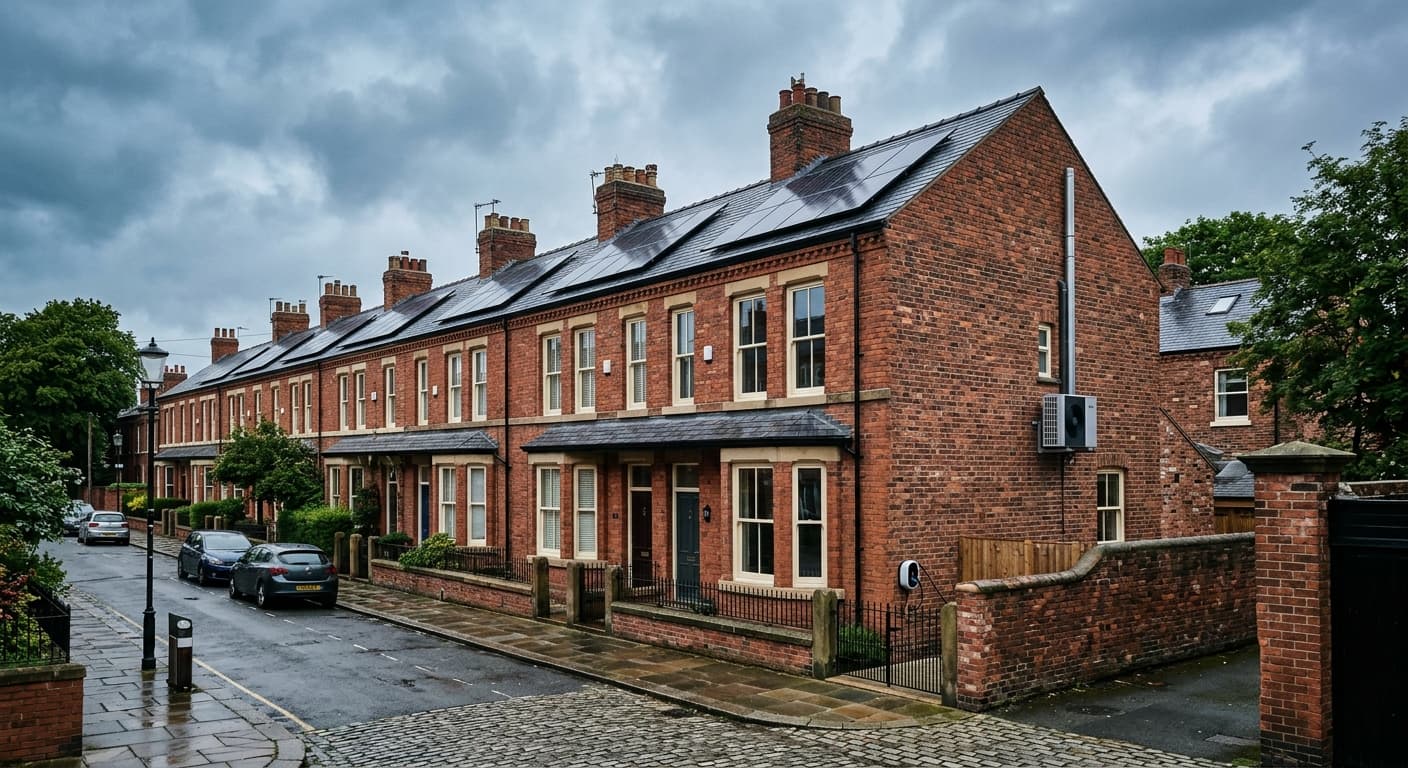
Liverpool landlords must hold a valid EPC rated E or above for every tenancy right now. The proposed minimum rises to band C by 1 October 2030, subject to a cost cap of £10,000. EPCGuide's analysis of 29.2 million EPC records shows Merseyside districts range from 41.8% below band C in Knowsley to 63.3% in the Wirral. The district your property sits in -- and whether it is a Victorian terrace or post-war semi -- shapes how much compliance will cost and how long it will take.
What EPC Rules Apply to Liverpool Landlords?
The Minimum Energy Efficiency Standards (MEES), set by SI 2015/962, apply uniformly across England and Wales. There are no Liverpool-specific EPC rules. Landlords in Toxteth and those in the Wirral face exactly the same legal framework as landlords in Bristol or Sheffield.
Under the current regulations, you must hold a valid EPC rated E or above before starting or renewing any tenancy. Letting a property rated F or G without a registered exemption carries a civil penalty of up to £5,000 per property. The cost cap that limits what landlords must spend to reach band E is £3,500 inclusive of VAT.
The proposed upgrade to band C by 1 October 2030 was announced in the government's 21 January 2026 consultation response. It is not yet law. Parliament must pass primary legislation and lay a statutory instrument before it takes effect, with that process targeted for 2027. Until a statutory instrument is laid, the legal minimum remains band E.
For the full regulatory picture, see our MEES regulations guide.
Liverpool and Merseyside EPC Compliance Data
EPCGuide's analysis of 29.2 million EPC records shows the proportion of properties below band C varies by more than 21 percentage points across Merseyside's six districts. The national rate is 55.4% below C. Four of the six districts perform better than the national average; Sefton and the Wirral sit noticeably above it.
| District | % Below Band C | Total EPC Records |
|---|---|---|
| Knowsley | 41.8% | 81,525 |
| Halton | 49.7% | 56,913 |
| Liverpool | 51.5% | 286,681 |
| St. Helens | 54.9% | 91,228 |
| Sefton | 61.2% | 137,433 |
| Wirral | 63.3% | 158,706 |
Knowsley's strong performance reflects its large stock of post-war council housing, built between the 1950s and 1970s, which received cavity wall insulation and central heating upgrades in successive government-funded programmes over the past 30 years. Properties that look modest from the outside often already meet or are close to band C because of that investment.
The Wirral sits at the opposite end. Its mix of Victorian and Edwardian terraces in Birkenhead and Tranmere, plus large stretches of interwar mock-Tudor semi-detached in Bebington and Heswall, produces the worst compliance rate in Merseyside and worse than the national average.
Liverpool city itself is close to the national average, but that figure spans a wide range of stock. Post-war flats in the city centre and 1960s towers in Norris Green score well. Victorian terraces in Kensington, Toxteth, Anfield and Wavertree typically do not.
Why Liverpool Properties Are Harder to Upgrade
Liverpool's rental market is dominated by pre-1919 terrace housing in the inner city. These properties present structural challenges that raise the cost and complexity of EPC improvements compared to Midlands or southern English towns with a heavier mix of interwar and post-war stock.
Solid brick walls. Victorian and Edwardian terraces in Liverpool, including the two-up two-down streets that still define large parts of L7, L8 and L6, were built with single-leaf or solid double-leaf brick walls and no cavity. Cavity fill is not possible. The only routes to meaningful improvement are external wall insulation (EWI) or internal wall insulation (IWI). EWI costs £6,000 to £15,000 depending on property size and access; IWI costs £3,500 to £10,000 but reduces room dimensions.
Conservation areas. Liverpool's Georgian Quarter, covering much of the area around Upper Parliament Street (L8), and the historic core around Castle Street and Dale Street carry conservation area designations. External alterations, including EWI, may require planning permission, which can be refused on grounds of character or appearance. Where it is refused in writing, a landlord may register a third-party consent exemption on the PRS Exemptions Register. See third-party consent exemptions for freeholder or planning refusal and EPC exemptions for listed and heritage properties.
Liverpool City Council Selective Licensing. Large parts of inner Liverpool have operated under a selective licensing scheme since 2015, covering wards including Picton, Riverside, Kensington and Fairfield, Everton, and others. Landlords in licensed areas are already subject to inspection and a separate fee structure, and EPC compliance sits alongside licence conditions. Properties that fail EPC requirements also risk renewal complications.
Leasehold flats. Liverpool's city-centre flat market is largely leasehold. Improvements to the external fabric, roof or shared heating system require consent from the freeholder or building manager. If consent is refused in writing, an exemption may be registered. See our full exemptions guide for the process.
EPC Upgrade Costs for Liverpool Landlords
Liverpool labour costs run broadly in line with the national average, unlike London where contractor rates add a significant premium. These ranges are indicative; a formal quote from an accredited installer is required before relying on any cost figure for cost cap purposes.
| Improvement | Typical Liverpool Cost | Approx. EPC Points Gained |
|---|---|---|
| Loft insulation (topping up) | £300 to £700 | 1 to 3 points |
| Cavity wall insulation | £600 to £1,500 | 2 to 4 points |
| External wall insulation | £6,000 to £15,000 | 5 to 15 points |
| Internal wall insulation | £3,500 to £10,000 | 4 to 12 points |
| New gas boiler (A-rated) | £2,000 to £3,500 | 2 to 5 points |
| Air source heat pump | £8,000 to £15,000 | 5 to 15 points |
| Double glazing (whole property) | £3,500 to £8,000 | 1 to 3 points |
| Solar panels (3 to 4kW) | £4,500 to £8,000 | 2 to 8 points |
The current legal cost cap is £3,500 inclusive of VAT. If the cheapest combination of measures that would bring a property to band E costs more than £3,500, you can register a cost cap exemption and continue letting legally below band E. The proposed 2030 cap of £10,000 applies to band C only when and if the legislation passes.
For a full breakdown of national upgrade cost ranges, see our cost-to-improve guide.
Want the exact upgrade route for your specific Liverpool property -- measures, cost order, and projected final band? Get your costed EPC C Action Plan (£29). In your inbox within the hour, then refined by a real person over the next 48 hours. Get your Action Plan
Grants for Liverpool Landlords
ECO4 is the main national scheme funding insulation and heating upgrades. It covers up to £14,000 per property for eligible measures. Tenants must receive a qualifying means-tested benefit (Universal Credit, Pension Credit, and others), or the property must qualify under ECO4 Flex, where the local authority sets its own eligibility criteria. Liverpool City Council, Knowsley MBC, Sefton Council, and Wirral Council all run Flex schemes with their own thresholds -- contact each council's housing or energy team for current criteria. ECO4 runs until 31 December 2026. The Warm Homes Plan replaces it from 2027. See our ECO4 landlord guide.
Boiler Upgrade Scheme (BUS) provides £7,500 toward an air source heat pump. Liverpool landlords are eligible; the scheme is not means-tested and does not require tenant eligibility. Applications go through the installing contractor. See our BUS guide for landlords.
Liverpool and Merseyside councils have intermittently offered local area-based schemes funded through the UK Shared Prosperity Fund and predecessor programmes. Availability changes year to year. Contact your district council's housing team directly for current funding.
When Does a Liverpool Property Need an EPC?
A valid EPC (dated within the past 10 years) is required before:
- Advertising the property to let
- Starting a new tenancy
- Renewing an existing tenancy on a new fixed-term agreement
A statutory periodic tenancy that rolls over automatically after a fixed term expires does not trigger a fresh EPC obligation, provided the tenancy terms and parties do not change. If the EPC expires during a periodic tenancy and you then serve a new fixed-term agreement to the same tenant, you will need a current EPC before doing so.
EPC assessment costs in Liverpool typically range from £50 to £90 for a flat and £70 to £130 for a terrace or semi-detached, depending on size and location.
Frequently Asked Questions
Q: Do Liverpool landlords face different EPC rules from landlords elsewhere in England? A: No. MEES applies uniformly across England and Wales under SI 2015/962. There are no Liverpool-specific or Merseyside-specific EPC rules. A landlord in Anfield faces the same legal framework as one in Bristol or Manchester.
Q: My Liverpool property is in the Georgian Quarter conservation area. Does that exempt it? A: Being in a conservation area does not automatically exempt a property. An exemption may apply if the works needed to reach band E (or proposed band C) would alter the external appearance and planning permission for those alterations is refused in writing. You must register the exemption on the PRS Exemptions Register before letting the property; you cannot register retrospectively.
Q: What is the proposed EPC band C deadline for Liverpool landlords? A: The proposed date is 1 October 2030, the same as for all English and Welsh landlords. This is not yet law. The government announced it on 21 January 2026; Parliament must pass an Act and a statutory instrument before it has legal force. No statutory instrument has been laid as of September 2026.
Q: Which Merseyside district has the lowest proportion of properties below band C? A: Knowsley, at 41.8% of EPC certificates below band C, according to EPCGuide's analysis of 29.2 million EPC records. The result reflects Knowsley's large stock of post-war council housing that received insulation and heating upgrades over several decades of government-funded programmes.
Q: Can I register a cost cap exemption if solid wall insulation is too expensive for my Liverpool terrace? A: Yes. If the total cost to reach band E using the cheapest qualifying measures exceeds £3,500 inclusive of VAT, you can register a cost cap exemption on the PRS Exemptions Register. It lasts five years and must be renewed. The proposed £10,000 cap for band C compliance has not yet passed into law.
Q: Are Liverpool landlords eligible for the Boiler Upgrade Scheme? A: Yes. BUS pays £7,500 toward an air source heat pump and is open to landlords across England and Wales, including all Merseyside districts. It is not means-tested, so your tenants' income is irrelevant to eligibility.