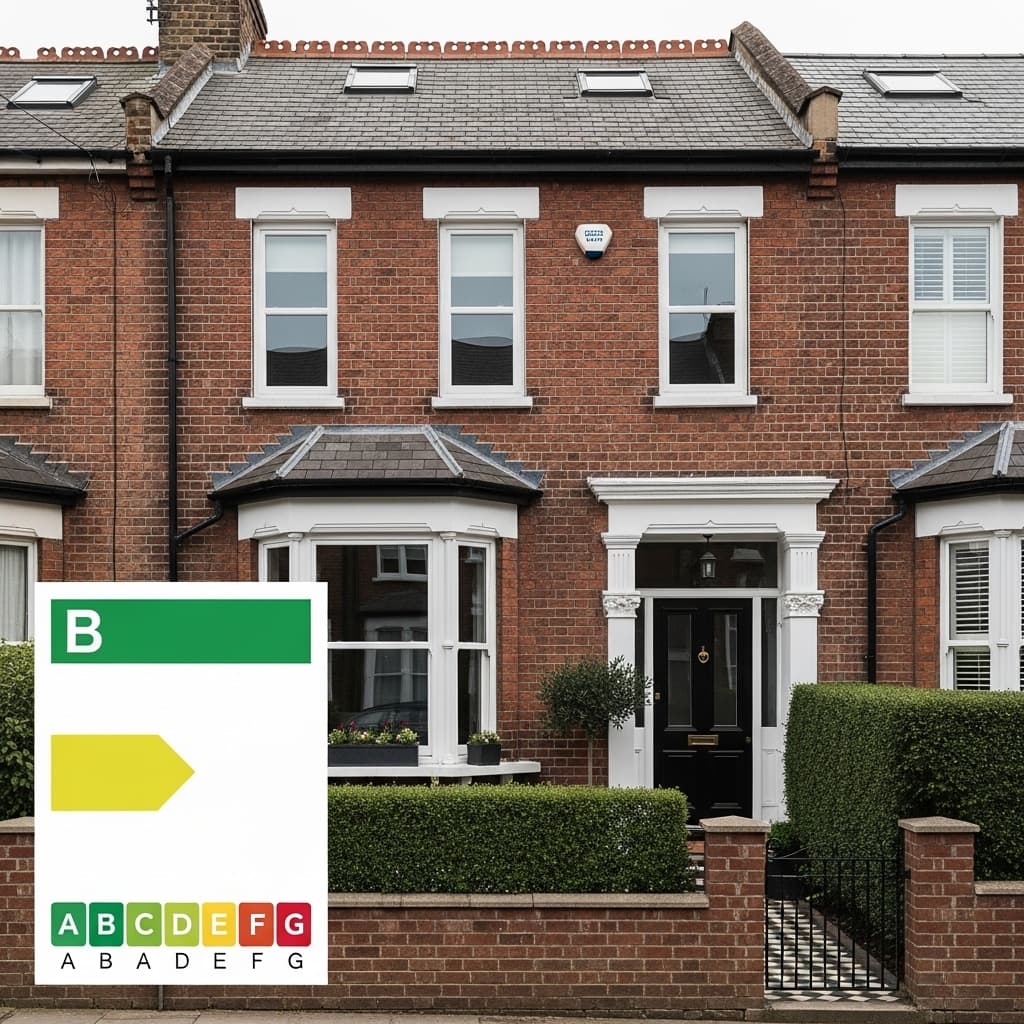
Your EPC rating is calculated using SAP (Standard Assessment Procedure), a government formula that scores your property from 1 to 100 based on insulation, heating, windows, and renewable energy. You cannot issue a legally valid EPC yourself, but you can get a reliable estimate using a free online EPC predictor, accurate enough to plan your upgrade strategy and prioritise spending. EPCGuide's analysis of 27.6 million EPC certificates covering 19.7 million homes shows 49.6% of homes in England and Wales currently sit below EPC C, the threshold government has proposed for rental properties from 2030.
What Is an EPC Rating?
An EPC (Energy Performance Certificate) rates a property's energy efficiency on a scale of A (most efficient) to G (least efficient). Each band corresponds to a range of SAP points:
| Band | SAP Points | Running Costs |
|---|---|---|
| A | 92-100 | Lowest |
| B | 81-91 | Very low |
| C | 69-80 | Low |
| D | 55-68 | Average |
| E | 39-54 | Above average |
| F | 21-38 | High |
| G | 1-20 | Very high |
Every rental property in England and Wales must hold at least an EPC E to be legally let, and has had to since 1 April 2020. Band D is legal to let. Government has proposed raising the minimum to EPC C for all tenancies from 1 October 2030 and dropped the earlier 2028 milestone for new tenancies in its January 2026 response. The band C standard is a policy intention, not law: it requires primary legislation and then a statutory instrument amending the Energy Efficiency (Private Rented Property) (England and Wales) Regulations 2015, and no such instrument has been laid.
How Is an EPC Rating Calculated?
Official EPC assessments for existing homes use RdSAP (Reduced Data Standard Assessment Procedure), a simplified version of the government's full SAP methodology designed to work from a physical property inspection rather than construction drawings.
An accredited Domestic Energy Assessor (DEA) visits the property and records:
- Floor area: total heated floor space in m²
- Wall construction: cavity, solid, timber-frame, or system-built
- Insulation: loft depth, cavity fill status, floor insulation
- Heating system: fuel type, boiler efficiency, controls (thermostat, TRVs, programmer)
- Hot water: storage cylinder, immersion, combi boiler, solar thermal
- Windows: glazing type (single, double, triple) and proportion of wall area
- Roof construction: flat or pitched, insulation depth
- Renewable energy: solar PV, wind turbines, heat pumps
The assessor enters this data into OFGEM-approved RdSAP software. The software calculates:
- Annual energy cost per m² of floor area
- Annual CO2 emissions per m²
- The overall SAP score (1-100)
- The resulting A-G band
The score is a cost index. It models what it costs to heat the property to a standard comfort level per square metre per year, then converts that to points. Lower running costs mean a higher SAP score and a better EPC band.
Can I Calculate My Own EPC Rating?
No, and this catches landlords out regularly. Only an accredited Domestic Energy Assessor can issue a legally valid EPC. Self-assessment is not permitted under MEES regulations, and a self-issued certificate would not be accepted by a local authority for compliance purposes.
What you can do is estimate your likely rating using a free online EPC predictor. These tools replicate the key SAP inputs (property type, construction era, heating, insulation) and return a probable band. The estimate will not be precise to the exact SAP point, but it is accurate enough to answer the questions landlords actually need answered:
- Am I likely to be above or below EPC C?
- Which improvements would move me into the next band?
- Is it worth getting a formal assessment now, or should I upgrade first?
For a free estimate, use EPCGuide's EPC Predictor Tool. It covers the main property types across England, Scotland, and Wales, and shows you the improvements most likely to push you into Band C.
What Moves Your EPC Score the Most?
The RdSAP methodology weights improvements differently depending on the property's current state. The biggest gains typically come from:
Insulation: Loft insulation on an uninsulated property tends to deliver some of the largest SAP point gains for lowest cost. Cavity wall insulation delivers similar results where the cavity exists and can be filled. Solid wall insulation delivers fewer points per pound spent but is often the only route for pre-1930s stock.
Heating system: Replacing an old low-efficiency boiler with a modern A-rated condensing boiler improves both efficiency and SAP score. Switching fuel source has a larger effect. Gas is scored more favourably than oil, and heat pumps score significantly higher than any fossil fuel system under the RdSAP 10 methodology introduced in 2024.
Windows: Upgrading from single to double glazing improves the score, but the gain is smaller than insulation or heating changes for most properties.
Solar PV: Photovoltaic panels can add meaningful SAP points, particularly in southern England, but the cost per point is high compared to insulation measures.
For costs and expected EPC impact by improvement type, see the Cheapest Ways to Improve EPC Rating guide.
Checking an Existing Certificate First
Before commissioning a new assessment or running an estimator, check whether your property already has a valid EPC. EPCs are valid for ten years from the date of assessment. Use EPCGuide's postcode lookup tool to find existing certificates and check the current rating, the assessor's improvement recommendations, and the certificate expiry date.
EPCGuide's analysis of 27.6 million EPC certificates covering 19.7 million homes across 318 local authorities shows the scale of the compliance challenge: from Tower Hamlets where 24.9% of properties sit below EPC C, to the Isles of Scilly where the figure reaches 85%. Where your property sits on that spectrum depends heavily on its construction era and the local housing stock.
What to Do Once You Have Your Estimate
If your estimate puts you at EPC D or E, you are compliant with MEES today and have room to plan rather than react. If you are at EPC F or G, those properties are already unlawful to let without a registered exemption and need immediate attention.
The cost cap in force is £3,500 including VAT per property, measured against the band E standard. A landlord who spends that much on recommended improvements without reaching E can register a high-cost exemption on the PRS Exemptions Register. Government has proposed replacing this with a £10,000 cap tied to band C, or 10% of property value where the property is worth under £100,000, but that is not yet law.
Under the rules in force, grant funding does not use up your £3,500 cap, so a measure funded through ECO4 (scheme closes 31 December 2026) or the Boiler Upgrade Scheme leaves that cap intact. Under the proposed £10,000 cap, Boiler Upgrade Scheme money would not count, but other third-party funding, such as ECO4 or local grants, could. For detail on all available grants, see the guide to every landlord energy grant.
Frequently Asked Questions
What is a free EPC calculator and how does it work? A free EPC calculator (or EPC estimator) takes key property inputs, including construction type, insulation level, and heating system, and returns an estimated A-G band and approximate SAP score. It replicates the main inputs of the RdSAP methodology without a physical assessment. The result is an indication only; a legally valid EPC requires a visit from an accredited domestic energy assessor.
How many SAP points do I need to reach EPC C? EPC C covers SAP points 69-80. If your property is currently Band D (55-68), you need between 1 and 25 additional points depending on where in the band you sit. The EPC points explained guide covers which improvements deliver the most points per pound spent.
How long is an EPC valid for? An EPC is valid for 10 years from the date of assessment. The certificate on the EPC register is the legally valid one. Check your certificate expiry date before making compliance decisions. If significant improvements have been made since the last assessment, a new EPC will reflect the upgraded rating.
Can I estimate my EPC rating without an assessor? Yes, using a free online EPC estimation tool. You cannot issue a legal EPC yourself, but estimation tools give you a reliable indication for planning purposes. You will need to know the property's construction type, approximate age, wall type, loft insulation status, and main heating fuel.
What is RdSAP 10 and does it affect my EPC score? RdSAP 10 is the updated EPC calculation methodology introduced in 2024. It changed how heat pumps, solar panels, and certain heating controls are scored. Certificates issued before RdSAP 10 may give a different picture than a new assessment would. If your property has had a heat pump installed since the last assessment, a new EPC under RdSAP 10 may significantly improve your band.
What is the minimum EPC rating for renting a property? EPC E, and has been since 1 April 2020. Band D is legal to let. The cost cap is £3,500 including VAT, and the maximum civil penalty is £5,000 in total per property across all breaches combined, not per breach. Government has proposed raising the minimum to EPC C from 1 October 2030, with a £10,000 cap and a £30,000 maximum penalty, and dropped the earlier date for new tenancies. Those figures are proposals and are not yet law.