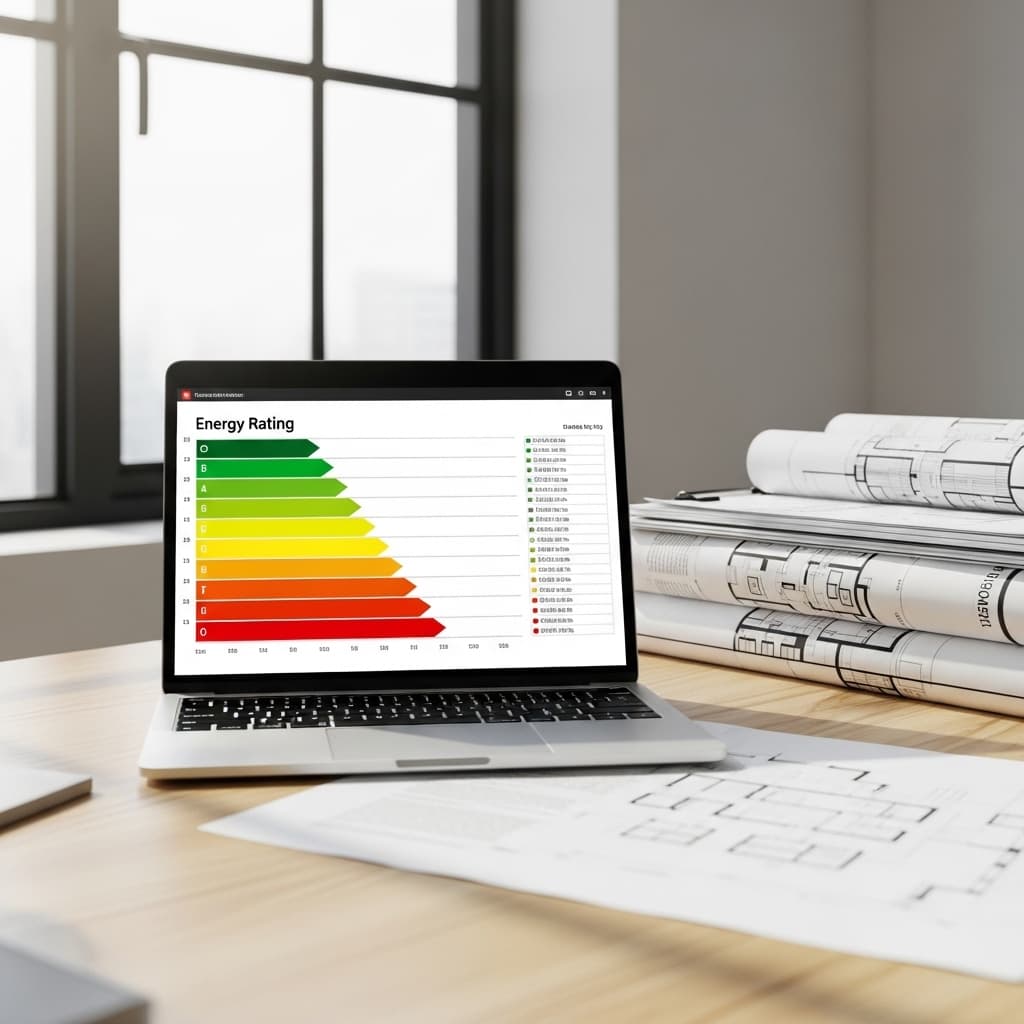
You can get a rough EPC band estimate for your rental property before spending £60-120 on a formal assessment. EPCGuide's free predictor tool takes five inputs and returns an estimated band, a SAP score range, and the improvement measures most likely to push you up. It is not the legal document, but it tells you whether you have a problem worth solving before a surveyor sets foot in the door.
How Are EPC Ratings Calculated?
EPC ratings are produced using RdSAP (Reduced Data Standard Assessment Procedure), a government-approved methodology that converts physical property data into a SAP score between 1 and 100. Band C starts at 69. Assessors collect around 25 data points on-site and run them through accredited software. The resulting certificate is the legal document required for lettings compliance.
The score is a weighted sum of energy costs across five main elements:
| Component | Approximate weighting |
|---|---|
| Heating system (type, efficiency, fuel) | ~35% |
| Wall construction and insulation | ~30% |
| Hot water system | ~15% |
| Windows and glazing | ~10% |
| Lighting and other fixed services | ~10% |
These weightings are not fixed in the regulation. They vary by property type, floor area, and climate zone. But they give a realistic sense of where improvements pay off most.
EPCGuide's analysis of 29.2 million EPC records shows that 55.3% of all EPC-registered homes in England and Wales sit below band C. For rental stock specifically, the share is higher because older terraced and semi-detached properties are over-represented in the buy-to-let market.
The legal requirements behind this are set out in the government's MEES landlord guidance at gov.uk. From 1 April 2028, all new tenancies must meet band C. From 1 April 2030, the same standard applies to all tenancies, with a £10,000 cost cap per property.
How to Use EPCGuide's Free EPC Calculator
The free EPC predictor tool takes five inputs and returns an estimated rating in under a minute. No account required. Here is what it asks for:
- Property type (detached, semi-detached, terraced, flat)
- Construction era (pre-1930, 1930-1966, 1967-1975, 1976-1990, 1991 onward)
- Wall type (solid, cavity unfilled, cavity filled, timber frame)
- Main heating system (gas boiler, oil boiler, heat pump, electric storage heaters, direct electric)
- Loft insulation depth (none, 100mm, 200mm, 300mm+, or no loft)
The tool returns three things: an estimated EPC band, a SAP score range (for example, 58-67 for band D), and the top two or three improvement measures ranked by estimated SAP point gain.
One caveat to be clear about: this is an estimate, not a certificate. It cannot account for everything a surveyor records on-site, including floor insulation, conservatory heat loss, secondary glazing, or the exact boiler model and its SEDBUK efficiency rating. Treat it as a triage tool, not a compliance document.
What Factors Have the Most Impact on Your EPC Score?
The highest-impact improvements for most UK rental stock, ranked by SAP point gain per pound spent, are these four. Get these right and band C becomes reachable for most properties.
Wall insulation is the single biggest lever, especially for pre-1930 solid-wall stock. Filling an unfilled cavity typically adds 8-14 SAP points. External or internal wall insulation on solid walls adds a similar amount but costs more (£7,000-15,000 for external wall insulation on a mid-terrace). See the full EPC improvement cost guide for a breakdown by measure and property type.
Heating system replacement is the second most impactful measure. Replacing an old gas boiler (say, a 1990s model at 70% efficiency) with a modern condensing boiler at 90%+ can add 8-12 SAP points. A heat pump can add more, but the economics depend heavily on the property's insulation baseline.
Loft insulation is the cheapest quick win in the list. Bringing a poorly insulated loft up to 270mm costs around £300-500 through most installers, and typically adds 3-6 SAP points. If you have any depth of loft insulation below 100mm, this is the first thing to do.
Glazing is the least impactful of the main measures. Upgrading from single glazing to double glazing adds roughly 2-4 SAP points at a cost of £4,000-8,000 for a three-bed. It matters, but it rarely gets you over the band C threshold on its own.
You can run the numbers for your property using EPCGuide's upgrade cost estimator.
What Does Your Estimated Rating Mean for Compliance?
The action you take depends on where you land. Here is how to read the result.
Estimated C or above: A formal assessment is still worth getting, because the certificate is the legal document your tenants and lender need. But you are likely compliant already, and the assessment is confirmation rather than crisis management.
Estimated D: This is the most common result for rental stock built between 1945 and 1980. You are one or two measures away from band C in most cases. Run cost estimates before booking a surveyor. Know which measures you will commit to, because many landlords find a D property tips into C once they insulate the loft and service the boiler.
Estimated E: You need a plan. Under current MEES rules, E is the minimum for active tenancies. The 2028 deadline will require C. Get a formal assessment now so you know the exact SAP score gap, then model which improvements take you there within the £10,000 cost cap.
Estimated F or G: This is urgent. MEES already prohibits F and G properties from being let without a registered exemption. You either need to improve the property to E or above immediately, or register a valid exemption on the PRS Exemptions Register.
Want a costed route from your current band to C for your specific property? Get your EPC C Action Plan at epcguide.co.uk/action-plan/start?src=blog_epc-calculator-landlords-guide (£29). In your inbox within the hour, refined by a real person over 48 hours.
You can also review available funding through the landlord grants guide, including ECO4 (up to £14,000, tenant-eligibility-gated, closes 31 December 2026) and the Boiler Upgrade Scheme (£7,500, open to landlords, not means-tested).
EPC Calculator vs. Full Assessment: When You Need Which
| Situation | Calculator | Full Assessment |
|---|---|---|
| Initial planning before improvements | Yes | Not yet |
| Modelling grant eligibility | Yes | Not yet |
| Legal compliance for a new tenancy | No | Required |
| Tenant transparency / pre-tenancy queries | Indicative only | Preferred |
| Registering an exemption on the PRS register | No | Required |
| Marketing a property for let or sale | No | Required (10 years valid) |
The calculator is a planning and triage tool. The formal assessment, carried out by an accredited domestic energy assessor and lodged on the national register, is what the law requires.
A Worked Example: 1970s Semi-Detached Rental
Consider a three-bed 1970s semi-detached in the East Midlands. Cavity walls (unfilled). Original gas boiler, 20 years old. 100mm of loft insulation. Double glazing throughout.
Running those inputs through the predictor:
- Estimated band: D
- Estimated SAP score range: 58-65
- Top improvement measures flagged: cavity wall insulation, boiler replacement
The gap to band C (SAP 69) is somewhere between 4 and 11 points depending on where in the range the property sits. Here is what closing that gap looks like in practice:
- Cavity wall insulation: £700-1,200. Estimated gain: 8-12 SAP points. Likely sufficient on its own to reach C, subject to a formal assessment confirming cavity suitability.
- Boiler replacement (A-rated condensing): £2,500-4,000. Estimated gain: 8-12 SAP points. Also likely sufficient on its own.
- Top up loft insulation to 270mm: £300-500. Estimated gain: 2-3 additional points. Worth doing regardless, cheapest measure on the list.
This property could plausibly reach C with a single measure (cavity wall insulation) costing under £1,200, well inside the £10,000 cost cap. A formal assessment would confirm it.
These are illustrative ranges. Actual SAP gains vary by floor area, exposed wall area, local climate, and the specific systems installed. The full improvement cost guide covers the variance in more detail.
Frequently Asked Questions
Can I calculate my own EPC rating?
You cannot self-certify an EPC. The legally valid certificate must be produced by an accredited domestic energy assessor and lodged on the national register. However, you can use EPCGuide's free predictor tool to estimate your band before booking a formal assessment, which helps you plan improvements and avoid paying for a certificate that just confirms a problem you already knew about.
What is band C in SAP points?
Band C covers SAP scores from 69 to 80. The midpoint of the band is around 74-75. If your property is currently in the low 60s (mid-D), you are typically 7-12 SAP points from the C threshold. That gap is usually bridgeable with one or two targeted measures.
How long does an EPC assessment take?
A typical domestic EPC assessment takes 45 minutes to an hour on-site for a standard three-bed house. Larger or more complex properties take longer. The certificate is usually issued within 24-48 hours and is valid for 10 years. You can find an accredited assessor via the Elmhurst Energy or Quidos registers.
Does my EPC rating change when I make improvements?
Yes, but only after you commission a new assessment. The existing certificate remains on the national register until it is superseded. If you have made improvements since the last assessment, you will need a new one to reflect them. This matters for compliance: if your current certificate shows band E but you have since added cavity wall insulation, you need a new certificate showing the improved band before you can legally let the property as band D or above.
What EPC rating do landlords need by 2030?
From 1 April 2028, all new tenancies in England and Wales must have an EPC of band C or above. From 1 April 2030, that requirement extends to all existing tenancies. The cost cap is £10,000 per property. Properties that cannot reach C within that cap may qualify for a cost-cap exemption, registered on the PRS Exemptions Register. See the 2030 deadline guide for the full timeline.
Is the EPC predictor tool accurate?
The tool is accurate enough for planning purposes, not for legal compliance. In EPCGuide's internal testing against formally assessed properties, the predictor lands within one band of the actual result in the majority of cases. The main sources of variance are the boiler's actual SEDBUK efficiency (which we cannot determine without the model number), floor insulation, and heat loss through party walls. Use it to understand the direction of travel, then get a formal assessment before committing to compliance claims.