
If your EPC rating is wrong, you challenge it in two steps: complain to the assessor named on the certificate, then, if that fails, complain to their accreditation scheme. Both steps are free, and a certificate found to be defective gets pulled from the register and replaced. The catch is that most "wrong" ratings are not mistakes in the legal sense. They are assumed defaults, applied because the assessor could not see the insulation, could not get into the loft, or picked the wrong construction age, and the fastest way to fix a default is to hand over the evidence that overrides it.
This guide covers why ratings come out low, how to read what the assessor recorded, how the Elmhurst and Quidos complaint routes work, and when a new assessment is the quicker fix.
Why is my EPC rating lower than it should be?
The domestic EPC is produced with RdSAP (Reduced data Standard Assessment Procedure), a non-invasive survey. Elmhurst Energy, the largest accreditation scheme, puts it plainly in its June 2024 EPC Q&A: the assessor "collects data based on what they can see on the day", and where they cannot access part of the property "the methodology would assume a default value". Those defaults are keyed to the construction age band, and for older stock they are pessimistic.
The GOV.UK certificate says the same in its features table: "Assumed ratings are based on the property's age and type. They are used for features the assessor could not inspect." Every line marked "assumed" is a place where your property may be scoring below what it deserves.
The five causes we see most often:
Insulation the assessor could not see. RdSAP convention 3.03a tells assessors to record walls, floors and roofs as "as built" wherever there is no evidence of retrofitted insulation. A 1960s cavity wall filled in 2015 scores as an empty cavity unless the assessor saw drill-hole patterns or you produced the guarantee.
The loft was not inspected. Convention 3.04 requires loft insulation to be measured and photographed where safe access is possible. If the hatch is painted shut, the loft is boarded, or it is full of stored boxes, the assessor records "loft insulation unknown" and the software falls back to the age-band default. Documentary evidence, or lifting the boards while the assessor is there, overrides it.
Wrong construction age band. BRE's RdSAP 10 specification assigns every default U-value by age band, from band A (before 1900) to band M (2023 onwards). Table 6 gives an unfilled cavity wall in England a U-value of 1.5 W/m²K for bands A to E (up to 1975), 1.0 for band F (1976 to 1982) and 0.60 for band G (1983 to 1990). Put a 1984 house in the 1970s band and its walls are modelled at more than double the heat loss.
Missing heating controls. Convention 4.13 says thermostatic radiator valves count only when fitted to 50% or more of the radiators, including hallway radiators. A programmer and room thermostat that the assessor did not find, or that were not labelled, get recorded as absent. App-based heating control counts only where there is a fixed receiver and evidence of the control type (convention 4.19).
Window age recorded as unknown. Convention 3.12a dates double glazing from the spacer bar, a FENSA or CERTASS certificate, a building control certificate or a manufacturer's guarantee. Without one of those, the assessor selects "unknown", and pre-2002 glazing performance is assumed.
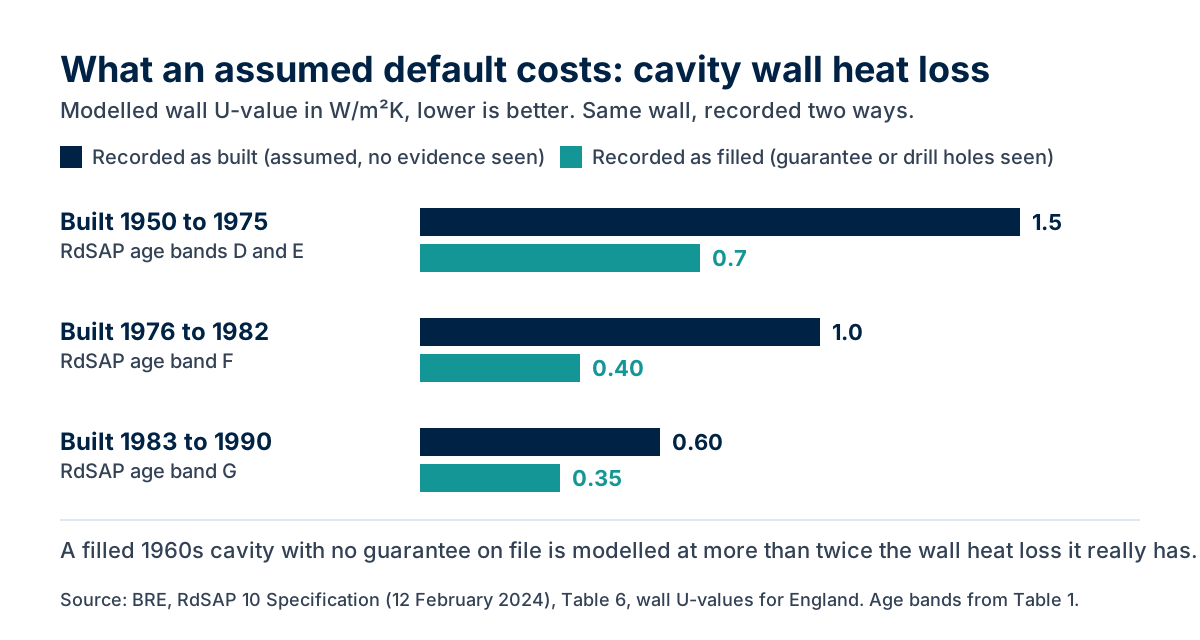 What the assessor cannot see is scored at the age-band default. Evidence moves each feature to what is actually there.
Plain data-entry errors (a top-floor flat recorded as ground floor, a floor area that does not match the internal dimensions) are also worth raising.
How do I check what the assessor actually recorded?
Before you complain, pull the certificate from the government's Find an Energy Certificate service (our EPC lookup guide walks through the search) and read three sections.
The features table
The section headed "Features in this property" lists Walls, Roof, Floor, Windows, Main heating, Main heating control, Hot water and Lighting, each with a description and a rating from very good to very poor. Look for the word "assumed" in any description. That is the assessor telling you a default was used.
The assessor and scheme details
Near the end is a section headed "Who to contact about this certificate", with the assessor's name, phone and email, then the accreditation scheme's name and contact details. The certificate's own wording sets the order: "If you're unhappy about your property's energy assessment or certificate, you can complain to the assessor who created it", then "If you're still unhappy after contacting the assessor, you should contact the assessor's accreditation scheme."
The date of assessment
Any improvement made after this date is not on the certificate, and no complaint will add it. Work done since needs a new EPC.
Then walk the property with the certificate in hand. Is the loft depth right? Does the boiler match? Are the TRVs counted? Run the real features through the free EPC predictor to see what band the corrected inputs should produce. A gap of a band or more is a case worth pursuing.
How do I challenge an EPC rating with the assessor?
Start with the assessor. Elmhurst's guidance is that anyone concerned about an assessment should approach the assessor first, and that the assessor should put it right "at no cost to the homeowner". Most will, because a scheme complaint triggers an audit of their work.
Send one email that does the assessor's job for them:
- The certificate number and address.
- Each disputed feature, quoted as it appears on the certificate, and what is actually there.
- The evidence for each, attached: guarantee, invoice, photograph with a tape measure in shot, building control completion certificate.
- What you want: a corrected EPC lodged on the register, or a revisit to inspect the features they could not see.
- A reasonable deadline for a reply, and a note that you will refer it to the scheme if you do not hear back.
Where the assessor accepts the evidence, they lodge a corrected certificate and the original is marked as not for issue (RdSAP convention 9.03). Where they need to see it, agree a revisit and make sure the loft hatch opens, the boards come up and the boiler cupboard is clear.
If the assessor has left the industry or does not answer, skip straight to the scheme. Quidos's procedure covers that case explicitly, and Elmhurst mediates where the assessor is unresponsive.
What happens when I complain to the accreditation scheme?
Every EPC in England and Wales is lodged through a government-approved scheme, and each scheme runs a complaints process at no cost to the complainant. The two you will meet most often are Elmhurst Energy and Quidos. Stroma Certification no longer exists as a separate scheme: its members transferred to Elmhurst on 1 October 2023, and Elmhurst's Stroma page sends Stroma-lodged EPC complaints to the Elmhurst complaints resolution process. ECMK and Sterling Accreditation also operate schemes, reached through the details printed on your certificate.
| Elmhurst Energy (includes former Stroma) | Quidos | |
|---|---|---|
| How to complain | Online Complaints Resolution Form on elmhurstenergy.co.uk | Email complaints@quidos.co.uk with full details |
| First response | Not published | Within 3 working days |
| Target resolution | Not published | Aim of 10 working days |
| What they check | Assessor's model inputs against their site evidence, recalculated | Quality assurance audit of the EPC, assessor must upload evidence |
| If the EPC is defective | Removed from the register and replaced with a correct EPC | Re-lodgement, possibly after a revisit, cost borne by the assessor |
| If the EPC is upheld | Mediation, then scheme decision | Result is final unless you supply new evidence, then it reopens |
| Appeal | Scheme appeal route | Third-party appeal on request |
| Cost to you | Free | Free |
Sources: Elmhurst Energy EPC Q&A, June 2024; Quidos Complaints, Disciplinary and Appeals Procedure v2.1, 15 May 2026.
The audit is where a challenge is won or lost. Elmhurst describes it as looking at "the assessor's model produced when they assessed the property", checking their inputs "against the evidence they provide for the audit", and recalculating. If the inputs do not match the evidence within the industry's agreed tolerances, the EPC is deemed defective. Quidos adds that if the audit finds the EPC accurate, "this result is final and binding unless further evidence can be provided by the complainant", in which case the complaint reopens.
Two things follow. The scheme judges the assessor against what was visible and evidenced on the day, so "the loft has 270mm now" does not fail an assessor who found it boarded and recorded it as unknown. And new evidence is your lever: a dated photograph or a guarantee that was not in the original bundle is grounds to reopen a decision that went against you.
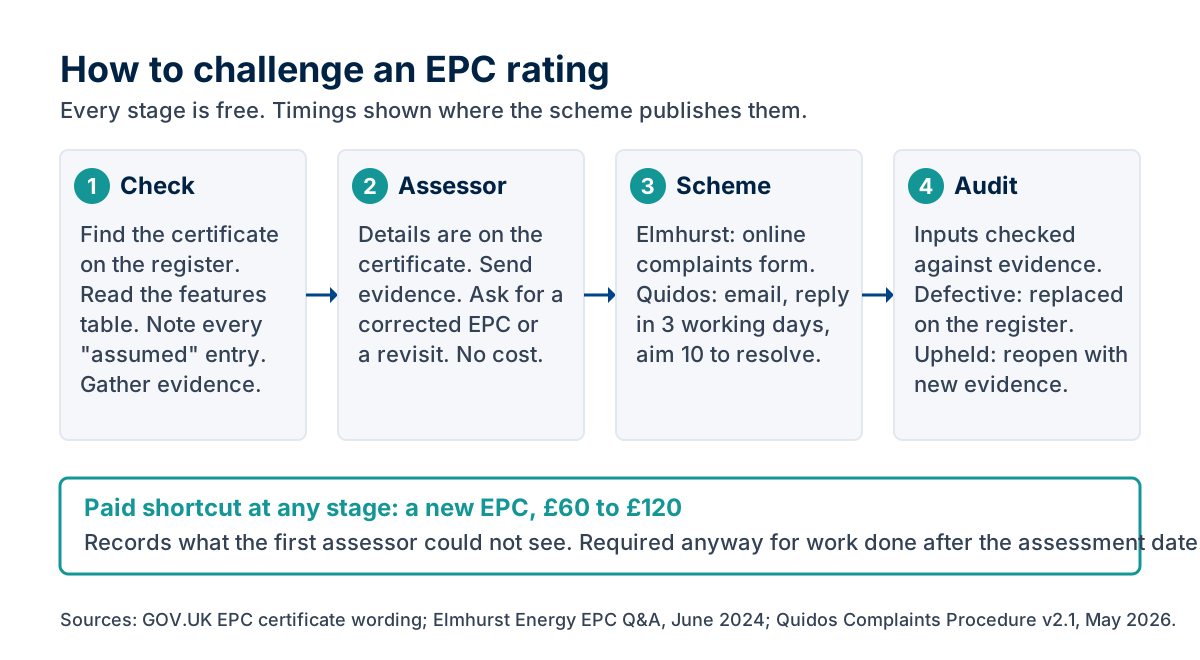 The challenge route. Each stage is free. A fresh assessment is the paid shortcut at any point.
When should I commission a fresh EPC instead of challenging?
A complaint costs nothing but can take weeks, and it cannot add anything that was not there on the assessment date. A new assessment costs £60 to £120 for most rental properties. The decision is about time and about what changed.
| Situation | Better route | Why |
|---|---|---|
| Assessor recorded a feature wrongly and you have paper evidence | Complain to the assessor | Free, and a corrected EPC keeps the original assessment date |
| Loft or cavity not inspected, no documents, but you can give access | Ask the assessor for a revisit, or book a new EPC | Someone has to measure it; a revisit is free if the assessor agrees |
| You made improvements after the assessment date | New EPC | No complaint can add works done later |
| Assessor gone, scheme upheld the certificate, no new evidence | New EPC with a different assessor | The register shows the most recent certificate |
| Certificate shows F or G and you need to let now | New EPC in parallel with the complaint | You cannot let below E without a registered exemption, and a complaint does not pause that |
If you book a fresh assessment, choose the assessor with the challenge in mind. Our assessor checklist covers accreditation and the questions to ask, but the two that matter here are whether they will go into the loft and whether they will read your evidence bundle before the visit. Send it in advance, open the hatch, clear the boiler cupboard, and stay for the survey. Elmhurst lists a second EPC lodged for the same property within three months as a trigger for an audit of the assessor, so the second assessor will be careful and the evidence has to be real.
What evidence do I need to gather?
RdSAP convention 9.02 defines what counts. Acceptable documentary evidence "includes, but is not limited to" certificates, warranties, guarantees "or any documents verifying that work has been carried out", and the assessor must be confident the documents relate to the actual property. Evidence of intent to install (a quote, a planning application on its own) does not qualify. Intent plus building control sign-off, or plus visible evidence of the work, does.
| Feature on the certificate | Evidence that overrides the default |
|---|---|
| Cavity wall insulation | Installer guarantee (CIGA or equivalent), invoice with the address, or visible drill-hole pattern on a revisit |
| Loft insulation depth | Dated photograph with a tape measure showing depth, installer invoice, or lift the boards for the assessor |
| Solid wall, floor or room-in-roof insulation | Building control completion certificate, installer guarantee, manufacturer data giving the material's thermal conductivity |
| Construction age band | Land Registry title register, dated planning or building control records, original deeds |
| Double glazing age | FENSA or CERTASS certificate, building control certificate, manufacturer's guarantee, or the date stamped on the spacer bar |
| Heating controls | Photographs of the programmer, room thermostat and TRVs on at least half the radiators; installer commissioning paperwork |
| Boiler | Manufacturer and model plate photograph, Benchmark commissioning checklist, installation invoice |
| Property type and floor area | Floor plan with measurements, lease plan for a flat |
Two rules are easy to miss. Under convention 3.07, insulation can be entered at double its measured thickness where the product's thermal conductivity is shown to be 0.025 W/m·K or better, which is why a PIR datasheet matters. Under convention 3.03b, a boarded loft counts as insulated only to the depth you can prove, capped at the joist depth, unless the boards come up.
Does a wrong EPC affect my MEES compliance right now?
Yes, which is the reason to act quickly. Under the MEES landlord guidance (last updated 5 May 2026), a property in England and Wales cannot be let at band F or G without a registered exemption, the cost cap on required improvements is £3,500 including VAT, and the maximum civil penalty is £5,000 per property. The council enforces against the certificate on the register, so an undersold F is a live compliance problem even when the property is really a D. Our F-rating guide covers the options while a challenge runs, and the exemptions guide covers registration.
Band E is the legal minimum today. Band C from 1 October 2030, a £10,000 cost cap and a £30,000 maximum penalty are proposed in the government's response of 21 January 2026 and are not law. A rating held down by assumed defaults still matters for that proposal: a property that is genuinely a C but certified as a D would be paying for improvements it does not need.
Frequently Asked Questions
How do I know if my EPC rating is wrong? Read the "Features in this property" table on the certificate and look for the word "assumed" or for descriptions that do not match what is installed. Then run the real features through the EPC predictor to see what band they should produce. A gap of a band or more between the two is a challenge worth making.
Does it cost anything to challenge an EPC rating? No. Complaining to the assessor and to their accreditation scheme is free, and the schemes are required to run their complaints processes at no cost to the complainant. The only paid route is commissioning a new assessment, typically £60 to £120.
How long does an EPC challenge take? It depends on the scheme and on how quickly the assessor responds. Quidos aims to acknowledge within 3 working days and resolve within 10 working days. Elmhurst does not publish a target, and a complaint that goes to a full audit with a revisit can take several weeks. If you need a compliant certificate quickly, book a new EPC in parallel.
Can the assessor change an EPC after it has been lodged? Yes. If the assessor accepts the correction, they lodge a new certificate and the erroneous one is marked as not for issue on the register. The scheme does the same where an audit finds the certificate defective. The old certificate does not stay live alongside the new one.
What if the assessor has retired or will not reply? Go straight to the accreditation scheme named on the certificate. Quidos's procedure covers assessors who cannot be contacted or have left the industry, and Elmhurst mediates where the assessor is unresponsive. If Stroma Certification is named, the complaint goes to Elmhurst, which took over Stroma's members on 1 October 2023.
Will a challenge definitely raise my rating? No. The scheme audits the assessor against what was visible and evidenced on the assessment date. If the loft was boarded and the assessor recorded it as unknown, the certificate was produced correctly even though it undersells the property. In that case the fix is a revisit or a new assessment with the loft open and the evidence in hand.
Can I let a property while I challenge an F or G rating? Not without a registered exemption. MEES applies to the certificate on the register, and a complaint in progress does not pause enforcement. Book a new assessment at the same time as the complaint if you need to let, and gather the evidence first so the second assessor records the property correctly.
Do improvements I made after the assessment count in a challenge? No. A complaint can only correct what existed on the date of assessment. Anything installed since needs a new EPC, and the new certificate will capture the challenge evidence and the improvements together.