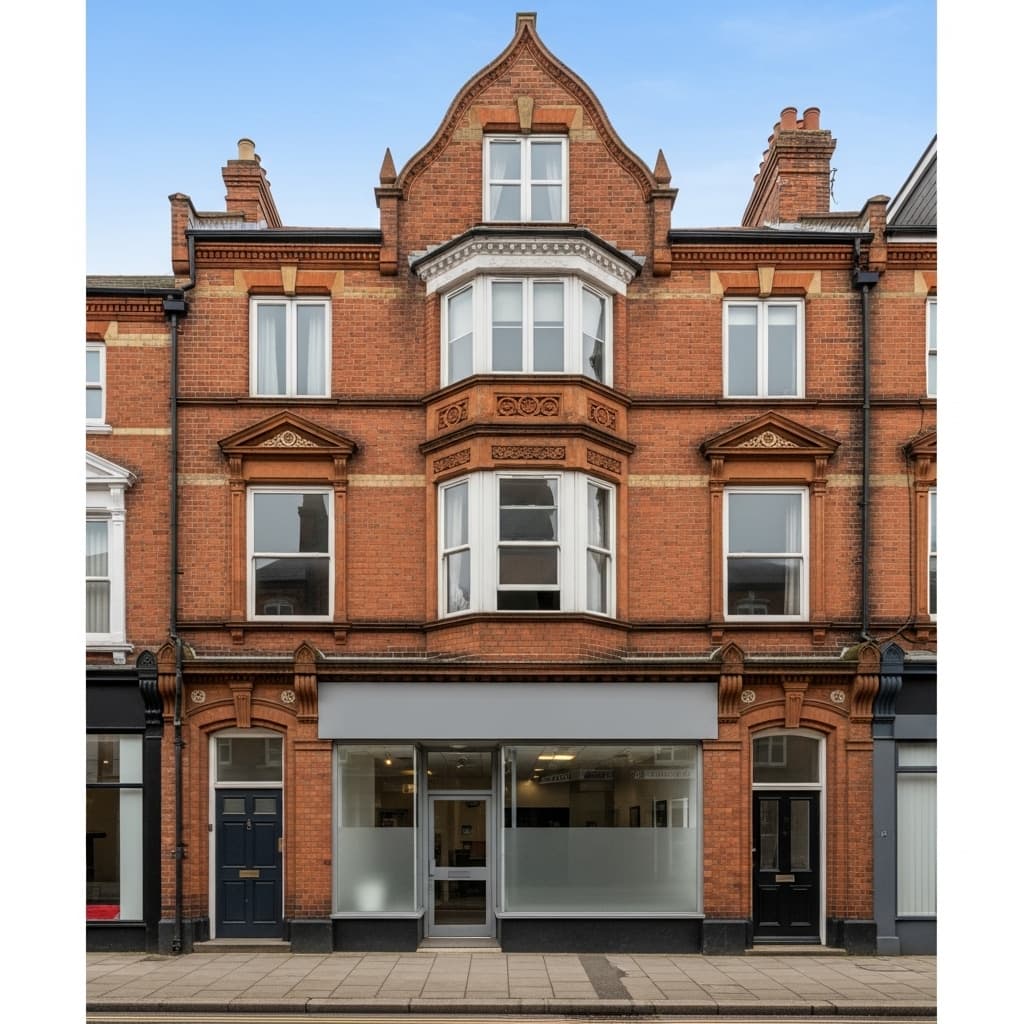
If you own a shop with a flat above it, a converted mill with commercial units, or any building where the lettable space spans both residential and commercial tenants, you are juggling two separate EPC regimes at once. The non-domestic rules that govern the commercial part of your portfolio are meaningfully different from the residential rules most landlord guides cover, and the June 2026 government announcement changed the proposed timeline for larger commercial buildings.
Non-domestic (commercial) properties privately rented in England and Wales must hold a minimum EPC band E rating. That is the law today and it is the only non-domestic energy standard currently enforceable. Government has proposed that privately rented non-domestic buildings over 1,000 square metres reach EPC band B by 2031 where cost-effective, but that is a proposal awaiting secondary legislation. Smaller commercial properties would stay at EPC E, with no new date proposed for them at all.
What Is a Non-Domestic EPC?
A non-domestic EPC (also called a commercial EPC) is an energy performance certificate issued for a building or building unit that is not used as a dwelling. It covers the same A-to-G rating scale as a domestic EPC but uses a different assessment methodology and a different register, and it is produced by a non-domestic energy assessor rather than a domestic assessor.
Non-domestic EPCs are required when:
- A commercial property is constructed, sold, or rented
- A building is modified in a way that changes the number of parts designed or altered for separate occupation
- The property has been marketed or let at any point in the past 10 years
The certificate is valid for 10 years, the same as domestic.
Which Properties Need a Non-Domestic EPC?
The non-domestic MEES regulations apply to privately rented non-domestic properties where the lease runs between 6 months and 99 years. Very short licences (under 6 months) and very long leases (99 years or more) fall outside the scope.
Covered property types include:
- Commercial shop units, offices, and warehouses
- The commercial element of a mixed-use building
- Industrial premises rented to a business tenant
- Agricultural buildings where an EPC is legally required
Agricultural land and buildings used for shelter, listed buildings where EPC compliance would unacceptably alter character, and temporary buildings intended for use under two years may be exempt from needing a certificate at all.
Current Non-Domestic MEES Rules: EPC E From April 2023
The minimum energy efficiency standard for non-domestic rented property is currently EPC band E. Landlords may not let, or continue to let, a commercial property rated F or G unless a valid exemption is registered.
The key date is 1 April 2023. From that date, the requirement applies to all privately rented non-domestic properties, including those where the existing tenancy has not changed hands. Prior to that, the minimum standard applied only to new lets and lease renewals (from 1 April 2018). Today, there is no legacy letting that avoids the requirement.
This means if you have a commercial unit on a long-running lease and the property is rated F or G, you are in breach of the Energy Efficiency (Private Rented Property) (England and Wales) Regulations 2015 unless you hold a registered exemption.
The June 2026 EPC B Announcement: What Actually Changed
On 18 June 2026, the Department for Energy Security and Net Zero (DESNZ) published its interim response to the long-running consultation on tightening non-domestic MEES. The headline number is EPC B by 2031. None of it is law, and secondary legislation must pass Parliament before any of it takes effect, per analysis from Mayer Brown (Mayer Brown, June 2026).
What government said it intends:
- Privately rented non-domestic buildings over 1,000 square metres would need to reach EPC band B by 2031, where it is cost-effective
- The existing seven-year payback test exemption would remain in place
- The existing six-category exemptions framework would continue to apply
What was dropped from earlier proposals:
- The previously proposed EPC C by 2027 interim milestone has gone entirely
- The earlier proposal of EPC B by 2030 has moved back a year to 2031
That second bullet is worth sitting with. The non-domestic target date has already moved once, and the interim milestone was deleted outright. A proposed date is not a countdown clock.
What is unchanged for most landlords:
- Non-domestic buildings under 1,000 square metres stay at the EPC E minimum, which is in force now
- No new date has even been proposed for smaller commercial properties
The practical reality for most landlords: a typical high-street retail unit, or a shop with a flat above, measures well under 1,000 square metres. The proposed 2031 EPC B target almost certainly would not touch your property even if it passes. The obligation that binds you right now is EPC E.
Mixed-Use Properties: Two EPCs, Two Deadlines
A mixed-use building, for example a shop on the ground floor with a let residential flat above, requires two entirely separate EPC certificates:
- Domestic EPC for the residential flat (A-to-G, produced by a domestic assessor)
- Non-domestic EPC for the commercial unit (A-to-G, produced by a non-domestic assessor)
Each certificate sits on a different register, is assessed against different criteria, and faces a different compliance deadline.
| Element | Certificate type | Minimum standard in force | Proposed change |
|---|---|---|---|
| Residential flat | Domestic EPC | EPC E | Band C from 1 Oct 2030 (proposed, not law) |
| Commercial unit (under 1,000 sq m) | Non-domestic EPC | EPC E | None proposed |
| Commercial unit (over 1,000 sq m) | Non-domestic EPC | EPC E | Band B by 2031 (proposed, not law) |
Read that table as two columns doing different jobs. The middle column is what a court or a local authority can act on today. The right-hand column is what government has said it wants, and neither entry in it has been through Parliament.
The two parts of the building are assessed independently. Improvements to the commercial unit do not improve the domestic EPC, and vice versa. Track and plan each element separately.
For the residential flat, the mainstream landlord EPC guidance applies: the cost cap for a high-cost exemption is £3,500 including VAT today, with £10,000 proposed, the maximum civil penalty is £5,000 per property with £30,000 proposed, and grant funding does not count against the cap. For the commercial unit, the non-domestic rules in this article govern.
Non-Domestic MEES Exemptions
Six exemptions allow commercial landlords to continue letting a property below EPC E. Each exemption must be registered on the PRS Exemptions Register and, unless stated otherwise, lasts five years.
1. Seven-year payback test The cost of all recommended improvements exceeds the energy savings achievable over seven years. This is the most commonly used commercial exemption. The landlord must demonstrate that no available improvement clears the seven-year cost-recovery test.
2. All improvements made Every feasible energy improvement has been installed and the property still does not reach EPC E. No further cost-effective improvements are available.
3. Wall insulation negative impacts The only viable improvement is cavity, external, or internal wall insulation, and an independent expert has confirmed this would damage the building fabric.
4. Third-party consent refused Consent from a freeholder, mortgagee, superior landlord, or planning authority was required, formally requested, and refused or granted only on terms the landlord cannot reasonably meet.
5. Property devaluation A qualified RICS surveyor has confirmed that the required improvements would reduce the market value of the property by more than 5%.
6. Recently became a landlord A six-month grace period applies for newly acquired properties. The landlord must register an exemption or carry out improvements within that window.
For detailed guidance on registering exemptions, see our EPC exemptions guide.
Fines and Enforcement
Commercial non-domestic MEES enforcement sits with local weights and measures authorities (typically Trading Standards). Unlike domestic EPC enforcement, the non-domestic penalty scale is based on the rateable value of the property and the duration of the breach.
Penalties for serious or prolonged non-compliance can reach £150,000 per property, per GOV.UK's non-domestic private rented property MEES landlord guidance.
Non-compliant landlords may also be listed on a public register. Note that the non-domestic ceiling is much higher than the domestic one, which is £5,000 in total per property. The two regimes are not comparable: the rateable-value calculation means a commercial penalty scales with the value of the asset being let unlawfully.
What This Means for Landlords
The practical checklist for any landlord with a commercial or mixed-use property:
- Check whether your commercial unit has a valid non-domestic EPC. If the property has been let in the last 10 years, an EPC should exist. Check the non-domestic EPC register at find-energy-certificate.service.gov.uk.
- If your commercial unit is F or G rated, you are already in breach. You need either to improve the property to EPC E or register a valid exemption immediately.
- If your commercial unit is over 1,000 square metres, the proposed 2031 EPC B target would catch it. Worth scoping the improvements and gathering payback evidence, while remembering the target is not law and has already slipped once.
- If you own a mixed-use building, treat the residential and commercial parts as entirely separate compliance tasks. Different certificates, different timelines, different improvement works.
- The residential part of a mixed-use property sits under domestic MEES, so its legal minimum is band E, with band C proposed from 2030. The commercial element being compliant does not help the residential EPC.
For the residential component of your mixed-use portfolio, our EPC C deadline guide covers every step from assessment to completion.
Want the exact route from your current band to EPC C for the residential part of your portfolio? Get your costed EPC C Action Plan (£29). In your inbox within the hour, then refined by a real person over the next 48 hours. Start here.
Frequently Asked Questions
Does my mixed-use property need two EPCs? Yes. The residential flat or flats in a mixed-use building require a domestic EPC assessed by a domestic energy assessor. The commercial unit requires a non-domestic EPC assessed by a non-domestic energy assessor. Each sits on a different government register and faces different minimum standards and deadlines.
What is the current minimum EPC rating for a commercial rented property? EPC band E. This has applied to all privately rented non-domestic properties in England and Wales since 1 April 2023, including properties on long-running tenancies where the tenancy has not changed hands. Properties rated F or G may not be let without a registered exemption.
When does the EPC B requirement apply to commercial buildings? It does not, and may never. EPC B by 2031 is a proposal, set out in the June 2026 DESNZ interim response, covering only privately rented non-domestic buildings over 1,000 square metres in England and Wales and only where improvements are cost-effective. Secondary legislation must pass Parliament before it binds anyone, and the date has already moved from 2030 to 2031. Smaller buildings would stay at EPC E, which is the standard in force for all non-domestic rented property today.
Can I use the same exemptions for commercial property as for residential? Commercial and residential MEES use different exemption frameworks. The non-domestic regime provides six exemptions (seven-year payback test, all improvements made, wall insulation negative impacts, third-party consent refused, property devaluation, recently became a landlord). The domestic regime uses a different six exemptions with different cost cap thresholds. Register commercial exemptions on the PRS Exemptions Register at prsregister.beis.gov.uk.
What are the fines for letting a commercial property below EPC E? Penalties are set by local weights and measures authorities and calculated on the rateable value of the property and the duration of the breach. GOV.UK's non-domestic MEES landlord guidance puts the ceiling at £150,000 per property for serious or prolonged non-compliance. That is the non-domestic figure and is far above the domestic maximum of £5,000. Non-compliant commercial landlords may also be listed on a public register.
Does the proposed 2030 EPC C residential change affect my commercial unit? No. The proposed band C requirement for 1 October 2030 concerns domestic (residential) rented property only, and it is not yet law even there. The commercial unit in a mixed-use building is governed by non-domestic MEES, which requires band E today. The two are separate regulatory regimes with separate registers, assessors, and timetables.