Yes. In England and Wales you must order an Energy Performance Certificate (EPC) before your home goes on the market, and you must give a copy, free of charge, to the person who buys it. GOV.UK says the same: "You must order an EPC for potential buyers and tenants before you market your property to sell or rent."
You may not need to pay for a new one. If the property already has a valid EPC, you can use it. Check the register first. If there is none, or it has expired, request an accredited assessor.
What does the law require when you sell?
Three rules in the Energy Performance of Buildings (England and Wales) Regulations 2012 matter to a seller.
- Order it before marketing. Regulation 7 says that before the building is put on the market, the relevant person must secure that an EPC is commissioned for it.
- Show it to buyers early. Under regulation 6, a valid EPC must be made available to prospective buyers at the earliest opportunity, and no later than the earlier of the time they are first given written information about the property or view it.
- Give it to the buyer. Regulation 6 also says the seller must ensure a valid EPC has been given free of charge to the person who ultimately becomes the buyer.
There is a fourth rule for your listing. Under regulation 11, the energy rating must be stated in any advertisement of the sale in commercial media. Check that the agent's portal listing shows the band.
How long do I have to get an EPC?
Regulation 7 sets a two-stage clock that starts on the day the property is first put on the market. You and anyone acting for you must use all reasonable efforts to have a valid EPC within 7 days. If that fails, it must be obtained before the end of the 21 days immediately following. That is 28 days at the outside.
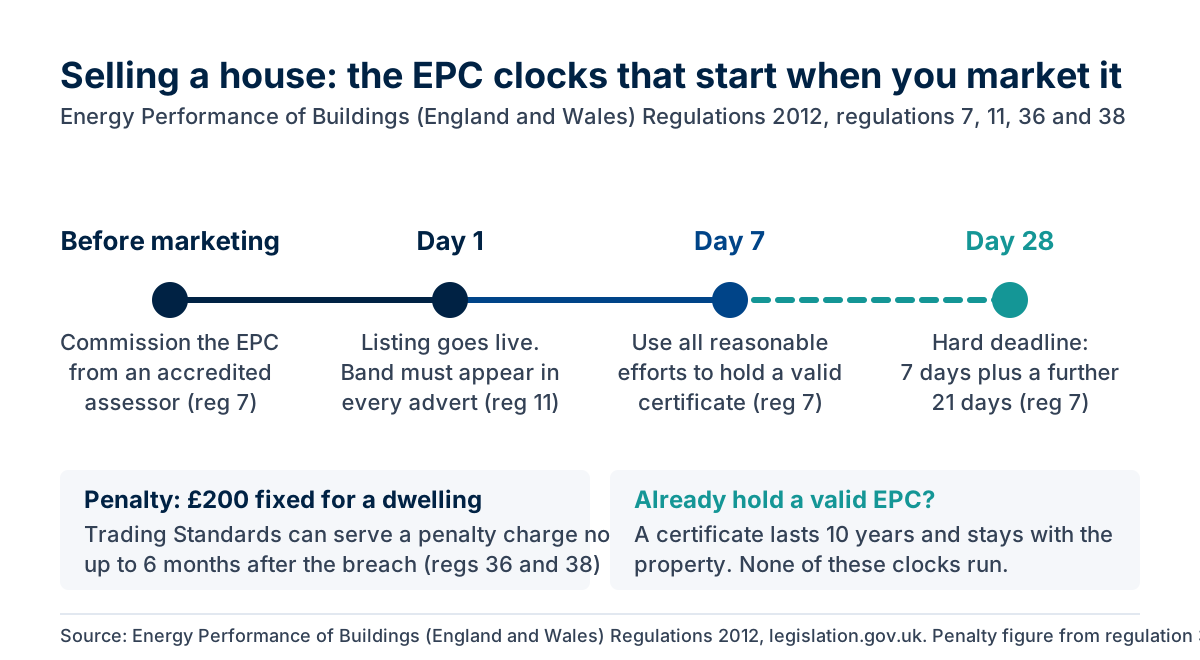 The 2012 Regulations set three clocks: commission before marketing, hold a certificate within 7 days (28 at the outside), and a six-month window in which Trading Standards can serve a penalty charge notice.
The 28 days are a backstop, not a licence to list first. The duty to commission comes before the first listing goes live. Regulation 37 gives a defence against a penalty for not having the EPC ready to show a buyer, if you commissioned it before marketing and, despite all reasonable efforts and enquiries, still did not have it. Under regulation 7, an EPC counts as commissioned when the request goes to an accredited energy assessor with the payment, or a promise to pay, usually needed. Keep the booking email and invoice.
None of these clocks run if you already hold a valid EPC.
Need an EPC for your property?
Only an assessment by an accredited energy assessor produces an official EPC. Tell us about the property and we can put you in touch with a trusted one.
Can you sell a house without an EPC?
You risk a penalty if you try. The fixed penalty for a dwelling is £200 under regulation 38, and GOV.UK's guide to EPCs for the marketing, sale and let of dwellings confirms the £200 figure.
- Who enforces it: every local weights and measures authority, which in practice means your council's Trading Standards team (regulation 34).
- Time limit: a penalty charge notice cannot be given after six months from the breach.
- Time to pay: at least 28 days from the day after the notice is given, or you can ask for a review (regulation 36).
- Withdrawal: the authority must withdraw the notice if you show you took all reasonable steps and exercised all due diligence to avoid the breach, or that the regulation 37 defence applies.
Many guides quote "up to £5,000". That is the maximum civil penalty for a landlord letting a property below the minimum standard, set out in GOV.UK's landlord guidance. It is a different rule and does not apply to selling your own home.
Can I use the EPC I already have?
Yes, if it is still valid. GOV.UK says an EPC "is valid for 10 years and can be reused as many times as required within that period". It stays with the property, whoever owns it.
Two checks before you rely on it:
- The "valid until" date. If it will pass during the sale, order a new one before you instruct an agent. Our EPC lookup guide shows you how to find the date.
- Whether a newer one exists. GOV.UK says only the most recent EPC for a building is valid. A newer certificate on the register replaces an older one.
You can also choose to commission a new EPC if you have done work since the last one. A new boiler, insulation or glazing will not appear on an old certificate until a new assessment is lodged. Whether the higher band is worth paying for is your call, and the law does not require it.
How do I get an EPC to sell my house?
Only an accredited domestic energy assessor can produce a valid EPC. GOV.UK says they must belong to a government-approved accreditation scheme and lodge the certificate on the national register.
- Request an assessor. We put you in touch with a trusted accredited assessor. You can also use GOV.UK's own find an accredited assessor service, or ask your estate agent, who may arrange one.
- Let them in. The assessor visits and assesses the property.
- Check it is lodged. The certificate is valid once it is lodged on the register. Search for it afterwards using the lookup.
The fee is not fixed. GOV.UK says the cost of an assessment "varies by assessor and the size of the property". Which? puts a typical EPC at around £60 to £120, and its own mystery shopping in February and March 2024 paid between £47 and £85. See EPC assessment cost for what affects the price.
Which homes do not need an EPC to sell?
GOV.UK lists the situations where an EPC is not required:
- temporary buildings with a planned time of use of two years or less
- stand-alone buildings with a total useful floor area under 50 square metres
- residential buildings intended to be used for less than four months of the year
- buildings suitable for demolition, where the planning permissions for both demolition and redevelopment are in place (regulation 8)
- historic buildings, but only where meeting minimum energy performance requirements would "unacceptably alter their character or appearance" (regulation 5)
- certain furnished holiday lets that meet specific HMRC conditions
A normal house or flat does not qualify. A listed building is not automatically exempt, because the test is whether compliance would unacceptably alter its character. See our listed building EPC guide. The government has said it intends to remove the heritage exemption, but that is a stated intention, not law.
Does a low EPC rating affect the sale price?
Slightly. Nationwide's June 2026 analysis of owner-occupied homes in England allowed for other property characteristics and found that homes rated A or B sold for a 1.6% premium over a similar D-rated home, about £4,500. Homes rated F or G sold for 1.4% less, about £4,000. It found little difference for C or E compared with D (Nationwide).
That is an average across homes in England. It does not predict the price of your home. Our EPC rating and property value guide covers more research.
There is no minimum EPC band you must reach to sell. The band E minimum in the MEES regulations is a rule for landlords letting property.
Selling a rental property: what landlords need to know
The rules above apply to a landlord selling a rental in exactly the same way.
- You probably hold one already. You needed a valid EPC to let the property, and it lasts 10 years. A valid one can be reused for the sale.
- Your buyer may keep letting. The minimum in force for letting is band E. The government's 21 January 2026 response says all in-scope tenancies must meet a new standard by 1 October 2030, usually described as EPC C. That is decided policy, not yet law, and needs an Act of Parliament and a statutory instrument first.
- Decide whether to upgrade first. Our sell or upgrade decision guide and the 2030 sell-or-upgrade guide cover the numbers, and the buyer due diligence guide shows what an investor will look at.
Does this apply in Scotland and Northern Ireland?
No. The 2012 Regulations cover England and Wales. Scotland has its own register and rules, covered in our Scottish EPC guide. For Northern Ireland, see nidirect.
Checklist before you instruct an agent
- Look up the property on the register and note the band, the reference number and the "valid until" date.
- If there is no valid EPC, request an accredited assessor before the listing goes live.
- Check the agent's draft listing shows the energy band.
- Keep the EPC and any booking email or invoice with your sale papers.
Frequently Asked Questions
Do you need an EPC to sell a house in England and Wales? Yes. Under regulation 7 of the Energy Performance of Buildings (England and Wales) Regulations 2012, you must commission an EPC before the property is put on the market if there is no valid one. Under regulation 6, a valid EPC must be given free of charge to the person who becomes the buyer. A few building types are exempt, such as some buildings suitable for demolition.
Do I need an EPC to sell my house if I have one already? No new one is needed if the existing EPC is still valid. GOV.UK says an EPC is valid for 10 years and can be reused as many times as needed within that period. Check the "valid until" date and that no newer certificate has been lodged.
Can you sell a house without an EPC? You risk a £200 penalty charge notice from Trading Standards if you market or sell without meeting the EPC duties. The notice must be served within six months of the breach. The simplest route is to order the EPC before you list.
How much is the fine for selling a house without an EPC? £200 for a dwelling, under regulation 38 of the 2012 Regulations. The "up to £5,000" figure quoted in some guides is the maximum civil penalty for letting a property below the minimum standard, which is a different law.
How long is an EPC valid when selling? Ten years from the date of issue. Only the most recent EPC for a building is valid, so a newer certificate replaces an older one on the register.
Who pays for the EPC when selling a house? The seller arranges the EPC. GOV.UK says you will need to pay for an EPC from an accredited assessor. The fee varies by assessor and property size.
Does a low EPC rating stop me selling? No rule sets a minimum EPC band for selling a home. The band E minimum applies to landlords letting property. A low band may affect price: Nationwide's June 2026 analysis found F and G rated homes sold for 1.4% less than similar D-rated homes.
Is a listed building exempt from needing an EPC to sell? Only partly. Regulation 5 exempts officially protected buildings where meeting minimum energy performance requirements would unacceptably alter their character or appearance. It is a narrow test, not a blanket exemption.