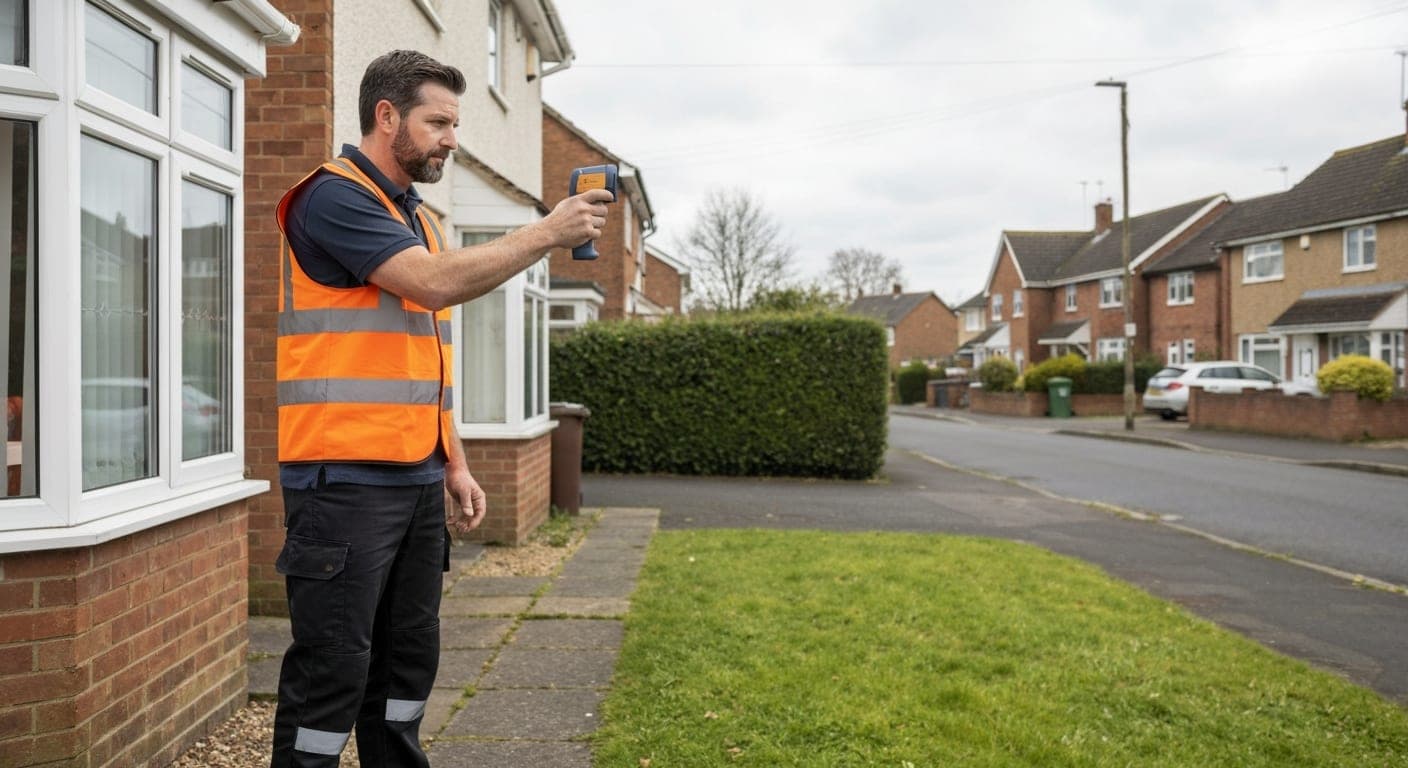
An EPC assessment costs between £60 and £120 for most residential rental properties in 2026. The exact price depends on property size, type, and location, but for a standard 1–3 bed flat or house, most landlords will pay in that range.
Here's what affects the price, when you legally need one, and the one detail most guides miss.
Typical EPC costs in 2026
There is no government-set price for an EPC. It's a market rate set by individual assessors. These are the ranges based on current 2026 pricing:
| Property type | Typical cost |
|---|---|
| 1–2 bed flat | £60–£80 |
| 3 bed house | £70–£100 |
| 4+ bed house | £85–£130 |
| Large detached / complex property | £120–£200+ |
| HMO (whole-house EPC) | £150–£300 |
| London and South East | Add 10–30% to national averages |
These are market averages. Some assessors charge more, some less. Always check accreditation before booking (more on that below).
What affects the price?
Property size. More rooms = longer assessment = higher fee. A 5-bed property takes roughly twice as long as a 1-bed flat.
Property type. HMOs require a whole-house EPC. The assessment is more detailed and complex, assessors typically charge £150–£300 depending on how many rooms the property has.
Location. Assessors in London and the South East typically charge a 10–30% premium over the national average. Rural properties may also incur travel surcharges.
Complexity. Non-standard construction (unusual wall types, mixed glazing systems, difficult access) adds assessment time. You'll pay more for hard-to-assess properties.
Volume discounts. If you have a portfolio of 5 or more properties, most assessors will negotiate a discounted rate per property. It's worth asking when booking multiple assessments.
When do you legally need a new EPC?
You need a valid EPC, and must provide it to the tenant, when:
- Letting to a new tenant, including a new fixed-term, periodic, or occupation contract
- Marketing a property for sale or rent, must be available to any prospective tenant at viewing stage
- Your existing EPC expires, EPCs are valid for 10 years. You must manage this proactively; there's no automatic reminder.
- You've carried out significant improvements, if you've upgraded insulation or heating and want the rating reassessed sooner
A new EPC is NOT triggered by:
- Renewing a tenancy with the same tenant on the same terms
- An AST automatically converting to a periodic tenancy on 1 May 2026 under the Renters' Rights Act, this is not a new letting for MEES purposes
See our guide on how to check your current EPC rating to verify your expiry date before booking.
Letting a property that requires an EPC without holding one is an offence under the Energy Performance of Buildings Regulations, enforced by trading standards. That is separate from MEES, where letting below band E without a registered exemption carries a civil penalty of up to £5,000 in total per property. See our full guide to EPC non-compliance penalties.
The cost cap, does the EPC fee count?
Yes, and almost no one mentions this.
The NRLA has said the cost of an EPC assessment counts toward the MEES cost cap. If you're undertaking a programme of improvements, every cost associated with that programme, including the assessment itself, can be tracked against your cap. The cap in force is £3,500 per property including VAT. The government has proposed raising it to £10,000 alongside a band C standard, but that is not law yet.
Practical implication: if you're approaching the limit, even a £90 EPC assessment is captured. Keep receipts and maintain a cost record for each property. Note that grant funding does not count towards the cap at all.
See our cost cap guide for the full framework, including what else counts and how to document your spend.
How to find an accredited EPC assessor
An EPC must be carried out by an accredited Domestic Energy Assessor (DEA), it cannot be self-assessed. The EPC must then be lodged on the national register to be valid.
How to find one:
- epcregister.com, search by postcode. Shows recent assessments and lets you contact local assessors directly.
- Elmhurst Energy (elmhurstenergy.co.uk), one of the major accreditation bodies. Their directory lists accredited assessors by location.
- Stroma (stroma.com), another major accreditation body with an assessor directory.
An EPC that isn't lodged on the national register is not valid, even if the assessment was carried out correctly. Always confirm the assessor will lodge it before you pay.
For a full checklist on what to look for when booking, see our how to choose an EPC assessor guide.
Frequently asked questions
Is there a fixed price for an EPC assessment?
No. There's no government-set pricing. Costs are market rate and vary by assessor, property type, size, and location. Expect £60–£120 for most standard rental properties.
How long does an EPC assessment take?
Around 30–60 minutes for a standard property. Larger properties or HMOs take longer. The assessor inspects insulation, heating systems, windows, and building fabric, they don't need to see every room, but they do need access to boilers, loft hatches, and meters.
Can I pass the EPC cost to my tenant?
No. The landlord is legally responsible for obtaining and providing the EPC. You cannot charge tenants for it.
Does getting a new EPC reset the proposed 2030 Band C date?
No. The Band C standard for 1 October 2030 is a government proposal that applies to the property regardless of when your EPC was issued. It is not in the MEES Regulations yet: that needs an Act of Parliament and a statutory instrument, neither of which has been laid. The minimum in force remains band E. A new EPC may improve your rating if you've done works, but it does not move the proposed date either way.
Does the EPC assessment cost count toward the cost cap?
Yes, according to the NRLA. Keep the invoice and include it in your cost cap records. The cap in force is £3,500 including VAT; the £10,000 figure is proposed.
An EPC assessment is a modest cost, typically under £100 for most properties. The bigger cost comes from what the assessment reveals. If you are planning for the proposed Band C standard in 2030, start on that programme now even though it is not yet law.
Check whether your upgrades might qualify for a government grant first, use our grant eligibility checker to see what's available for your property.