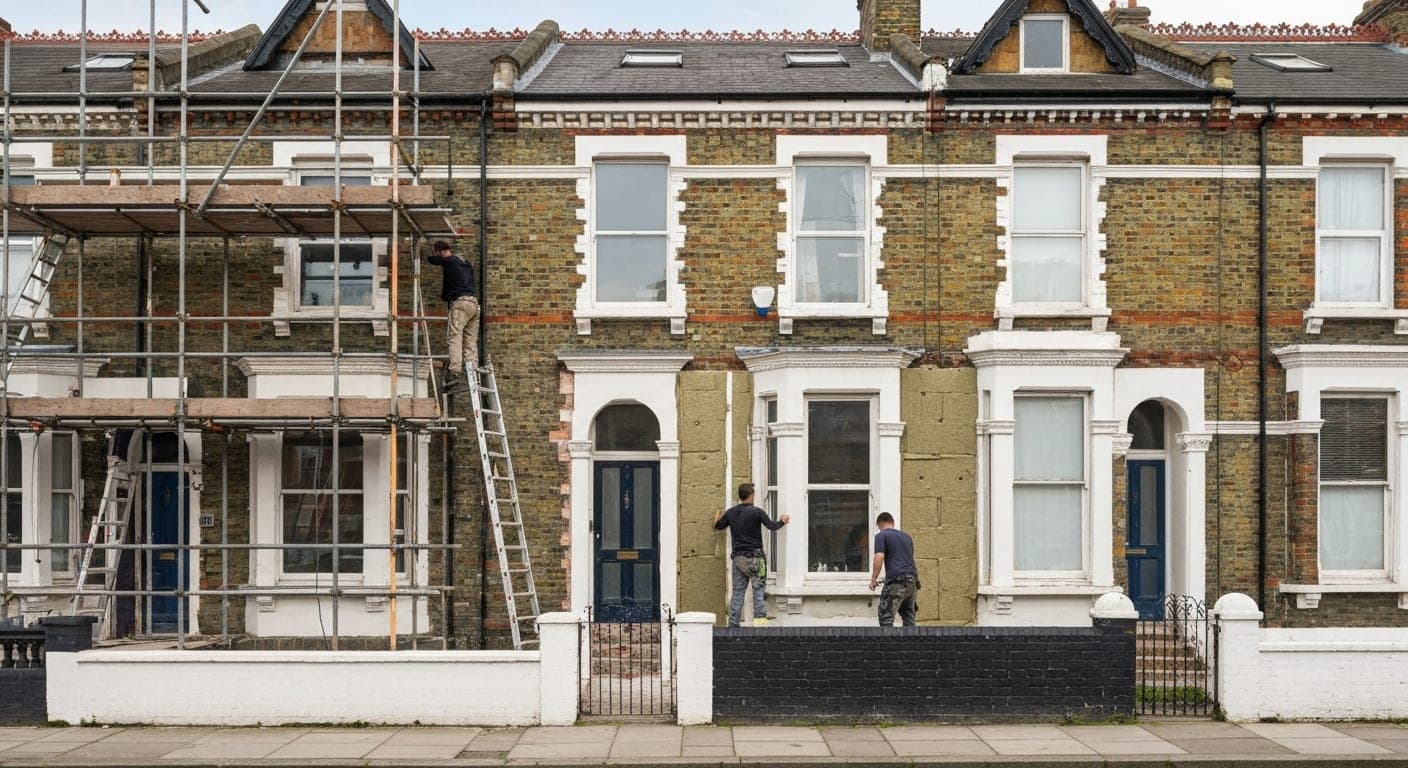
Improving the EPC rating of a Victorian terrace takes 4 to 20 weeks depending on which measures you need. Quick wins like loft insulation and heating controls can be done in under two months. A full programme, including solid wall insulation, is a 3–5 month project.
This matters now because the government proposed in January 2026 that privately rented homes in England and Wales should reach EPC C by 1 October 2030, with the MEES cost cap raised to £10,000 from £3,500. Neither change is law: the minimum in force is band E and the cap in force is £3,500 including VAT. EPCGuide's analysis of 75,000 lodged certificates across 15 local authorities shows that solid-wall homes, which include most pre-1919 Victorian terraces, are among the hardest property types to move to band C, because they cannot take low-cost cavity wall insulation.
This guide gives you a practical timeline for each improvement, what each measure costs, plus two planning scenarios: quick wins only, and the full upgrade.
Quick Answer: 4 to 20 Weeks
| Programme | What's Included | Typical Total Time |
|---|---|---|
| Quick wins | Loft insulation, heating controls, LED | 4–8 weeks |
| Full upgrade | Above + solid wall insulation | 12–20 weeks |
| Grant-funded | Any of the above via ECO4/Warm Homes | Add 4–8 weeks |
The biggest variable is wall insulation. Victorian terraces are solid-wall properties, they can't have cavity fill, so you need external or internal wall insulation instead. Both take longer to install and require more planning than simpler measures.
Why Victorian Terraces Are Different
Built before 1919, Victorian terraces have solid brick or stone walls with no air gap between inner and outer layers. Modern properties have a cavity that can be filled with insulation in a few hours, Victorian properties don't have that option.
Instead, your choices are:
- External wall insulation (EWI): Cladding applied to the outside face of the wall. More disruptive to the street appearance; often needs planning permission. Typically adds 7–12 SAP points.
- Internal wall insulation (IWI): Insulation boards fitted inside rooms, reducing floor area slightly. Requires redecoration. Also adds 5–10 SAP points.
Both take significantly longer to plan, survey, and install than loft insulation or heating controls. If your property is rated E or below, wall insulation is likely unavoidable.
For a detailed breakdown of which improvements make the most sense for your property, see our full Victorian terrace EPC guide.
Step-by-Step: The Improvement Process
Step 1, Book an EPC Assessment (Week 1–2)
Before you do anything else, get a current EPC assessment if your certificate is more than a few years old. A current assessment tells you exactly which measures the assessor recommends and how many SAP points each would add.
Most domestic EPC assessors have 1–2 week lead times. The assessment itself takes 1–2 hours on site. Your certificate is issued the same day or within 24 hours.
Tip: Book this before you contact installers. The assessment report gives you a prioritised list, saves you getting three quotes for loft insulation when the assessor tells you it's already at 270mm.
Step 2, Get Installer Surveys (Week 2–4)
Once you know which measures to pursue, you need installer surveys. This is a separate visit from the EPC assessment.
- Loft insulation: Most installers will survey within a week and install within 2–3 weeks
- External or internal wall insulation: Specialist surveyors, typically 1–3 week wait for survey. Then you'll need at least 1-2 weeks to receive and compare quotes.
- Heating controls / boiler: Gas Safe engineer survey, often same week
If you're applying for ECO4 or the Warm Homes Local Grant, the grant body will arrange the installer survey for you, but this adds 4–8 weeks to the process.
Step 3, Schedule and Complete the Works (Week 3–20)
Work in this order to avoid rework:
- Structural/external work first (EWI, scaffolding)
- Loft insulation
- Heating system changes
- Draught proofing, hot water cylinder jacket
- LED lighting last (easiest, can be done at any time)
Timeline by Measure
| Measure | SAP Points Added | Installation Time | Total Process Time |
|---|---|---|---|
| Loft insulation (300mm) | 4–8 pts | 1–2 days | 2–4 weeks |
| External wall insulation | 7–12 pts | ~2 weeks | 8–12 weeks |
| Internal wall insulation | 5–10 pts | 3–5 days/room | 4–8 weeks |
| Heating controls / TRVs | 2–4 pts | 1 day | 1–2 weeks |
| LED lighting (full house) | 1–2 pts | Half day | 1–2 weeks |
| Hot water cylinder jacket | 1–2 pts | 1–2 hours | 1 week |
| Boiler replacement (A-rated) | 4–6 pts | 1–2 days | 2–4 weeks |
SAP point estimates are for typical Victorian terraces under current RdSAP methodology. Actual improvement varies by property.
What Does It Cost to Improve a Victorian Terrace EPC?
Quick wins are cheap: a loft insulation top-up to 270mm typically costs £400 to £800 and saves £150 to £250 a year on heating (Energy Saving Trust, 2026). Heating controls, LED lighting, and draught proofing each run a few hundred pounds. The cost driver is solid wall insulation, the measure most Victorian terraces need to reach band C, at £8,000 to £15,000 fitted.
| Measure | Typical Cost (2026) | Annual Saving |
|---|---|---|
| Loft insulation (top-up to 270mm) | £400–£800 | £150–£250 |
| Heating controls, LED, draught proofing | A few hundred pounds each | Varies |
| Solid wall insulation (internal or external) | £8,000–£15,000 | Higher, longer payback |
Because solid wall insulation on its own can exceed the MEES cost cap several times over, many Victorian terrace landlords who still fall short after spending up to the limit may qualify for a high-cost exemption. The cap in force is £3,500 including VAT against band E; the £10,000 cap against band C is proposed and not yet law. Grant schemes can also cover the cost for eligible properties, and third-party funding does not count towards the cap: ECO4 and the Warm Homes Local Grant fund insulation and heating measures, and the Boiler Upgrade Scheme offers £7,500 toward a heat pump. See our solid wall insulation guide for Victorian terraces for a full cost breakdown.
Two Planning Scenarios
Scenario A, Quick Wins Only (4–8 Weeks Total)
If your Victorian terrace is already rated D and you need to reach C, or if you want to make progress before tackling wall insulation, quick wins can often get you there.
Typical quick-win programme:
- 300mm loft insulation top-up
- Heating controls (room thermostat, TRVs)
- Hot water cylinder jacket
- LED lighting throughout
Timeline:
- Week 1–2: Book and complete EPC assessment
- Week 2–3: Confirm loft specification + book installer
- Week 3–5: Loft insulation installed (1–2 days work)
- Week 4–6: Heating controls fitted (1 day)
- Week 4–5: LED lighting replaced (half day)
- Week 6–8: Book reassessment + receive new certificate
Total: 6–8 weeks from decision to new EPC certificate.
For many D-rated Victorian terraces, this programme is enough to reach C. Check our EPC D to C guide to see which measures typically tip the balance.
Scenario B, Full Upgrade Including Wall Insulation (12–20 Weeks Total)
If your property is E or below, or if quick wins aren't enough to reach C, wall insulation is usually required.
Timeline:
- Week 1–2: EPC assessment
- Week 2–4: EWI/IWI specialist survey + quotes
- Week 4–6: Planning permission check (EWI may require it in conservation areas)
- Week 6–8: Installer confirmed + materials ordered
- Week 8–12: Works completed (external) or 4–6 weeks (internal, depends on rooms)
- Week 12–14: Redecoration (IWI only), snagging
- Week 14–16: Quick wins completed (if not done earlier)
- Week 16–20: Reassessment + new certificate
Total: 12–20 weeks, depending on wall insulation type and planning requirements.
Important: Victorian terraces in conservation areas, or listed buildings, face additional restrictions on external alterations. Check with your local planning authority before assuming EWI is an option.
Planning Around Your Tenancy
The biggest practical question is whether you can do the works with a tenant in place, or whether you need the property vacant.
- Loft insulation, LED, cylinder jacket, heating controls: Tenants can stay in. Minimal disruption, typically one or two half-days.
- External wall insulation: Tenants can usually stay in. Work is external, though scaffolding causes noise and some visual impact.
- Internal wall insulation: Tenants cannot stay in room by room as IWI is done. If doing multiple rooms, the property effectively needs to be empty. This is the most disruptive option.
If your tenant's lease is ending in the next 3–6 months, a full upgrade including IWI is best timed during the void period. For EWI, scaffolding can be planned around a tenant changeover.
What If You're Applying for a Grant?
ECO4 and Warm Homes grant-funded work adds time to the process. The grant body manages the installer allocation, which typically adds 4–8 weeks to the total. Budget 3–5 months for a grant-funded full upgrade.
On the upside, some grant schemes cover the full cost of wall insulation and heating upgrades for eligible properties, so the extra wait can be worth it significantly. See our cheapest EPC improvements guide for a full overview of which measures can be grant-funded.
Use our property cost estimator to get a rough budget for your specific property type and current rating before booking your first assessment.
Frequently Asked Questions
Do I need a new EPC assessment before starting work? Yes. Unless you've had an assessment in the last 12 months, get a fresh one first. It confirms your current rating and tells you exactly which measures will add SAP points, which avoids paying for work that doesn't move your band.
How soon after works are complete can I get a new EPC? You can book a reassessment as soon as works are finished. Lead times are typically 1–2 weeks. The new certificate is issued on the same day as the assessment.
Will my current EPC still count after the Home Energy Model changes? The Home Energy Model (HEM), which will introduce new EPC methodology, has been delayed to H2 2027. Your current certificate remains valid until it expires (10 years). But an EPC C under current RdSAP may not automatically be a C under HEM, which weights heat pumps and solar more heavily. For a full breakdown, see our Victorian terrace EPC guide.
Can I do the improvements myself to speed things up? LED lighting and draught proofing can be DIY. But loft insulation, heating controls, and any wall insulation must be installed by a registered installer for the improvement to be recognised by an EPC assessor. DIY work won't appear on your certificate.
How much does it cost to improve a Victorian terrace's EPC rating? Quick wins are inexpensive: a loft insulation top-up costs £400 to £800 and heating controls or LED lighting run a few hundred pounds each (Energy Saving Trust, 2026). The big cost is solid wall insulation at £8,000 to £15,000 fitted, which is why many Victorian terraces blow through the MEES cost cap: £3,500 including VAT in force, or the £10,000 the government has proposed.
Can a Victorian terrace reach EPC C? Yes, most can. A D-rated Victorian terrace often reaches C on quick wins alone (loft insulation, heating controls, LED). E-rated and below usually need solid wall insulation to get there. Bear in mind D and E are legal to let today, so this is planning for the proposed 2030 standard, not a current obligation. Where works up to the cost cap still fall short, the property may qualify for a registered high-cost exemption.
The Bottom Line
For most Victorian terrace landlords, EPC improvement is a manageable project once you know the timeline. Quick wins, loft insulation, heating controls, LED, can be done in 6–8 weeks with a tenant in place. Wall insulation is the big one: plan for 12–20 weeks and consider timing it with a void period if you're doing IWI.
Start with an EPC assessment. From there, you'll know exactly what's needed and can plan the programme around your tenancies.