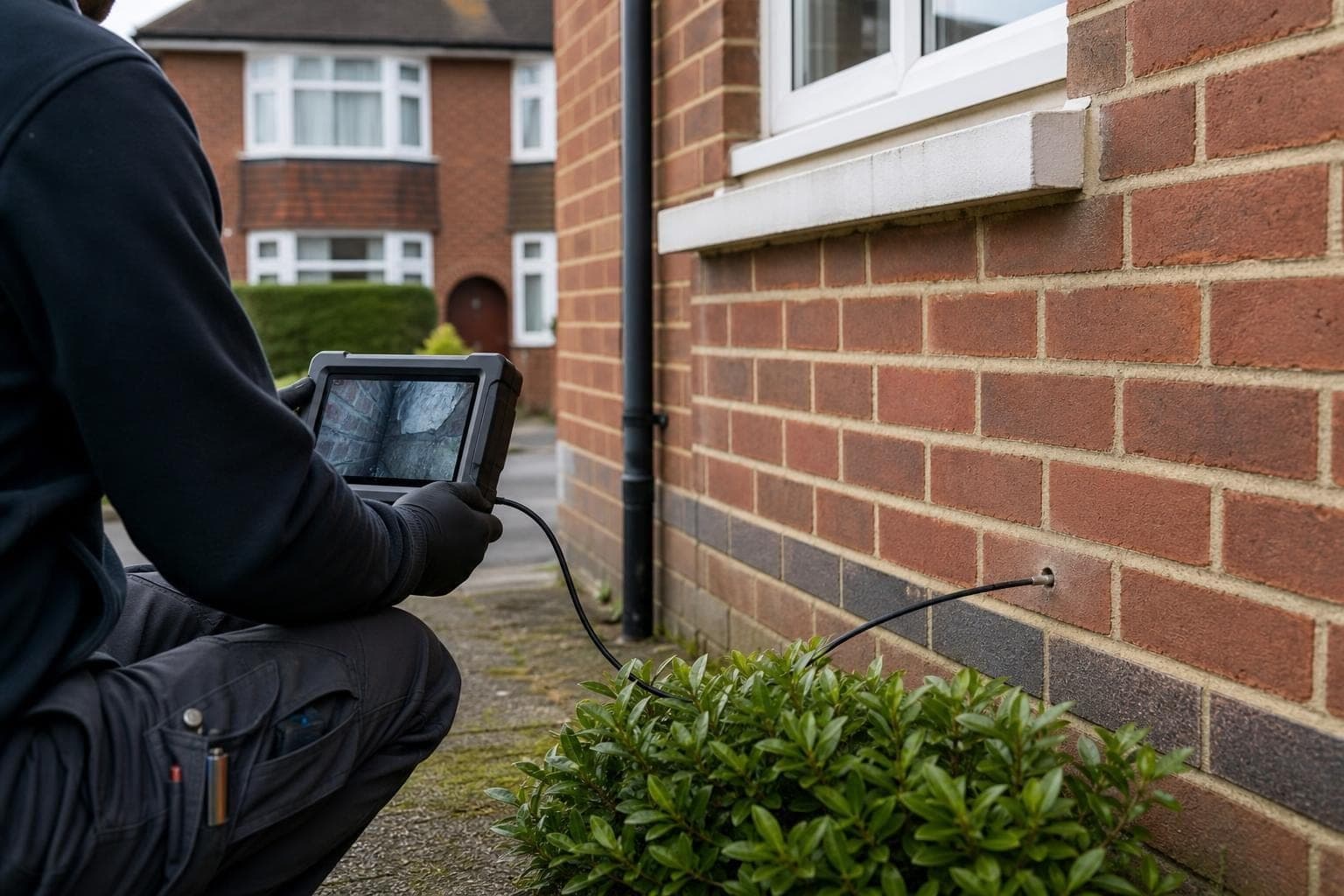
Cavity wall insulation is one of the cheapest, highest-impact EPC upgrades a landlord can make, but only when the cavity is sound. Before filling a cavity you should commission a borescope survey to confirm the wall is dry, clean and built with cavity-fill in mind. Insulating a damp or debris-filled cavity can bridge moisture across the wall ties and cause penetrating damp, so the survey comes first and the fill comes second. For most D and E-rated rental properties the work is grant-funded through ECO4 or ECO4 Flex, often at no cost to the landlord.
Cavity wall insulation shows up as a recommendation on a large share of the sub-C rental stock built between roughly 1920 and 1990, which is when cavity construction was standard and fill was not. It typically adds 4 to 8 SAP points for £500 to £1,500 of work, making it the best value measure on the cheapest ways to improve your EPC rating. The catch is that some of the worst retrofit outcomes in the UK housing stock also involve cavity walls: insulation pumped into cavities that were never suitable for it. This guide explains how to get the upside without the risk.
Should I insulate my cavity walls now?
In most cases yes, but only after a survey confirms the cavity is suitable, and for reasons that have nothing to do with a legal deadline. The minimum band in force in England and Wales is E, so a D-rated property is lawful to let. Band C from 1 October 2030 is a government proposal that still needs an Act of Parliament and a statutory instrument, and none has been laid. Cavity fill is worth doing because it is the highest return-on-cost measure available on properties built after roughly 1920, it is cheap, it is quick, and grant funding usually covers it in full for D, E, F and G-rated properties. If the band C rules do arrive, you will have done the cheap part already.
The exception is properties where the cavity is unsuitable: walls that are exposed to driving rain, cavities already partially filled with mortar droppings or rubble, corroded wall ties, or homes that have a history of damp. In those cases filling the cavity can do more harm than good. That is the entire reason a survey exists, and why you should never let an installer fill a cavity without one.
Across a mixed portfolio the sequence is the same for each property: survey first, then fill the cavities that pass. An exemption only comes into it where a property is F or G and £3,500 of qualifying work will not lift it to E, since E is the standard actually in force.
What is a cavity wall survey and why does it matter?
A cavity wall survey, more precisely a borescope inspection, is a non-destructive check of the inside of your wall cavity before any insulation is installed. A surveyor drills a small hole (usually in a mortar joint), inserts a borescope camera, and inspects the cavity for width, cleanliness, existing fill, debris and the condition of the wall ties.
It matters because cavity wall insulation is irreversible in practice, and extraction (removing failed insulation) costs £2,000 to £4,000 per property, far more than the original fill. The survey is the cheap insurance that stops you turning a £1,000 upgrade into a £5,000 damp problem.
A proper survey checks for:
- Cavity width. A clear cavity of at least 50mm is needed for most fill systems. Narrower cavities limit your options.
- Existing fill or debris. Mortar droppings ("snots") on the wall ties or rubble at the base of the cavity create bridges that carry moisture across to the inner leaf.
- Wall tie condition. Corroded or mortar-fouled ties are the main route for moisture to track from the outer leaf to the inner leaf once the cavity is filled.
- Exposure rating. Properties in severe wind-driven rain zones (much of western and coastal UK) may be unsuitable for some fill types under BBA guidance.
- Existing damp. Any current penetrating or rising damp must be resolved before, not after, insulation.
What causes moisture to track across wall ties after cavity insulation?
Moisture bridges across the cavity when something physically connects the wet outer leaf to the dry inner leaf. The two usual culprits are mortar droppings sitting on the wall ties and the insulation itself contacting debris that spans the gap. Once a continuous damp path exists, water that the cavity was designed to keep out can reach the internal wall, showing up as patchy damp, staining or mould months after the work was done.
This is exactly the failure mode landlords with older stock worry about, and the worry is justified. The cavity was originally engineered as a deliberate air gap to stop exactly this. Filling it removes that safety margin, so the cavity has to be genuinely clean and the ties sound before fill is appropriate. A borescope survey is the only way to confirm that without opening the wall.
If a survey finds fouled ties or bridging debris, the right answer is usually not "don't insulate" but "clean the cavity first" or "use a bead system rather than mineral fibre". A bonded-bead (EPS) system is more tolerant of imperfect cavities than blown mineral wool, which is why a good surveyor recommends a system to match the wall rather than a one-size-fits-all fill.
What should I look for in a cavity wall surveyor?
Use this checklist when choosing who inspects your cavities. The goal is an independent, properly accredited assessment, not a sales visit dressed up as a survey.
- CIGA-registered installer or independent surveyor. Insulation installed by a Cavity Insulation Guarantee Agency (CIGA) registered firm carries a 25-year independent guarantee. For an unbiased view, an independent damp and timber surveyor (CSRT / PCA qualified) who does not sell insulation is the gold standard.
- TrustMark registration. Any work funded by a government grant scheme must be carried out by a TrustMark-registered business. Check the installer's number on the TrustMark register before agreeing to anything.
- BBA-approved system. The insulation product itself should hold a British Board of Agrément (BBA) certificate, and the installer should confirm your property meets that certificate's exposure and construction conditions.
- Borescope inspection included. The survey must include an actual camera inspection of the cavity, with photos. A visual-only "survey" from the pavement is not a survey.
- Written report with photos. You should receive a report covering cavity width, fill status, tie condition, exposure zone and a clear go / no-go recommendation, plus the recommended system type.
- No-fill recommendations welcomed. A trustworthy surveyor will sometimes tell you not to insulate, or to remediate first. A firm that passes every wall it sees is a red flag.
- Independent guarantee, not just a company warranty. A company warranty is worthless if the company folds. CIGA's guarantee is backed independently and transfers to new owners, which matters when you sell.
- References on similar-age stock. Ask for examples of work on properties of your era and construction (for example interwar or 1960s cavity-built rentals).
A useful rule: get the survey from someone who is not financially motivated to recommend the fill. If the same visit ends in a quote, treat the recommendation with more caution and consider a second opinion before committing.
Which grants pay for cavity wall insulation on D and E-rated properties?
For D and E-rated rentals, cavity wall insulation is usually funded in full through one of three routes, and a landlord rarely needs to pay for it directly. The deciding factors are your tenant's circumstances and the property's Council Tax band, not your own income.
| Scheme | Covers cavity wall insulation? | Route for landlords | Typical landlord cost |
|---|---|---|---|
| ECO4 | Yes, often fully funded | Tenant must be on a qualifying benefit; property EPC D to G | Usually £0 |
| ECO4 Flex | Yes | Council referral on low-income or cold-home grounds, no formal benefit needed | Usually £0 |
| Warm Homes: Local Grant | Yes | Council-run; low-income tenant or LA Flex route | £0 to part-funded |
| GBIS (Great British Insulation Scheme) | Closed 31 March 2026 | No longer accepting applications | N/A |
For landlords whose tenants are working and not on benefits, ECO4 Flex is the realistic route. Your council can refer the property on low-income or cold-home grounds without a formal benefit claim. As long as the property is rated EPC D or below, cavity wall insulation can often be funded without a tenant means-test. GBIS previously offered a Council Tax band route for this, but the scheme closed on 31 March 2026.
One restriction matters: these schemes will not fund cavity wall insulation on a property that already has it. The survey confirms whether usable cavity capacity remains. Worth knowing on the compliance side: grant money does not count towards the MEES cost cap. GOV.UK says that where third-party funding covers the full cost of the improvements "the cost cap does not apply". So a fully funded cavity fill does not use up any of your £3,500. For every scheme and the stacking rules, see the complete guide to EPC grants for landlords, and check a specific property with the grant eligibility checker.
How much does cavity wall insulation cost and what does it do to my EPC?
Unfunded, cavity wall insulation costs roughly £500 to £1,500 for a typical semi or terrace, making it the cheapest meaningful EPC measure available. A borescope survey on top is usually £50 to £150, or free when bundled with a grant-funded installation. Cavity extraction, if a previous fill has failed, is the expensive outlier at £2,000 to £4,000.
On the EPC itself, filling previously empty cavities typically adds 4 to 8 SAP points. For a property sitting in the upper D band, that is frequently enough to cross into C on its own or in combination with loft top-up. To model the exact effect on a specific property before spending anything, run it through EPCGuide's EPC predictor tool, which estimates the band change from each measure.
Where a property has solid walls rather than cavities (most pre-1920 stock), cavity insulation does not apply and the route is internal or external wall insulation instead, which is a different and far more expensive job covered in our solid wall insulation guide.
What if my cavities can't be safely insulated?
If a survey rules out cavity insulation, you have two routes. First, address the underlying issue if it is fixable: clean the cavity of debris, replace corroded ties, or resolve existing damp, then re-survey. Second, if the wall genuinely cannot take fill (severe exposure, unsuitable construction), go to the next-best measures: loft insulation, heating upgrades, glazing.
Exemptions only enter the picture where a property is F or G, because band E is the standard in force. If £3,500 including VAT of qualifying improvements will not lift such a property to E, you can register a high-cost exemption on the PRS Exemptions Register, valid five years and backed by quotes and evidence. A D-rated property needs no exemption at all today. For the full compliance picture, see the private landlord EPC compliance checklist.
Frequently Asked Questions
Do I need a survey before cavity wall insulation?
Yes. A borescope cavity survey confirms the cavity is wide enough, clean, dry and free of debris on the wall ties before any fill goes in. Insulating an unsuitable cavity can bridge moisture to the inner wall and cause damp. Any reputable installer or grant scheme should require this inspection first.
Can cavity wall insulation cause damp?
It can, if installed in the wrong wall. Damp occurs when mortar droppings on wall ties or debris in the cavity create a bridge that carries moisture from the wet outer leaf to the dry inner leaf. A pre-installation survey and a system matched to the wall's exposure rating prevent this. Properly installed in a suitable cavity, insulation does not cause damp.
Is cavity wall insulation free for landlords?
Often, yes. For D and E-rated properties it is usually funded in full through ECO4 (where the tenant is on a qualifying benefit), ECO4 Flex (council referral on low-income or cold-home grounds), or the Warm Homes: Local Grant. The funding depends on the tenant's circumstances and the property's Council Tax band, not the landlord's income. (GBIS, which offered a Council Tax band route, closed on 31 March 2026.)
How much does cavity wall insulation add to an EPC rating?
Typically 4 to 8 SAP points for previously empty cavities, which is often enough to move an upper-D property into band C on its own or with a loft top-up. The exact gain depends on wall area and current insulation, which you can model with EPCGuide's EPC predictor tool.
What does a cavity wall surveyor check?
Cavity width, existing fill or debris, the condition of the wall ties, the property's wind-driven-rain exposure zone, and any existing damp. The survey ends in a written go / no-go recommendation with photos and, where suitable, the recommended fill system (bonded bead or blown mineral fibre).