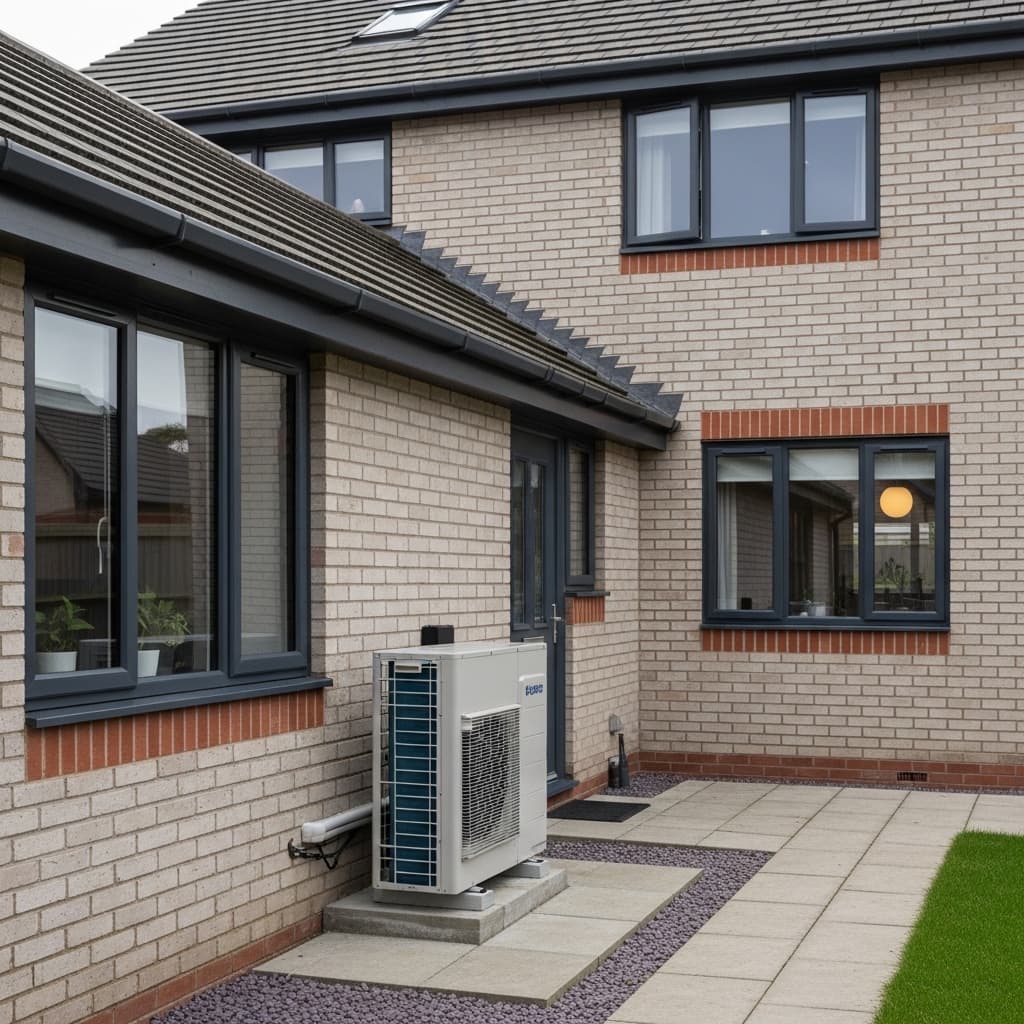
The Boiler Upgrade Scheme (BUS) regulations govern grant payments of up to £7,500 toward heat pump installation in England and Wales. Landlords are explicitly eligible, with no means test and no tenant income requirement. The April 2026 amendment removed the EPC rating requirement and extended the scheme to 2030, making it more accessible than at any point since launch.
What Are the Boiler Upgrade Scheme Regulations?
The BUS is established by the Boiler Upgrade Scheme (England and Wales) Regulations 2022, as amended. It provides capital grants to replace fossil fuel heating systems with low-carbon alternatives: air source heat pumps at £7,500, ground source heat pumps at £7,500, and air-to-air heat pumps at £2,500 (added 28 April 2026). The scheme is funded by the Department for Energy Security and Net Zero (DESNZ) and administered by Ofgem.
The grant is not paid to the property owner directly. It is paid to the MCS-certified installer, who applies the discount at the point of invoice. The statutory basis and full regulatory text are published in Ofgem's BUS guidance for property owners.
Who Administers the Scheme?
Ofgem is the scheme administrator. DESNZ sets policy; Ofgem handles voucher applications, verification, and payment to installers.
The process runs entirely through the installer. You do not submit an application to Ofgem yourself. Your MCS-certified installer submits the voucher request, Ofgem issues the voucher, installation proceeds, and the installer redeems the voucher and reduces your invoice by the grant amount. The GOV.UK Find a Grant listing for BUS provides a plain-English summary alongside Ofgem's technical guidance.
Eligibility Under the BUS Regulations
Four conditions must all be met to qualify:
The property must be in England or Wales. Scotland operates its own schemes through Home Energy Scotland. The BUS does not cover Scottish properties.
A valid EPC must be lodged for the property. Since the April 2026 amendment, the EPC rating itself is no longer a qualifying or disqualifying factor. You need a lodged EPC on record, but the band does not affect eligibility. Properties with a C or above, previously excluded, are now eligible.
The property must currently rely on a fossil fuel heating system. Properties already heated by a heat pump or electric system are not eligible. The scheme exists to replace oil, gas, or LPG boilers.
Your installer must be MCS certified. Only heating engineers holding a Microgeneration Certification Scheme (MCS) certificate for the specific system type can submit BUS applications to Ofgem. If an installer is not MCS-certified, the grant is unavailable regardless of all other conditions.
Landlords are eligible on equal terms with owner-occupiers. There is no income test, no requirement for the property to be owner-occupied, and no tenant income threshold.
Which Heating Systems Are Covered?
| System | Grant Amount | Notes |
|---|---|---|
| Air source heat pump (ASHP) | £7,500 | Most common type for rental properties |
| Ground source heat pump (GSHP) | £7,500 | Requires outdoor space for ground loop |
| Air-to-air heat pump | £2,500 | Added 28 April 2026; provides heating and cooling |
| Biomass boiler | Separate rates apply | Covered under BUS; additional eligibility criteria apply |
From 21 July 2026, uplifted grant values are available for eligible off-gas grid properties. The specific uplift amounts were not confirmed in time for publication. Check the Ofgem BUS guidance directly for current figures if your property is not on the gas grid.
What Changed in April 2026?
The April 2026 amendment (in force 28 April 2026) made three substantive changes to the BUS regulations:
EPC requirement removed. Properties rated EPC C or above were previously excluded. That restriction is gone. Any band is now eligible, provided the other conditions are met.
Air-to-air heat pumps added. Air-to-air systems, which heat and cool via wall or ceiling units without wet radiator systems, are now covered at a £2,500 grant. These are suited to flats and properties where retrofitting a wet heating system would be difficult.
Scheme extended to 2030. The BUS was previously due to close in March 2028. The amendment extended it to 2030, which lines up with the date government has proposed for an EPC C minimum in the private rented sector.
For a full breakdown of these regulatory changes and their practical effect on applications, see BUS April 2026 Regulation Changes: Landlord Impact.
BUS Regulations and Landlords: Key Rules
One grant per property. Each address can receive one BUS grant across the life of the scheme. A landlord with a portfolio can apply for each property individually, but each property is limited to one grant.
No means test. The scheme is not income-assessed at any level: not for the landlord, not for the tenant.
Tenant notification, not consent. Before an installation in a tenanted property, the landlord must give 28 days' written notice to the tenant. This is a notification requirement, not a consent requirement. The tenant must be given adequate written notice, but cannot veto the works.
England and Wales only. Scottish landlords should contact Home Energy Scotland for equivalent schemes.
MCS installer handles the application. The landlord does not submit anything to Ofgem directly. All regulatory paperwork sits with the installer.
How Does BUS Interact With Your EPC Rating?
Since April 2026, the BUS has no EPC rating gate. Any property with a lodged EPC can apply, regardless of band.
Before the amendment, EPC C and above properties were excluded. That meant BUS was unavailable to many well-maintained properties still running gas boilers. That barrier is now removed.
The effect of a heat pump on an EPC score is not automatic. The current SAP methodology scores on modelled fuel cost, and because electricity costs several times more per unit than gas, a heat pump in a poorly insulated property can score no better than the gas boiler it replaced, and occasionally worse. In a well-insulated property the high efficiency of the heat pump wins out and the score rises. Insulation first, heat pump second, is the order that protects the rating. Ask your assessor to model the change before you commit.
For E, F, and G properties, pairing BUS with insulation measures through ECO4 (which closes 31 December 2026) often makes the most financial sense: good insulation reduces the heat pump size required and improves running efficiency. See the ECO4 grants landlord guide 2026 for how to stack the two schemes before the ECO4 deadline.
BUS and the MEES Cost Cap
Under the rules in force, grant funding does not use up your £3,500 cap, and if it covers the full cost the cap does not apply. Under the proposed £10,000 cap, Boiler Upgrade Scheme money would not count, but other third-party funding such as ECO4 or a local grant could. That works in your favour: a £7,500 BUS grant reduces the amount of landlord money in the calculation, it does not use up your cap allowance.
The cap in force today is £3,500 including VAT, under the Energy Efficiency (Private Rented Property) (England and Wales) Regulations 2015. Government has proposed raising it to £10,000, or 10% of property value where that value is below £100,000, as part of the changes it says it intends to make. Those changes are not yet law. See our guide to the cost cap for how the calculation works.
As an example: an ASHP installation quoted at £11,000 gross, with the £7,500 BUS grant applied, leaves a net landlord spend of £3,500. It is that £3,500, not the £11,000, that counts against the cap. The practical effect is that BUS makes it substantially easier to reach a meaningful EPC improvement without your own spend running past the cap.
This matters for the exemption calculation. A landlord facing a G-rated property where full compliance would otherwise blow through the cap on their own money can use BUS to bring actual liability down to a viable level.
How to Apply: Regulatory Process
The application process under the BUS regulations runs through your installer in five steps:
- Get a quote from an MCS-certified installer for the heat pump system.
- Your installer submits a voucher application to Ofgem on your behalf before installation begins.
- Ofgem issues a voucher (currently valid for three months, extendable in certain circumstances).
- Installation is completed by the MCS installer.
- The installer redeems the voucher with Ofgem and reduces your invoice by the grant amount.
You pay the net invoice. The grant never passes through your hands. For a detailed walkthrough, including what documents are required and common reasons vouchers are declined, see the BUS application walkthrough.
BUS vs ECO4: Which Should Landlords Use?
Both schemes are available to landlords, but they serve different situations.
| BUS | ECO4 | |
|---|---|---|
| Means-tested | No | Yes (tenant income or benefits route) |
| Grant amount | £7,500 (air or ground source heat pump), £2,500 (air-to-air), £5,000 (biomass), plus £1,500 for oil or LPG homes with no mains gas until March 2027 | No set amount: the energy supplier decides |
| EPC requirement | Any band (since April 2026) | E, F or G for privately rented homes |
| Who applies | Your MCS installer | Energy supplier or ECO4 broker |
| Scheme deadline | 2030 | 31 December 2026 |
| Scotland covered | No | Separate Scottish scheme |
ECO4 closes on 31 December 2026 and covers insulation measures that BUS does not (loft insulation, cavity wall insulation, solid wall insulation). They are complementary, not alternatives. For heat pump installation, BUS is the relevant route. For insulation, ECO4 is the route if your tenant qualifies. Combining both before the ECO4 deadline is the most cost-effective approach for properties below EPC C.
What This Means for Landlords
The BUS regulations are currently more favourable than at any point since the scheme launched. The EPC rating barrier is removed, air-to-air systems are in scope, and the scheme runs to 2030.
A few practical implications:
Off-gas properties should check the July 2026 uplift. If your property is not on the gas grid, the uplifted grant values available from 21 July 2026 may materially change the financial case. Check the Ofgem BUS guidance for the specific uplift amounts.
The proposed 2030 date is not imminent, and not yet law. Government has said it intends to require EPC band C in the private rented sector from 1 October 2030, but that still needs an Act of Parliament and then a statutory instrument amending the 2015 Regulations. Installer capacity has been a constraint throughout the scheme's history regardless, so booking early avoids any rush.
One grant per property is finite. Once a BUS grant has been claimed on a property, it cannot be claimed again. Use the grant strategically: if a property is close to EPC C already, pair the heat pump installation with any remaining insulation measures to ensure compliance is achieved in one go.
The Boiler Upgrade Scheme costs page has a breakdown of typical installation costs by property type to help frame the net spend calculation.
Frequently Asked Questions
Can landlords apply for BUS directly?
No. Applications must be submitted by your MCS-certified installer before installation takes place. The installer submits the voucher request to Ofgem, completes the work, and redeems the voucher to reduce your invoice. Your role is to select an MCS-certified installer and ensure the property meets eligibility conditions.
Is BUS means-tested?
No. The BUS is not means-tested at any level. There is no income threshold for landlords, no benefit requirement for tenants, and no eligibility assessment based on financial circumstances. Any landlord with an eligible property in England or Wales and an MCS-certified installer can apply.
What changed in April 2026?
Three changes came into force on 28 April 2026: the EPC rating requirement was removed (any band is now eligible), air-to-air heat pumps were added at a £2,500 grant, and the scheme end date was extended from March 2028 to 2030.
Can I use BUS on an EPC C or above property now?
Yes. Before April 2026, properties rated C or above were excluded. That restriction has been removed. If your property has a valid lodged EPC and meets the other eligibility conditions, the EPC band is no longer a barrier.
Does BUS cover Scotland?
No. The Boiler Upgrade Scheme applies to England and Wales only. Scottish landlords should contact Home Energy Scotland for information on equivalent low-carbon heating grants.
When does BUS end?
The current scheme runs to 2030. The April 2026 amendment extended it from the previous end date of March 2028. No further extensions have been announced; treat 2030 as a firm deadline when planning installation timelines.