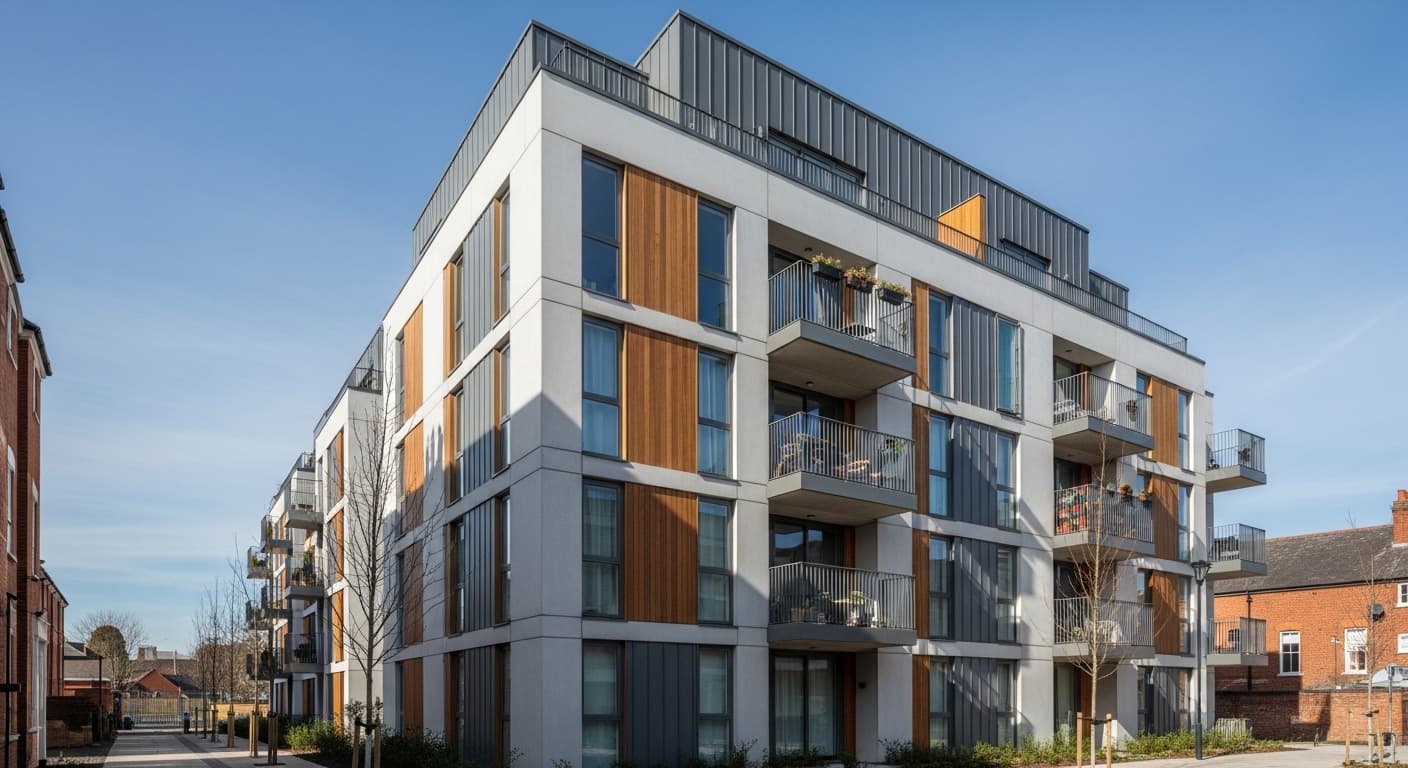
Purpose-built flats are the good news story of the private rented sector. According to EPCGuide's analysis of the full EPC register for England and Wales, purpose-built flats average a SAP score of around 70, one point above the band C threshold, and only about 39.1% fall below band C. Compare that to detached houses, where over 71% miss band C, and the picture looks comfortable. But averages hide the problem cases, and for flat landlords the route to compliance runs straight through the one thing they do not fully control: the building itself.
This guide is the deep-dive companion to our purpose-built flat EPC overview. Rather than repeat the summary there, it focuses on the harder questions: why so many flats already pass, what to do when yours does not, and how leasehold structures, communal heating, and freeholder consent complicate the path to EPC C. The minimum standard in force in England and Wales is band E; the band C standard from 1 October 2030 is a government proposal that has not yet been made law, so treat the date as a planning assumption rather than a legal deadline.
Why do purpose-built flats generally score better on EPC?
The physics favours flats. A purpose-built flat is a compact box surrounded on several sides by other heated spaces, and that geometry does most of the work.
Shared walls, floors and ceilings. A mid-floor flat may only have one or two external walls. The rest of its boundaries face neighbouring flats that are themselves heated. Heat lost through an internal party wall is not really lost, because there is warmth on the other side. Fewer external surfaces means less heat leaking to the outside.
Compact form factor. Flats have a low ratio of external surface area to internal volume. Heat loss scales with exposed surface, so a smaller external envelope means lower heating demand and a better SAP score for the same amount of insulation.
Newer stock skews modern. A large share of purpose-built flats were constructed under more recent building regulations, with cavity walls, double glazing and better loft or roof insulation built in from the start. Converted flats, carved out of older houses, do not enjoy this advantage, which is why they average a SAP of around 60 and over 62% sit below band C. The gap between purpose-built and converted flats is one of the widest between any two property types in the register.
The result is that the typical purpose-built flat is already at or near band C. Many landlords find their flat passes without any work at all. The challenge is concentrated in the minority that fail, and their reasons for failing are usually structural rather than cosmetic.
Which purpose-built flats fail EPC C, and why?
If your flat sits in the roughly 39% below band C, the cause is rarely poor insulation alone. It is usually one of a handful of specific issues.
| Common failure cause | Why it drags the rating down |
|---|---|
| Electric-only heating (old storage heaters or panel heaters) | Electricity has a higher cost and carbon factor in SAP than mains gas, so all-electric flats score worse for the same warmth |
| Inefficient communal or district heating | An old, poorly controlled communal boiler system counts against every flat it serves |
| Single glazing in older blocks | Common in 1960s and 1970s blocks where windows were never upgraded |
| Ground-floor or top-floor exposure | These flats lose heat through an exposed floor or roof that mid-floor flats do not have |
| No individual heating controls | SAP rewards room-by-room and time control; communal systems often lack it |
The pattern is clear: the worst-performing purpose-built flats tend to be older blocks with electric heating, communal systems the landlord cannot touch, and glazing that only the freeholder can replace. Each of these problems collides with leasehold ownership, which is where compliance gets complicated.
You can get a property-specific projection using our EPC predictor tool before committing to any works.
What are the realistic routes to EPC C for a flat?
The good news is that most flats need only modest measures, and the cheapest ones are inside your own front door where no freeholder consent is required.
Measures you usually control (inside the flat):
- Upgrading heating controls: smart thermostats, programmers, and thermostatic radiator valves
- Replacing old electric storage heaters with modern high-heat-retention models
- Low-energy lighting throughout
- Draught-proofing around your own doors and internal windows
- Improving hot water controls and cylinder insulation
Measures that usually need freeholder involvement (the building):
- Replacing windows and external doors (often a demised responsibility but frequently controlled by the lease)
- Any external wall insulation
- Communal heating system upgrades
- Roof or loft insulation for top-floor flats where the roof is communal
For a flat sitting at band D and only a few SAP points short, the internal measures alone are often enough. Storage heater upgrades and heating controls are frequently the single most effective change for an all-electric flat, because SAP rewards controllability heavily. Our cheapest ways to improve your EPC rating ranks measures by cost per SAP point, and the flat landlord EPC compliance guide covers the leasehold-versus-freehold split in detail.
How much does it cost to get a flat to EPC C?
Costs for purpose-built flats are generally lower than for houses, precisely because the fabric is usually better to begin with and the shortfall is smaller.
| Measure | Typical cost range | Notes |
|---|---|---|
| Smart heating controls and TRVs | £150 to £500 | Often the highest value-per-pound measure for flats |
| Modern high-heat-retention storage heaters | £400 to £700 per heater | Replaces old storage or panel heaters |
| Low-energy lighting | £50 to £200 | Small SAP uplift, negligible cost |
| Double glazing (per flat, if permitted) | £3,000 to £6,000 | Depends on window count and whether the lease allows it |
| Share of communal heating upgrade | Highly variable | Recovered through service charge, potentially thousands |
A flat needing only internal measures might reach band C for a few hundred pounds. A flat dependent on window replacement or a communal system upgrade is a different proposition entirely, and the cost is often outside your direct control. Use our EPC cost calculator for an estimate tailored to your flat's current rating, and see our EPC C cost for flat landlords guide for a fuller breakdown.
Who pays for communal upgrades, and how does leasehold complicate it?
This is the crux of flat compliance, and it is where many landlords get stuck. As a leaseholder, you own a long lease of your flat, but the structure, external walls, roof, and communal systems usually belong to the freeholder. You cannot unilaterally decide to insulate the external walls or replace the communal boiler.
The lease sets the boundaries. Most leases require written consent from the freeholder before you alter anything structural or anything affecting the external appearance. That routinely includes replacing windows, changing the heating source, or fitting a heat pump. Even where windows are technically part of your demise, the lease may reserve control over their appearance to keep the block uniform.
The freeholder controls communal measures. If your block runs on communal or district heating, or if the shortfall requires external wall insulation, only the freeholder can commission the work. You cannot force them to, and if they choose to do it, the cost typically comes back to leaseholders through the service charge.
Service charges spread the cost. When a freeholder carries out qualifying works to the building, the cost is apportioned across leaseholders and collected via the service charge. That means you may face a bill for a communal upgrade you did not initiate, on the freeholder's timetable rather than your own.
What is Section 20 consultation and why does it matter?
Where a freeholder wants to carry out major works to the building, they must follow the Section 20 consultation process before charging leaseholders. Under the Landlord and Tenant Act 1985, consultation is triggered when the cost to any single leaseholder for qualifying works would exceed £250, or for a qualifying long-term agreement (such as a communal heating supply contract) where the cost to any leaseholder exceeds £100 per year.
The consultation gives leaseholders the right to be informed, to nominate contractors, and to make observations on the proposed works and costs before money is spent. There is a real protection here: if a freeholder fails to consult properly, they generally cannot recover more than £250 per leaseholder for those works through the service charge. Any excess is simply not recoverable.
For flat landlords, Section 20 cuts both ways. It gives you a voice in communal EPC works and protects you from unconsulted bills, but it also slows the process, because consultation takes time the freeholder must build into any retrofit programme. For details on the mechanics, Lease Advisory Service guidance on Section 20 is the authoritative reference.
What if the freeholder refuses consent for EPC works?
This is the scenario the MEES exemption framework was built for. If your route to band C depends on a measure that requires freeholder or third-party consent, and that consent is refused or granted only on unreasonable conditions, you may be able to register a third-party consent exemption.
The exemption applies where you have taken reasonable steps to obtain consent (for example, to replace windows, alter the heating system, or carry out external works) and consent has been refused, or granted subject to conditions you could not reasonably comply with. To register it, you must document the request, the refusal, and the works it prevented.
A registered exemption is not a permanent free pass. It is time-limited and typically lasts five years, after which you must try again, because circumstances (and freeholders) change. It also does not cover you for measures you could have done inside your own flat without consent. The exemption is for the measures genuinely blocked, not for the whole property.
Our complete guide to EPC exemptions for landlords explains every exemption category and the evidence each one needs, and the exemption checker tool helps you work out which one might apply to your flat.
When should flat landlords act?
The temptation with a flat already near band C is to wait. That is a mistake for three reasons.
First, the flats that fail tend to fail for reasons that take time to resolve: freeholder consent, Section 20 consultation, and communal upgrade programmes all move slowly. A landlord who discovers in 2029 that their flat needs communal works has left themselves no room to influence the freeholder's timetable.
Second, the cost cap in force today is £3,500 including VAT, and the government has proposed a higher £10,000 cap with qualifying expenditure counting from 1 October 2025 if the reforms become law. Keeping receipts for eligible measures now protects your position under either cap, because spend up to the cap is what supports an all-improvements-made exemption.
Third, the government has proposed replacing RdSAP with the Home Energy Model for EPC assessments later this decade. Some flats that pass under today's methodology may score differently under a new model, so an early, current EPC gives you a clearer baseline.
The practical order of play for a flat landlord: get a current EPC, do the internal measures you control first (they are cheap and need no consent), then open the conversation with your freeholder or managing agent early about any communal or external works your flat depends on. For the wider deadline picture, see our EPC C deadline 2030 complete guide.
Frequently asked questions
Do purpose-built flats usually pass EPC C already?
Often, yes. EPCGuide's analysis shows purpose-built flats average a SAP score of around 70 and only about 39.1% fall below band C, better than any house type. Many landlords find their flat passes without works. The exceptions are older blocks with electric heating, single glazing, or inefficient communal systems.
Why do purpose-built flats score better than houses?
They have fewer external walls, share heat with neighbouring flats through party walls and floors, and have a compact form with a low ratio of external surface to internal volume. Less heat escapes, so the SAP score is higher for the same insulation. Much of the stock is also newer and built to modern standards.
Can I replace the windows in my flat to improve the EPC?
Sometimes, but check your lease first. Even where windows are part of your demise, most leases require freeholder consent for changes affecting the building's external appearance. If consent is refused, you may be able to register a third-party consent exemption for that measure.
Who pays for a communal heating upgrade in my block?
The freeholder commissions communal works, and the cost is usually recovered from leaseholders through the service charge. If the cost to any single leaseholder exceeds £250, the freeholder must run a Section 20 consultation first, or they cannot recover more than £250 per leaseholder for those works.
What is a Section 20 consultation?
It is the statutory process a freeholder must follow before charging leaseholders for major works. It applies where the cost to any leaseholder for qualifying works exceeds £250, or £100 per year for a qualifying long-term agreement. It gives leaseholders the right to be consulted and to nominate contractors before money is spent.
What can I do if my freeholder refuses consent for EPC works?
If you have taken reasonable steps to get consent and it has been refused, or granted on unreasonable conditions, you may register a third-party consent exemption under MEES. It is time-limited, usually five years, and only covers the measures genuinely blocked, not works you could have done inside your own flat.
What does EPC improvement cost for a flat?
Flats are usually cheaper than houses because the shortfall is smaller. A flat needing only internal measures such as heating controls and modern storage heaters might reach band C for a few hundred to a couple of thousand pounds. Flats dependent on window replacement or communal upgrades cost considerably more and are often outside your direct control.
Does the cost cap apply to flats?
Yes. The cap in force today is £3,500 including VAT and applies to all privately rented properties, flats included. The government has proposed raising it to £10,000, or 10% of property value where the property is worth under £100,000, with qualifying expenditure counting from 1 October 2025. That higher cap is not yet law. Under either version, if you have spent up to the cap and the property still cannot reach the standard, you may be able to register an all-improvements-made exemption.
This article was last updated on 19 August 2026. EPCGuide's analysis covers the full domestic EPC register for England and Wales, 27.6 million certificates covering 19.7 million homes. For methodology and interactive data, visit the EPCGuide Research Hub.