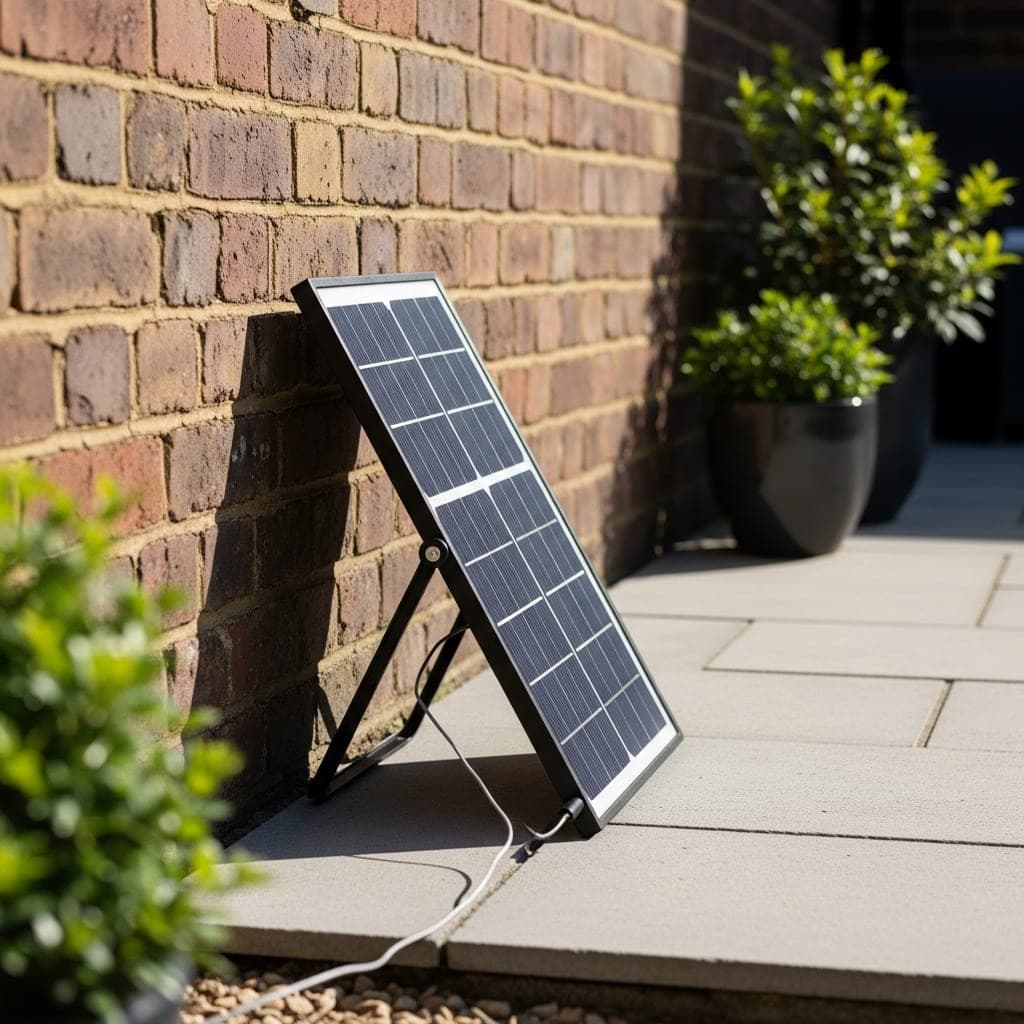
On 16 March 2026, Energy Secretary Ed Miliband announced that the UK government will legalise "plug-in solar", low-wattage solar panels that connect directly to a standard domestic mains socket, with no electrician needed. Products are expected in supermarkets and online from mid-2026, starting from around £500 a kit.
For landlords with leasehold flats, HMOs, or large portfolios where rooftop solar is impossible, this is the most accessible solar option the UK has ever offered. But before you order a kit, there is a critical caveat about EPC ratings that most guides are not telling you, and as a landlord, it matters.
What Is Plug-In Solar?
A plug-in solar kit, sometimes called balcony solar or a Balkonkraftwerk, is a simple system: one or two solar panels, a compact microinverter, and a standard UK 3-pin plug. You position the panels outside (balcony rail, garden wall, south-facing flat roof, window ledge), the microinverter converts the DC electricity from the panels into 230V AC, and the power feeds directly into your home circuit through the socket.
There is no battery, no storage, and no complex installation. The electricity reduces what the property draws from the grid while the sun is shining, nothing more.
The 800W limit: Under the new regulations, plug-in solar systems are capped at 800W of AC output. This is the safety threshold that allows connection to a standard domestic ring main without risk of overloading household wiring. Germany operates the same limit and has a well-established balcony solar market, which is where most of the current product designs come from.
G98 notification: You do not need an electrician to install a plug-in kit, but the occupier or kit provider must notify the local District Network Operator (DNO) under the G98 "Connect and Notify" rules before connecting. This is an administrative step, not an inspection, most kit providers handle it on your behalf.
Retail partners confirmed: Lidl, Iceland, and Amazon are working with the government to stock approved products. Manufacturers include EcoFlow and others. UK-certified products are expected on shelves once the BSI product standard is published, currently estimated around July 2026.
What Does Plug-In Solar Cost, and What Does It Save?
Kit prices quoted at launch were around £400 to £500 for a standard two-panel, 800W system, which puts a ten-property portfolio in the region of £4,000 to £5,000.
We are not going to publish a savings or payback figure, because any honest one depends entirely on the property's orientation, the tenant's daytime usage pattern and the unit rate they pay. An 800W system generates a fraction of what a full rooftop array does, and it only offsets electricity used while the sun is shining, with no battery to store the rest. Treat the bill reduction as real but modest, and ask your supplier for a calculation based on your actual property rather than a headline number.
A note on timing: China removed its solar panel export rebate on 1 April 2026, which may push prices slightly higher over the coming months. Pre-standard European import kits are available now but are not yet UK-certified. If you want the guaranteed-legal option, wait for BSI-standard products from mid-2026.
⚠️ The EPC Impact Question: What Plug-In Solar Does, and Doesn't, Do
This is the section every landlord needs to read before deciding whether plug-in solar is an EPC compliance strategy.
The short answer: under current rules, a plug-in solar kit will not change your EPC band.
Here is why. EPC ratings are calculated using the Standard Assessment Procedure (SAP). A full rooftop solar installation, typically around 4 kilowatts of capacity, contributes enough to a property's score to shift some D-rated homes into band C. Our solar panels and EPC guide covers this in detail.
A plug-in kit at 800W is roughly a fifth of that output, so the contribution is proportionally small: not enough to move a property up a band on its own, and in many cases not enough to register meaningfully at all.
The reason runs deeper than just size. Under current RdSAP methodology, an MCS-certified rooftop installation is logged against the property and modelled as a permanent generation asset. A plug-in kit, portable, unregistered with the property record, connected to a socket, is not captured in the same way. RdSAP measures theoretical energy efficiency, not the actual electricity bills your tenant pays month to month.
Under HEM (from late 2027): recognition may improve
The incoming Home Energy Model (HEM) is designed to capture on-site energy generation more accurately, and its energy cost metric should better reflect the bill reduction that plug-in solar actually delivers. The home-energy-model.co.uk commentary notes that plug-in solar "reduces actual energy bills, a distinction the reformed EPC's energy cost metric should eventually capture better than the current system."
But there are two important caveats. First, HEM is not expected until the second half of 2027, the original 2026 launch was delayed. Second, the specific treatment of sub-1kW systems under HEM has not been confirmed. Do not build a compliance strategy on an assumption about how HEM will handle plug-in solar.
⚠️ Important: If your goal is to reach EPC band C ahead of the standard government has proposed for 2030, plug-in solar alone will not get you there. Use it alongside genuine band-shifting measures, loft insulation, cavity wall insulation, heating controls, or heating upgrades. For a step-by-step path from D to C, see our EPC D to C upgrade guide.
Why Plug-In Solar Is Still Worth Considering for Landlords
Despite the EPC limitation, there are five good reasons landlords should pay attention to plug-in solar.
1. It works where rooftop solar cannot. A large share of the private rented stock is leasehold flats, where freeholder consent barriers, shared roof ownership, and block restrictions make rooftop solar practically impossible. For leasehold flat landlords who have run out of EPC improvement options, a balcony or garden-mounted plug-in kit may be the only solar route available. Ground-floor properties, HMOs, and converted buildings with unsuitable roofs face the same constraint.
2. The portfolio economics are favourable. A full rooftop system runs to several thousand pounds per property, so equipping a ten-property portfolio is a five-figure or six-figure decision. Plug-in kits across the same portfolio cost a few thousand pounds in total. The bill savings per property are modest, but the capital outlay is an order of magnitude lower than any other solar option.
3. Lower bills attract and retain tenants. Even without shifting the EPC band, reducing a tenant's electricity bills has real value in the current cost-of-living environment. Energy costs are consistently the top affordability concern for renters. A property with lower running costs is easier to let and harder to vacate.
4. No planning permission required in most cases. Small solar panels positioned at ground level or on a balcony do not require planning permission under permitted development rules in England. If the property is leasehold and the panels would be attached to the building's external fabric, check with the freeholder first. Freestanding or balcony-railed units typically avoid that issue entirely.
5. HEM future-proofing. While the HEM treatment of plug-in solar is not confirmed, installing now positions your properties ahead of the methodology change. If HEM does give more EPC credit to on-site generation, as expected in principle, properties that already have kits will benefit from that recognition without additional spend. See our upgrade now or wait guide for the broader decision framework.
Can a Tenant Install Plug-In Solar? The Renters' Rights Act Angle
Worth clearing up a misconception first. The Renters' Rights Act does not give tenants a general right to make improvements to a property. Its "cannot unreasonably refuse" duty is about requests to keep a pet. Whether a tenant may install anything else is governed by the tenancy agreement, as it was before the Act.
That said, a plug-in kit is about as low-risk as a tenant request gets: fully portable, no structural work, and no trace when it is removed. The pragmatic approach for most landlords is to say yes, subject to conditions: the kit must meet UK safety standards (BS 7671 Amendment 4), the G98 DNO notification must be completed, and the product must carry a CE/UKCA mark once BSI-standard products are available.
If a tenant asks, treat it as a goodwill opportunity. It reduces their bills, causes no property damage, and costs you nothing under the new periodic tenancy regime.
When Will Plug-In Solar Be Available in Shops?
| Date | What Happens |
|---|---|
| 16 March 2026 | Government announces legalisation ✅ |
| 15 April 2026 | BS 7671 Amendment 4 published, the legal foundation |
| ~July 2026 | BSI product standard published, UK-certified kits can go on sale |
| October 2026 | BS 7671 Amendment 4 transition period ends |
| Late 2027 | Home Energy Model EPC launch (EPC recognition may improve) |
If you want to buy now: European plug-in solar kits (sold in Germany as Balkonkraftwerk units) are available online from around £200–£350 and operate on the same principle. The risk is that they are not yet UK-certified. Once the BSI standard publishes around July 2026, approved kits from retailers like Lidl will be the correct option for UK installations.
Frequently Asked Questions
Does plug-in solar improve your EPC rating?
Not meaningfully under the current RdSAP methodology. An 800W plug-in system is a small fraction of a rooftop array and is not logged against the property record in the same way, so it is not enough to change EPC band on its own. The incoming Home Energy Model (expected late 2027) may give more credit to on-site generation, but this is not confirmed for sub-1kW systems. If you are working toward the band C standard government has proposed for 2030, combine plug-in solar with band-shifting measures such as insulation or heating upgrades.
Do you need planning permission for plug-in solar on a rental property?
In most cases, no. Small solar panels at ground level or on a balcony fall within permitted development rights and do not require planning permission in England. If the property is leasehold and the panels would be attached to external building fabric (rather than standing freely or clipped to a balcony rail), check with the freeholder first.
When can you buy plug-in solar kits in the UK?
UK-certified products are expected on shelves from around mid-2026, once the BSI product standard is published (estimated ~July 2026). The regulatory foundation, BS 7671 Amendment 4, publishes on 15 April 2026. Lidl, Iceland, and Amazon are confirmed retail partners.
Can a tenant ask to install plug-in solar?
They can ask, but there is no statutory right to install one. The Renters' Rights Act duty not to refuse unreasonably applies to pet requests, not to improvements generally, so consent for a solar kit is governed by the tenancy agreement. Most landlords will find it easy to agree, subject to conditions: the product must meet UK standards and the G98 DNO notification must be completed before connection.
For traditional rooftop solar and its EPC impact, see our solar panels and EPC rating guide. For the air-to-air heat pump grant (another accessible technology for flat and leasehold landlords), see our air-to-air heat pump guide.