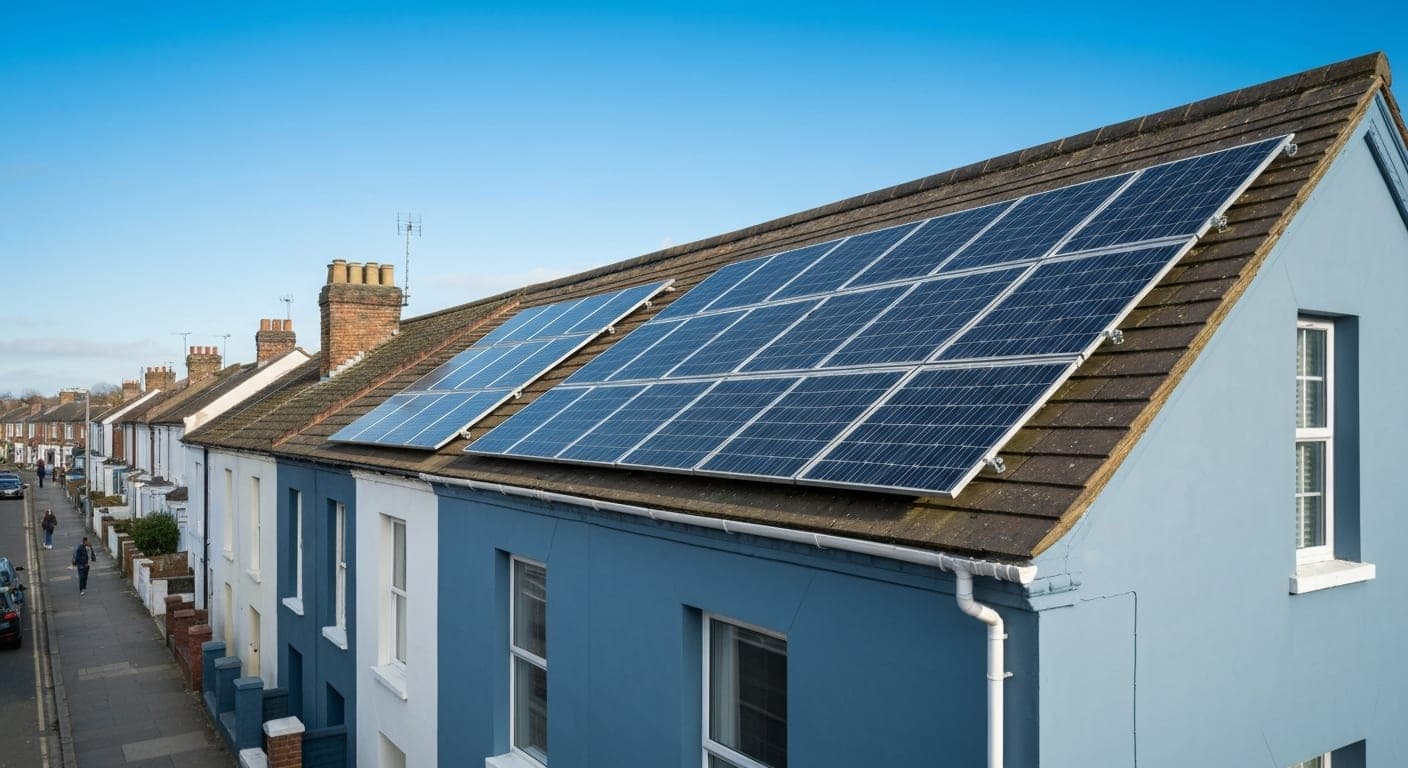
Yes, solar panels do improve your EPC rating. A typical 4kW solar PV system adds 6-10 SAP points to a property's energy score, often enough to lift a D-rated rental into Band C. Band D is currently legal to let (the minimum standard is E, in force since 1 April 2020). The government has proposed a Band C requirement from 1 October 2030, which is not yet law.
How Solar Panels Improve Your EPC Rating
EPC ratings are calculated using the Standard Assessment Procedure (SAP), a scoring system that runs from 1 to 100 and translates into bands A to G. Solar PV panels improve your SAP score in two ways: they reduce the property's reliance on grid electricity (lowering carbon emissions) and they generate on-site renewable energy, which is treated as a direct efficiency improvement in the methodology.
SAP points explained
A higher SAP score = a better EPC band. Here are the band thresholds:
| EPC Band | SAP Score Range |
|---|---|
| A | 92–100 |
| B | 81–91 |
| C | 69–80 |
| D | 55–68 |
| E | 39–54 |
| F | 21–38 |
| G | 1–20 |
To let a property today you need band E, a SAP score of at least 39. To reach band C, whether because you want to or because the proposed 2030 standard eventually lands, you need at least 69.
How many points does solar add?
A well-specified solar PV installation adds 6–10 SAP points on average (lendology.org.uk). A 16-panel system specifically has been shown to add around 10 SAP points (Goodlord). The exact impact depends on:
- System size (kW capacity)
- Roof orientation and shading
- Property size and baseline energy consumption
- Whether a battery storage system is included
A south-facing roof with minimal shading and a 3–4kW system is the optimal scenario. East/west-facing installations still add points but at the lower end of the range.
Averages only get you so far, though. You can model the points a solar array would add to your rating alongside the measures the property already has, rather than working from the mid-point of a range.
Can Solar Get You from EPC D to C?
For D-rated properties, solar is often the single measure that closes the gap to Band C, and it's worth understanding why.
Band D runs from SAP 55 to 68. Band C starts at 69. A D-rated property sitting at SAP 65 needs just 4 more points to cross into C territory. A 10-point solar installation would push it to SAP 75, comfortably into Band C.
Worked example
A mid-terrace, 3-bedroom rental property with gas central heating, double glazing, and loft insulation has a current SAP score of 63 (Band D). Installing a 16-panel (4kW) solar PV system on the south-facing rear roof adds 9 SAP points. New score: 72, Band C.
This is why D-rated properties are the solar sweet spot. Band D is the largest single cohort in the private rented stock, and for many of those properties solar is not just an improvement measure, it is the finishing move.
For properties with a lower SAP score (E, F, or G), solar alone is unlikely to be sufficient. You'll need to address insulation and heating systems first, then layer solar on top. See our EPC D to C upgrade guide for a full step-by-step approach.
How Solar Compares to Other EPC Improvements
Solar PV is one of several measures landlords use to raise a property's SAP score. The table below shows where it sits relative to the most common alternatives.
| EPC improvement | Typical SAP gain | Approximate cost (2026) | Best suited to |
|---|---|---|---|
| Cavity wall insulation | 5–15 points | £600–£3,000 | Pre-1990s properties with unfilled cavities |
| Loft insulation (to 270mm) | 5–10 points | £200–£700 | Properties with under 100mm of existing insulation |
| Solar PV (4kW system) | 6–10 points | £5,000–£8,000 | D-rated properties close to the Band C threshold |
| Smart heating controls | 1–3 points | £200–£400 | Gas-heated homes without a room thermostat or programmer |
| LED lighting throughout | 1–2 points | £50–£100 | Any property |
Cavity wall insulation and loft insulation typically cost less per SAP point gained. Solar PV makes most sense once the fabric of the building is already in reasonable shape, which is why D-rated properties with modern insulation already fitted are the solar sweet spot.
For most E and F-rated properties, the right sequence is: insulation first, heating controls second, solar third. Running it in reverse order wastes money on a system that scores fewer points than it would after the building fabric is sorted.
Insulation costs from Checkatrade (cavity wall, 2026) and EPC Advisor (loft insulation, 2026). SAP gain ranges are indicative and vary by property size, specification, and assessor methodology.
Solar Panels and the Future EPC System (HEM)
This is where solar becomes even more strategically important, and where most landlords are unaware of what's coming.
The government is replacing the current RdSAP 10 methodology with the Home Energy Model (HEM), a new scoring framework that places much greater weight on renewable energy and low-carbon heating. Following the March 2026 outcome update, HEM has been delayed to H2 2027 and will be compulsory for new EPCs from 1 October 2029.
Under HEM, the implications are significant. Simply Business (January 2026) confirmed that "most landlords will need to install a heat pump or solar panels to get an EPC with an equivalent rating of C or higher under the new system." The new methodology prioritises:
- Low-carbon heating (heat pumps)
- Renewable electricity generation (solar panels)
- Smart readiness (battery storage, smart meters)
This creates a critical risk: a property that currently holds an EPC C under RdSAP may not qualify as Band C once HEM takes over. If you're relying on an older certificate, particularly one achieved with gas heating and limited renewables, you may need to reassess after October 2029.
Solar panels are one of the few improvements that deliver EPC points under both the current system (RdSAP) and the new one (HEM). Installing solar now is a low-regret decision: it earns compliance credit today and aligns with where the system is heading. For more on whether to act now or wait, see our HEM delay decision guide.
What Does Solar Cost, and What Grants Are Available?
Installation costs
| System size | Approx. cost (2026) | Typical SAP gain |
|---|---|---|
| 2kW (8 panels) | £3,500–£5,000 | 4–6 points |
| 4kW (16 panels) | £5,000–£8,000 | 8–10 points |
| 6kW (24 panels) | £7,000–£10,000 | 10–12 points |
These figures are before any incentives. Most landlords installing for EPC compliance purposes opt for the 4kW (16-panel) system, it hits the maximum SAP improvement for typical residential properties without oversizing for the roof.
Available incentives
0% VAT, Solar panel installations in the UK carry 0% VAT (confirmed from April 2022, still in force in 2026). This is a significant saving on a £5,000–£8,000 system.
Smart Export Guarantee (SEG), Any electricity your panels generate but your tenant doesn't use gets exported to the grid. You (or your tenant, depending on lease terms) receive export payments from an Ofgem-licensed SEG tariff. Rates vary by provider.
ECO4, If your rental property has a tenant claiming qualifying benefits (Universal Credit, income-based JSA, ESA, Pension Credit, child benefits in low-income households), it may be eligible for the ECO4 scheme, which can fund solar installation at no cost to you. ECO4 is currently scheduled to end on 31 December 2026, if your property and tenants qualify, this window is closing. See our ECO4 landlord guide for eligibility details.
Note: The Boiler Upgrade Scheme (BUS) £7,500 grant is for heat pump installations only, it does not cover solar panels directly. However, combining a heat pump grant with a solar installation is a common strategy for landlords targeting both measures.
Is Solar the Right EPC Measure for Your Property?
Solar is not the right first move for every property. Here's a quick assessment framework:
Solar works best when:
- The property is D-rated (small gap to close)
- The roof is south- or southwest-facing with minimal shading
- The landlord intends to hold the property beyond 2030
- Other basic measures (loft insulation, double glazing) are already in place
- ECO4 eligibility applies, the measure effectively becomes free
Solar alone may not be enough when:
- The property is E, F, or G-rated (insulation must come first)
- It's a leasehold flat, roof access and freeholder consent can be significant barriers
- The roof is significantly shaded or north-facing
Stacking measures for maximum SAP impact
For properties close to the D/C boundary, solar combined with other measures creates the most cost-effective path:
- LED lighting throughout, 1–2 SAP points, negligible cost
- Smart heating controls, 1–3 SAP points, ~£200–£400
- Solar PV (4kW), 8–10 SAP points, ~£5,000–£8,000
Total investment of ~£6,000–£9,000 can deliver 10–15 SAP points, enough to move most D properties to mid-C range, leaving headroom for HEM reassessment.
Frequently Asked Questions
Do solar panels automatically update my EPC?
No. Installing solar panels does not update your EPC certificate automatically. You need to commission a new EPC assessment from an accredited energy assessor after the installation is complete. The assessor will input the solar system specifications into the SAP calculation and issue an updated certificate. Budget £60–£120 for a residential EPC assessment.
Can I get solar panels on a leasehold flat?
This is complex. Most leasehold flats do not give individual lessees the right to install solar panels on the roof, that typically requires freeholder consent, which may involve a service charge process or an application to all leaseholders. If you own a leasehold flat and want to explore solar, your first step is reviewing your lease and contacting the freeholder or managing agent. In some purpose-built blocks, communal solar installations are being considered as a collective measure. See our EPC leasehold flat guide for more on the challenges facing flat landlords.
Does solar installation cost count toward the MEES cost cap?
Be careful here, because two different figures get mixed up. The cost cap in force today is £3,500 including VAT per property, and it applies to reaching the band E minimum. Solar PV is a qualifying improvement, but at £5,000 to £8,000 a typical array exceeds the whole of the current cap on its own.
The £10,000 cap, and the rule that landlord spend counts from 1 October 2025, belong to the government's proposed band C reforms. Neither has been legislated, so do not plan on the basis that spending today is already banked against a £10,000 allowance. Keep your invoices regardless: if the reforms arrive in the form proposed, that record is what you would rely on.
Is solar thermal the same as solar PV for EPC purposes?
No. Solar thermal panels heat water using sunlight; solar PV panels generate electricity. Under the SAP methodology, they are assessed differently. Solar thermal typically adds 2–3 SAP points, because it only affects the domestic hot water calculation. Solar PV adds 6–10 points by offsetting the property's electricity consumption, which is the larger energy load. If your goal is EPC compliance, solar PV is the higher-impact installation (epcrate.co.uk, 2026). Make sure your installer and assessor are clear on which system you have.
Will my EPC C still be valid after the Home Energy Model launches?
Yes, certificates remain valid for 10 years under current rules. There is a forward risk though: if the proposed band C standard is legislated, properties would need to meet it under whatever methodology is then in force, and HEM is due to be compulsory for new EPCs from October 2029. A property that scores C under RdSAP may score lower under HEM. Solar is one of the measures HEM rewards most, which makes it a low-regret choice either way.
Next Steps
If your rental property is D-rated, solar panels are often the most direct route to band C, and one of the few measures that pays off under both the current methodology and the one replacing it. To get quotes from MCS-accredited installers:
Get solar panel quotes for your rental property →
You can also use our EPC cost estimator to model the full upgrade cost for your property type and current rating before committing to any single measure.