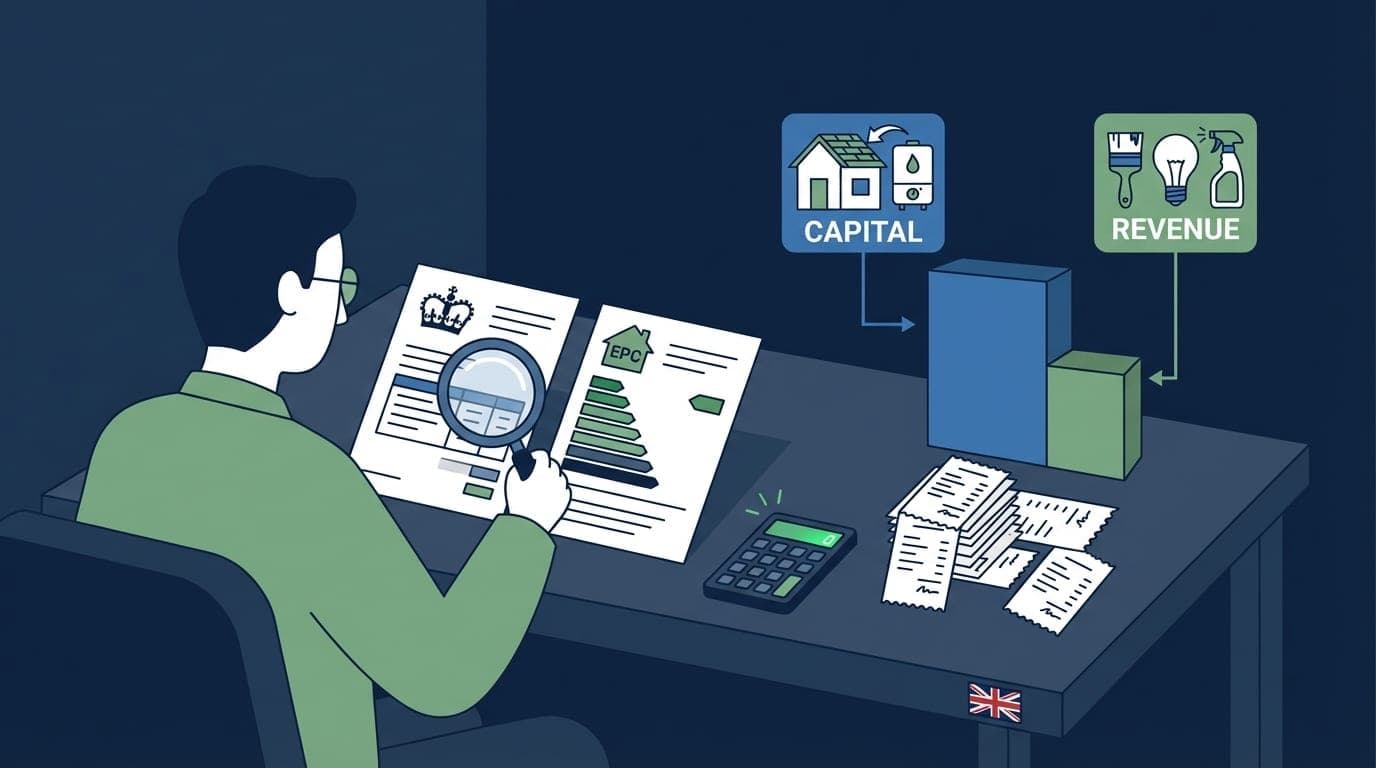
Most EPC upgrades are not tax-deductible against your rental income. That's the short answer, and it's the one most landlords don't want to hear. HMRC treats the majority of energy efficiency improvements as capital expenditure, money that enhances the property beyond its original state, which means you cannot deduct the cost from your rental profits on your self-assessment.
But "most" isn't "all". Some common EPC improvements do qualify as allowable revenue expenses, and there are three separate routes to recover upgrade costs at tax time. This guide breaks down exactly which improvements fall on which side of the line, based on HMRC's Property Income Manual.
The Core Rule: Capital vs Revenue Expenditure
HMRC's Property Income Manual (PIM2025 and PIM2030) draws a clear line:
- Revenue expenditure, day-to-day repairs and maintenance that keep the property in its current condition. Deductible against rental income.
- Capital expenditure, costs that improve, enhance, or extend the life of the property beyond its original state. Not deductible against rental income.
The test is straightforward: does the work restore the property to its previous condition, or does it make it better than before?
Adding loft insulation where there was none before is an improvement. Replacing a broken gas boiler with the same type of gas boiler is a repair. The distinction matters because it determines whether you can offset the cost against this year's rental profits or whether you have to wait until you sell the property.
Which EPC Improvements Are Deductible?
A few common EPC-relevant upgrades do qualify as revenue expenditure:
Like-for-Like Boiler Replacement
Replacing a broken or failing gas boiler with a broadly equivalent gas boiler is a repair under HMRC rules. The cost is fully deductible against rental income. However, upgrading from a standard boiler to a combi boiler, or from a gas boiler to a heat pump, is an improvement, and therefore capital.
LED Lighting
Replacing light bulbs is a consumable, trivial expense. LED bulbs are deductible as a maintenance cost regardless of whether the property previously had LED or traditional bulbs.
The "Modern Materials" Exception
HMRC's PIM2030 contains an important nuance: replacing old materials with "broadly equivalent" modern alternatives remains a revenue expense even if there's a slight performance improvement. For example, replacing lead pipes with copper pipes is still a repair. But if the new materials are designed for significantly greater capacity or performance, the whole cost becomes capital.
This means some borderline cases, like replacing old draught-proofing strips with modern equivalents, may still qualify as revenue expenditure. The key test is whether the new material is a broadly equivalent modern replacement, not a significant upgrade.
Hot Water Tank Jackets
Adding or replacing a hot water cylinder jacket is typically a trivial cost (under £20) and is generally treated as maintenance rather than improvement.
EPC Improvements by Tax Treatment
Here's how the most common EPC upgrades are classified:
| Improvement | HMRC Treatment | Why |
|---|---|---|
| Loft insulation (new) | Capital | Adding something that wasn't there |
| Cavity wall insulation | Capital | New installation |
| Boiler replacement (like-for-like) | Revenue ✅ | Repair, same type replaces same type |
| Boiler upgrade (e.g. to heat pump) | Capital | Enhancement beyond original spec |
| Double glazing (replacing single) | Capital | Significant improvement |
| LED lighting | Revenue ✅ | Consumable replacement |
| Draught-proofing (new installation) | Capital | New feature (but often trivially small) |
| Draught-proofing (replacing existing) | Revenue ✅ | Like-for-like maintenance |
| Smart heating controls (new) | Capital | New feature not previously present |
| Solar panels | Capital | Entirely new asset |
| Hot water tank jacket | Revenue ✅ | Maintenance / trivial cost |
If your planned upgrades fall mostly in the "Capital" column, as they will for most landlords aiming to move from EPC D to C, you cannot deduct those costs from your rental income.
Three Ways to Recover EPC Upgrade Costs at Tax Time
The costs aren't lost forever. There are three routes to recover at least some of the money:
1. Capital Gains Tax Offset When You Sell
Capital expenditure on improvements is added to your property's base cost when you sell. This reduces your capital gains tax liability. If you spend £5,000 on insulation and double glazing, that £5,000 is added to the purchase price when calculating your gain.
Keep all receipts and invoices. You'll need them when you eventually dispose of the property, which could be years or decades later.
2. Zero-Rate VAT on Energy Saving Materials (Until March 2027)
The government's January 2026 consultation response confirmed that 0% VAT applies to energy saving materials and their installation, including insulation and low-carbon heating, until at least March 2027.
This isn't income tax relief, but it's a significant cost saving. Before this zero-rating, energy materials attracted 5% VAT. On a £5,000 insulation job, that's a £250 saving. Make sure your installer is applying the correct VAT rate, some are still charging 5% or even 20% in error.
3. Replacement Domestic Items Relief
If you're replacing furnishings, appliances, or soft furnishings in a rental property, you can claim Replacement Domestic Items Relief. This covers the cost of a like-for-like replacement (any upgrade element is disallowed). It applies to items like boilers replaced with the same type, but does not cover structural improvements like insulation or glazing.
Don't Confuse the £10,000 Cost Cap with Tax Relief
This is one of the most common misconceptions among landlords. The MEES regulations include a £10,000 per-property cost cap, the maximum you're required to spend on EPC improvements before you can claim a cost-cap exemption.
The cost cap is a regulatory spending threshold, not a tax deduction. Spending £10,000 on insulation doesn't give you £10,000 of tax relief. It gives you a regulatory exemption from the EPC C requirement if you still can't reach that rating after spending that amount.
The two systems, HMRC tax treatment and MEES cost cap, operate completely independently.
Limited Company Landlords: Any Difference?
If you hold rental property through a limited company, the same capital vs revenue distinction applies. Energy efficiency improvements that enhance the property are capital expenditure under corporation tax rules too.
The main difference is accounting treatment: a limited company can depreciate capital assets over time through the accounts, but this depreciation is not a tax-deductible expense for residential property. There are no special capital allowances for residential energy efficiency improvements.
FAQ
Can I claim insulation as a repair?
No. Installing insulation where there was none before is always capital expenditure, you're adding a new feature. If you're replacing existing insulation with modern equivalent material, it may qualify as a repair, but new installations do not.
Does the £10,000 cost cap give me tax relief?
No. The cost cap is a MEES regulatory threshold. It determines when you can claim an exemption from the EPC C requirement. It has no connection to your income tax or corporation tax position.
What if I replace an old boiler with a heat pump?
Capital expenditure. A heat pump is a fundamentally different heating system, not a like-for-like replacement. The cost is not deductible against rental income, but can be added to your base cost for CGT purposes. You may also be eligible for up to £7,500 via the Boiler Upgrade Scheme.
Should I get an accountant?
Yes, if you're spending more than £3,000 on improvements. Borderline cases exist, particularly around boiler replacements, draught-proofing, and the "modern materials" exception. A property-specialist accountant can identify deductible elements within a larger improvement project. The accountant's fee is itself an allowable expense.
Does Making Tax Digital affect how I claim?
Yes. From April 2026, landlords with property income over £50,000 must maintain digital records and submit quarterly updates under Making Tax Digital for Income Tax. This means keeping digital records of all improvement expenditure, capital and revenue, from day one.
Use Our Tools to Estimate Your Upgrade Costs
Before worrying about the tax treatment, find out what your upgrades will actually cost. Our property cost estimator gives you a quick estimate based on your property type, size, and current EPC rating. Check which grants you qualify for to offset your costs. For a breakdown of the cheapest D-to-C upgrades, see our dedicated guide.
You can also check how your area compares on regional upgrade costs.
This article is for general information only and does not constitute tax advice. Always consult a qualified accountant or tax adviser for guidance on your specific circumstances.