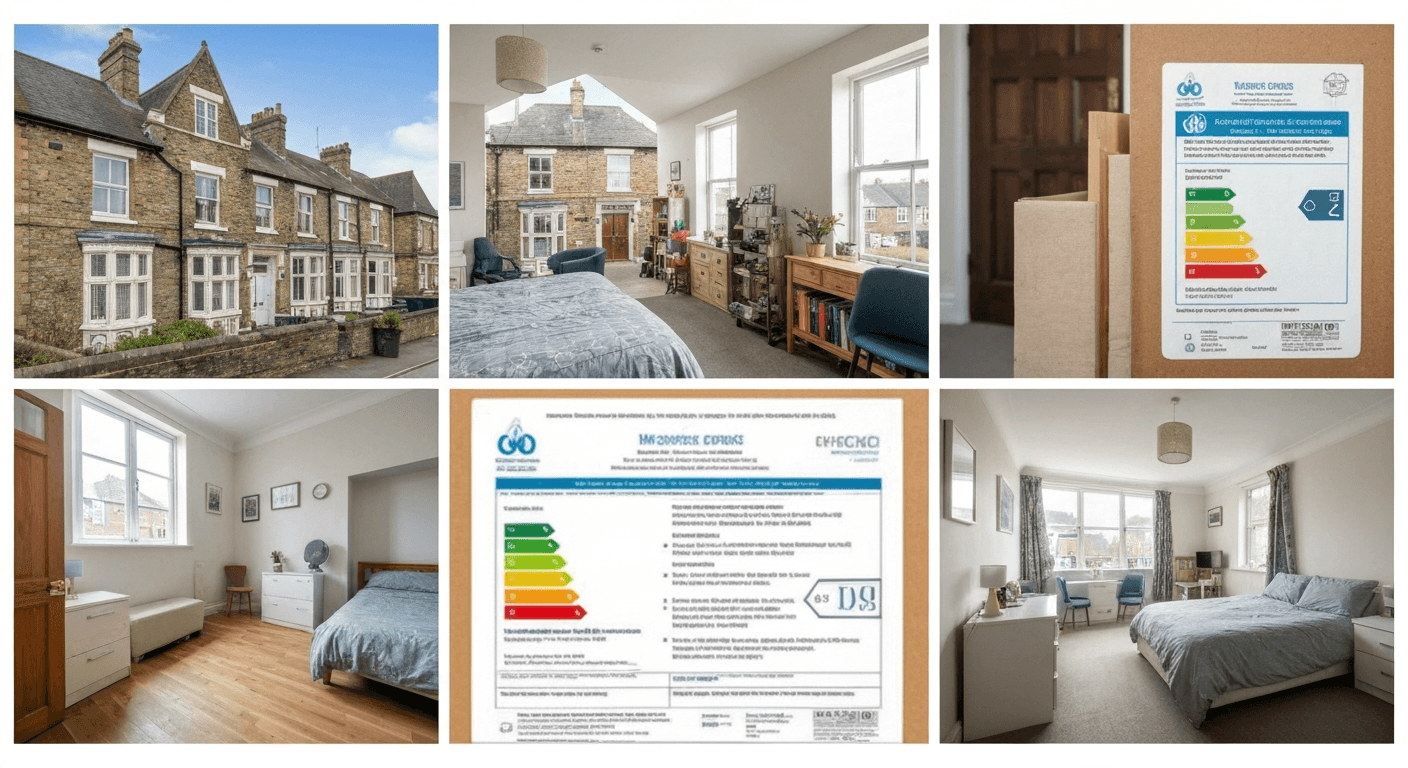
🔄 Update, March 2026: The government has confirmed that the full EPC reform package, including the new HMO whole-house EPC rule, has been delayed from October 2026 to H2 2027, following industry feedback on implementation timelines. The 24-month transitional period remains in place and will start from whenever the legislation actually takes effect. The 2030 EPC C deadline is unchanged. The core advice in this article stands: act early, don't wait for the clock to start.
If you've been renting out rooms in an HMO, you've probably been told you don't need an Energy Performance Certificate. That was correct, under current guidance, EPCs aren't required when individual rooms are let to separate tenants.
That's about to change.
In its January 2026 partial response on EPC reforms, the government confirmed it is expanding EPC requirements to cover HMOs when any single room is rented out. For the ~500,000 HMO landlords who currently operate without a whole-house EPC, this means a compliance requirement they've never had before, and the 2030 EPC C deadline will apply once they're brought into scope.
Here's what the rule change means, who it affects, and what to do now.
The Current Rule: Why Most HMO Landlords Don't Have an EPC
Under current guidance, an EPC is only required when a "whole building or building unit designed or altered for separate use" is rented out. When an HMO landlord lets individual rooms to separate tenants, the legal position is that the property doesn't trigger the EPC requirement.
This means two things for room-by-room HMO landlords:
- No EPC required, they can legally let without one
- No MEES obligation, because MEES (Minimum Energy Efficiency Standards) only applies to properties that require an EPC, HMOs outside the EPC requirement are also outside MEES. They can technically let F or G-rated properties.
This isn't a grey area. The government's own guidance confirms it. Many HMO landlords have operated this way entirely legally for years.
What's Changing: The January 2026 Government Confirmation
The GOV.UK "Reforms to the Energy Performance of Buildings regime – partial government response" (published January 21, 2026) confirmed:
"Mandating EPCs for HMOs when a single room is rented out will ensure that HMOs will need to comply with the requirements set out in the MEES Regulations if they did not have a valid EPC before this point. This would provide consistency across the private rented sector."
In plain terms: the government is closing the gap. Once the new rule takes effect, renting out any room in an HMO will require a whole-house EPC for the entire property, and MEES regulations will apply.
The government's stated rationale: consistency across the private rented sector. It doesn't make sense for a single-household landlord to face EPC C requirements by 2030 while an HMO landlord renting to five tenants in the same building faces no EPC obligation at all.
The 24-Month Transitional Period
The government has confirmed a 24-month transitional period for HMO landlords newly brought into scope. This means:
- When the legislation takes effect, you won't face immediate enforcement
- You'll have 24 months from that date to obtain a valid whole-house EPC
- After that, the standard enforcement regime applies
This is not a reason to relax. Consider the timeline:
- The 2030 EPC C deadline is confirmed
- Even with a 24-month transitional period, landlords who get their EPC at the last moment may find they have very little time to plan and fund upgrades before 2030
- Assessment, planning, finding contractors, and completing works typically takes 6–18 months
The smart move: get your EPC now, find out your band, and start planning, before the clock officially starts.
What This Means for Your HMO
The impact varies depending on your current situation. Three scenarios:
Scenario 1: You have a licensed HMO
Some council licensing schemes require an EPC as part of the application. If your HMO is licensed and you provided an EPC, you may already have a valid certificate.
Action: Check the national EPC register with your property's postcode, if there's a valid EPC (issued within 10 years), you're ahead of the game. Review the band and start planning if it's below C.
Scenario 2: You have an unlicensed HMO rented by the room
This is the most commonly affected group. Unlicensed HMOs, properties let to 3 or more unrelated people where mandatory licensing doesn't apply (or where landlords are in selective licensing exemptions), frequently have no whole-house EPC.
Action: Book an EPC assessment. It costs £80–£150 and gives you your baseline. Don't wait for the legislation, the sooner you know your band, the more time you have to plan.
Scenario 3: Your HMO is currently rated E, F, or G
Once the new rule brings your HMO under MEES scope, you'll be subject to both the minimum E requirement (current) and the 2030 EPC C deadline.
Action: This is the most urgent scenario. Get an EPC, understand the upgrade cost, check grant eligibility, and start the process. HMO upgrades can cost more than single-household properties due to larger floor areas and multiple rooms, budget early.
The 2030 EPC C Deadline Applies to HMOs Too
Once the new rule is in force, HMOs fall fully under MEES regulations. That means:
- Immediate requirement: Minimum EPC E (current MEES standard)
- 2030 deadline: EPC C for all rental properties, including HMOs
- Cost cap protection: If upgrading your HMO to C would cost more than £10,000, you can register a cost cap exemption
HMO upgrades often cost more than equivalent single-household properties. A large HMO with multiple rooms may need more insulation, larger heating systems, and more complex upgrade work. Get an assessment early so you're not facing an expensive surprise close to 2030.
If tenants are on qualifying benefits and the property is below EPC D, the ECO4 scheme can fund insulation and heating upgrades at no cost to the landlord.
What to Do Now
You don't need to wait for the legislation to act. Here's a simple checklist:
Step 1, Check if you already have an EPC Search the GOV.UK EPC register or use the postcode EPC lookup tool. If there's a valid EPC on record for your property, check the band and the expiry date.
Step 2, If no EPC, book one An EPC assessment costs £80–£150. Find an accredited assessor through the Elmhurst Energy or Quidos registries. Book it, the assessment takes 1–2 hours and gives you a clear picture of where you stand.
Step 3, Review your band
- A–C: You're ahead of the 2030 compliance requirement. Check the expiry date.
- D: You're likely to reach C with modest improvements (£1,000–£3,000).
- E: MEES compliant today, but you'll need to upgrade before 2030. Plan upgrades now.
- F or G: Non-compliant under current MEES even without the new rule. Act immediately.
Step 4, Check grant eligibility ECO4 and the Warm Homes Local Grant can significantly reduce upgrade costs. Check what's available in your area.
Step 5, Register an exemption if costs exceed £10,000 If your EPC assessment shows that upgrading to C would cost more than £10,000, you can register a cost cap exemption on the PRS Exemptions Register. This provides protection against enforcement while the exemption is valid.
Frequently Asked Questions
Do I currently need an EPC for my HMO?
Under current guidance, no, not if you rent individual rooms to separate tenants. The EPC requirement is triggered when a whole building is rented to a single household. This is the current legal position. However, the government has confirmed this will change.
When will the new HMO EPC rule come into force?
The January 2026 partial response confirmed the government's intention to extend EPC requirements to HMOs. The broader EPC reform package, originally planned for October 2026, has since been delayed to H2 2027 (confirmed by the government in March 2026, following industry feedback). A specific date has not yet been set; the government has said it will confirm the new timeline by summer 2026.
The 24-month transitional period for HMO landlords newly brought into scope remains in place. It will begin from whenever the legislation actually takes effect, not from the originally planned October 2026 date. The 2030 EPC C deadline is unaffected by this delay.
Does my HMO licence mean I already have an EPC?
Not automatically. HMO licensing and EPC requirements are entirely separate. Some councils require an EPC as part of their licensing conditions, others don't. Check your licence conditions and verify on the national EPC register.
Will the 2030 EPC C deadline apply to my HMO?
Yes, once the new rule brings your HMO into MEES scope, the 2030 EPC C deadline applies. You'll need to reach EPC C or register a valid exemption before October 2030.
What if the EPC shows my HMO is F or G rated?
F and G-rated properties are currently non-compliant with MEES even before this new rule (they need to reach minimum E). If your HMO is F or G, you need to act regardless of the new whole-house EPC requirement. Check what grants might cover the cost and see the MEES regulations guide for enforcement details.
Source: GOV.UK "Reforms to the Energy Performance of Buildings regime – partial government response," January 21, 2026. The Independent Landlord (March 2025). Property118 (February 2025).